
By trade
Concrete calculators
Concrete is ordered by volume and almost every mistake starts with an area. The pour, the steel in it and the shutter around it scale differently from each other: double a slab's length and the volume and the mesh double, the perimeter does not, and the thickening under a wall does not move at all.
- 56Calculators
- 3Parts of the site
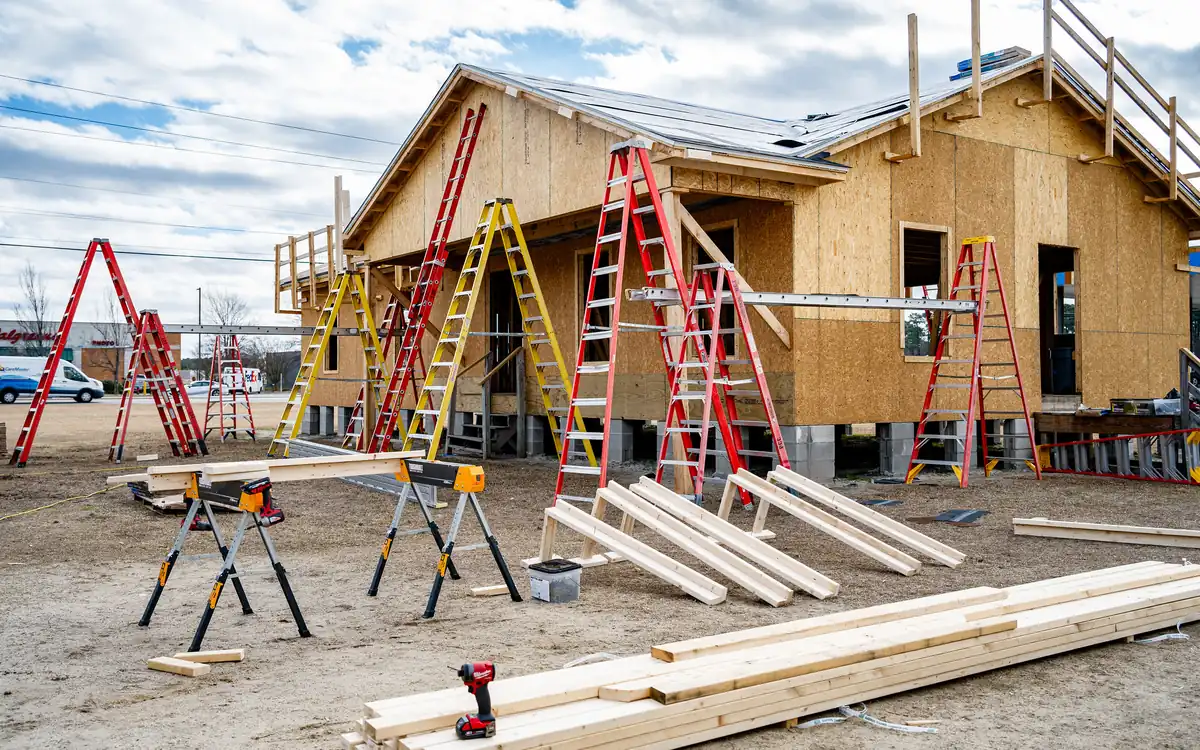
How concrete is measured
Cubic metres for the pour, tonnes or metres for the reinforcement, square metres of contact face for the formwork — and the pour is the only one of the three that a supplier will refuse to part-deliver. Bagged mixes are a fourth unit again: a bag's yield is a volume of finished concrete, not a weight of powder.
Materials & Quantities53
- ACI 211.1 Water-Cement Ratio Calculator
- ACI 347 Column Formwork Pressure Calculator
- ACI 347 Wall Formwork Rate-of-Placement Pressure Calculator
- Aggregate Fineness Modulus Calculator (ASTM C136)
- Built-In Bench/Planter Seat Wall Concrete Volume Calculator
- Circular Pier / Cylinder Concrete Calculator
- Concrete Aggregate Moisture Correction Calculator
- Concrete Air-Entrainment Admixture Dosage Calculator
- Concrete Bag Calculator
- Concrete Calculator
- Concrete Control Joint Spacing Calculator
- Concrete Curb and Gutter Volume Calculator
- Concrete Curing Blanket Calculator
- Concrete Curing Compound Coverage Calculator
- Concrete Evaporation Rate Calculator
- Concrete Expansion Joint Filler Calculator
- Concrete Formwork Calculator
- Concrete Formwork Tie Spacing Calculator
- Concrete Maturity Method Calculator (Nurse-Saul)
- Concrete Mix Design Calculator — ACI 211.1 Absolute Volume Method
- Concrete Mix Ratio Calculator
- Concrete Mix Temperature and Ice Substitution Calculator
- Concrete Poker Vibrator Insertion Spacing Calculator
- Concrete Pump Line Friction Loss Calculator
- Concrete Relative Yield Calculator (ASTM C138)
- Concrete Resurfacer and Patch Calculator
- Concrete Sidewalk Control Joint Spacing Calculator
- Concrete Slab + Rebar Combined Mass Calculator
- Concrete Slump Flow Test Calculator (ASTM C1611)
- Concrete Steps Volume Calculator (Solid and Waist-Slab Flights)
- Concrete Trial Batch Yield Adjustment Calculator
- Concrete Unit Weight (Density) Calculator (ASTM C138)
- Concrete Washout Basin Solidifier Dosage Calculator
- Continuous Footing / Grade Beam Volume Calculator
- Drilled Pier Concrete Volume Calculator (Straight Shaft / Belled)
- Fiber-Reinforced Concrete (FRC) Dosage Calculator
- Formwork Brace & Kicker Force Calculator
- Insulated Concrete Form (ICF) Block Count Calculator
- Mass Concrete Thermal Gradient Calculator
- Poured Retaining Wall Stem Concrete Volume Calculator
- Raft Slab Concrete Volume Calculator (Edge Thickenings and Downstands)
- Rebar Calculator
- Rebar Chair and Bolster Count Calculator
- Rebar Lap Splice Length Calculator (ACI 318)
- Rebar Standard Hook Development and Cut-Length Calculator
- Rebar Weight Calculator
- Retaining Wall Footing Sizing Calculator
- Reverse Concrete Slab Solver
- SCC Formwork Lateral Pressure Calculator
- Stepped Foundation Calculator (Steps, Bays and Overlaps on a Slope)
- Structural Column Pour Calculator
- Water-Cement Ratio and Concrete Strength Calculator (Abrams' Law)
- Welded Wire Mesh Calculator — Reinforcing Mesh Sheets for a Slab
Sustainability & Compliance2
Heavy Civil & Infrastructure1
What gets left off a concrete order
- The thickenings: a slab with a perimeter beam or a load-bearing wall under it holds far more concrete than its nominal thickness suggests.
- Over-dig and uneven ground. Concrete poured against excavated faces takes what the ground gives it, which is always more than the geometry.
- The waste from part-loads. Ordering 7.3 m³ means taking 7.5, and the extra is paid for whether it is placed or not.
- Curing: blankets, compound or water for days after the pour, which is labour and material nobody puts on the concrete line.
Job takeoffs8
Where concreters meet the rest of the job: each runs one of these calculators, with every other trade in the same job beside it.
Worked examples4
A real job estimated step by step, with this trade's steps counted.
Comparisons22
Two ways of doing the same work, weighed against each other.
- Bagged Concrete vs Ready-Mix
- Cooling the Mix vs Protecting the Surface
- Curing Compound vs Curing Blankets
- Mass Concrete Thermal Gradient vs Surface Curing
- Rebar vs Fiber Mesh in a Concrete Slab
- SCC vs Conventional Formwork Pressure
- Block Retaining Wall vs Poured Concrete
- Block vs Poured Concrete Foundation Wall
- Concrete Slab vs Pavers
- Dowelled Joints vs Aggregate Interlock
- Frost-Protected Shallow Foundation vs Deep Footing
- Helical Piles vs Poured Concrete Piers
- ICF vs Concrete Block
- ICF vs Wood Frame Walls
- Lap Splice vs Development Length
- Lower-Carbon Concrete vs Changing the Material
- Operational vs Embodied Carbon
- Pad Footings vs Continuous Strip Footing
- Post-Tensioned Slab vs Rebar Slab
- Retaining Wall Footing vs Stability
- Shed on Skids vs Concrete Slab
- Spread Footing vs Drilled Pier
Planners2
Work this trade out from a space rather than from a job.