
SettingsSettings for this calculationUS
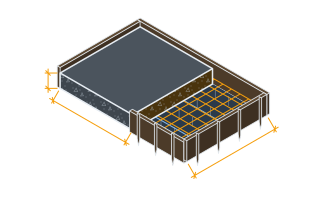
The horizontal cross-sectional area of the shaft or excavation being poured.
For a circular drilled shaft, this is pi x radius².
How deep the concrete already placed currently measures, from the base of the pour.
Measure with a weighted tape from the top of the tremie pipe down to the rising concrete surface, subtracted from the known pipe length.
The full length of the tremie pipe currently in the shaft.
Used only to flag if the pipe is long enough to reach the required embedment depth as the pour continues.
Safe pipe withdrawal available
5.079 ft of pipe safely withdrawable
The pipe can be raised by up to this amount and still keep at least 1.5 m (5 ft) of embedment in the placed concrete.
- Concrete volume placed so far
- 5.98 yd³
- Remaining pipe length above pour surface
- 23 ft
They open the calculator with your figures already in it
Tremie Pipe Safe Withdrawal & Embedment Calculator: 5.08 ft of pipe safely withdrawable — shown in imperial, US market. The link sets both, so the result they see is the one on your screen.
Show calculation logicHide calculation logic
How this was calculated
Formula source(s)
- Standard tremie placement practice requires the pipe's discharge end to stay embedded at least 1.5 m (5 ft) into the already-placed concrete at all times, so new concrete displaces water or slurry upward without washout or contamination of the mix
Inputs used
- Pour Cross-Sectional Area
- 16.15 sq ft
- Current Concrete Depth Placed
- 10 ft
- Total Tremie Pipe Length
- 33 ft
Intermediate steps
- Concrete volume placed so far
- 5.98 yd³
- Remaining pipe length above pour surface
- 23 ft
Confidence note: The pipe can be raised by up to this amount and still keep at least 1.5 m (5 ft) of embedment in the placed concrete.
What this calculation does not cover
- Embedment is taken to be the whole depth of concrete placed, which only holds while the pipe's discharge end is still sitting at the base of the shaft. There is no input for the current tip elevation, so once the pipe has been raised the withdrawal figure is too generous by exactly the height the tip has already travelled.
- The volume line is a plain prism, cross-sectional area multiplied by depth, and it is never reconciled against the concrete actually delivered. It therefore cannot reveal overbreak, sidewall collapse or loss into a permeable stratum, each of which shows up as a shaft taking more concrete than the calculated rise accounts for.
- Embedment is only half of what keeps a tremie flowing. The concrete head inside the pipe has to stay above the water or slurry head outside it, and a mix that stiffens between loads can plug the pipe or let slurry in with embedment still well above 1.5 m (5 ft). None of that is checked here.
- The 1.5 m (5 ft) embedment is a hardcoded constant rather than an input, and it is the common minimum, not the design value for a particular shaft. Many specifications require deeper embedment on deep or slurry-supported shafts, and some also cap the rate of withdrawal; the governing figure is the one in the project specification rather than the one built into this page.
- The depth entered is counted as sound concrete throughout. The top of a tremie pour carries laitance and slurry-contaminated material that has to be overpoured and cut off, and neither that cut-off allowance nor the extra concrete it consumes appears in the volume shown.
Estimated cost — your price
This site holds no price list for this material — local prices vary too much to publish honestly. Enter your supplier's price and the result is costed with it.
Computed in your browser — nothing you enter is uploaded. Presented in US customary units and US trade terminology. Where a formula follows a published standard, that standard and its edition are cited beside it on this page; where none governs, the page says so. Local amendments override model codes — verify against the code in force where you build.
Sources checked 2026-09-02 · in the site-wide review of 2026-09-06 · v1.0.1
Regulatory standards & verification citations1
- Standard tremie placement practice requires the pipe's discharge end to stay embedded at least 1.5 m (5 ft) into the already-placed concrete at all times, so new concrete displaces water or slurry upward without washout or contamination of the mix
Cite this page
Your workspace
Most jobs need more than one number. Add the calculators you need next and they open right here, underneath this one — your figures stay on screen and nothing is lost to a page change.
Tools and safety for this job
To place and finish concrete, erect formwork and saw-cut cured concrete. Generic types, no brands, no prices.
Protection this work requires
- Cutting or grinding concrete, masonry, screed, tile or fibre-cement board releases respirable silica: cut wet or extract at the tool, and wear a P2/N95 respirator at minimum — a nuisance dust mask does not filter it.
- Hardwood dust is a recognised carcinogen: extract at the tool and wear a P2/N95 respirator when cutting or sanding indoors.
- Wet cement and lime burn skin and eyes painlessly until the damage is done: waterproof gloves to EN 374, safety glasses whenever the mix can splash, and never kneel in wet mix in permeable trousers.
- Saws, grinders and breakers run above 85 dB, where hearing damage accumulates and does not recover: defenders or plugs for every cut, not just the long ones.
- Breakers and grinders cause permanent nerve damage: limit continuous trigger time, keep hands warm, and stop if fingers tingle or blanch.
- Boards, blocks and bagged material cause most lasting back injuries on small sites: two people or a lifter for full sheets, and never a bag on one shoulder up a ladder.
Show the 17 tools this job needsHide tools
Essential
Angle grinder
Bull float and edger
Circular saw
Claw hammer
Dust extractor or vacuum with a fine filter
Screed bar or rail
Shovel and spade
Spirit level
String line and pins
Tape measure
Wheelbarrow
Recommended
Chalk line
Cordless drill/driver
Floor or cut-off saw
Plate compactor
SDS rotary hammer
Optional
Power float
Also needed as materials: chalk refill, circular saw blades, cutting and diamond discs, diamond blades, drill and driver bits, SDS bits and chisels.
what each concrete tool is for, and the spec that decides which to buy where one does.