
By trade
Every calculator, by who does the work
The rest of this site is filed by subject, which is where a calculator lives. This is the other question — whose job is it — and the two do not line up: a roofer’s work is spread across four of the thirteen subject categories, and a third of the catalogue belongs to no trade at all. Every page below was read and classified one at a time.
- 25Trades
- 744Calculators in one
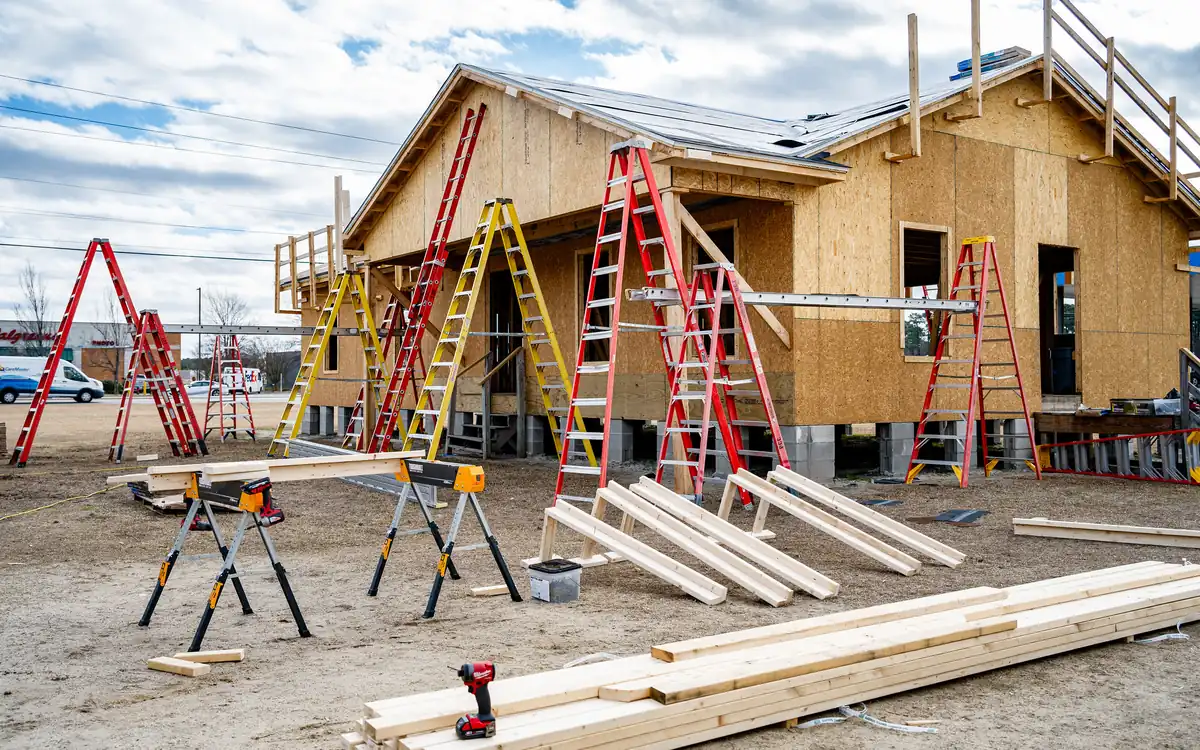
Everything below and before the building: excavation and the spoil it makes, compaction, drainage runs and the stone they sit in.
Concrete
56Ordered by volume and never by area, with the reinforcement and the formwork that scale differently from it and from each other.
Masonry
31Brick, block and stone by the unit, and the mortar, ties and lintels that go with a wall rather than in it.
Members, plates and the connections between them, weighed rather than counted, and the bolts nobody adds up.
Framing and first fix: studs, joists, rafters and sheathing, where a spacing decides a count and a count decides a lorry.
Roofing
47A covering measured on the slope and not on the plan, with the underlay, fixings, flashings and edges the slope brings with it.
Cladding
23What keeps the weather off a wall — siding, render carriers, rainscreen and brick slips — and its fixing schedule.
Glazing
27Windows, doors and screens: the openings a wall is measured around, and the glass and beads that fill them.
Membranes, tanking and falls — the work where a square metre missed is not a shortfall but a leak.
Depth, lambda and continuity: the quantity follows from a target as often as from an area.
Drywall
39Boards, and then the tape, compound and screws that follow from how many boards meet each other.
Coverage by coat and by background, where the same area takes a different quantity on block than on board.
Tiling
17Tiles by the box with the cuts in them, and the adhesive, grout and trim that come with the format chosen.
Flooring
32The covering, the underlay, the adhesive and the thresholds — and the levelling that has to happen first.
Spread rate by coat and by surface, on an area that is rarely the area of the room.
Plumbing
37Pipe runs, falls and flows: sizing that follows from what has to move, and drainage that follows from gravity.
Loads, rates and duct sizes — what a space has to lose, gain or change, before any equipment is chosen.
Circuits, cable sizes and loads, where the answer is a limit to design within rather than a quantity to buy.
Arrays, inverters, batteries and the runtime they buy, sized against what the building actually uses.
Firestopping, intumescent coatings and detection spacing: quantities set by a rating rather than by a room.
Bought by the metre at a height, or by the square metre at a pattern, with the posts and footings underneath.
Drives, paths and yards, where the surface is the visible tenth and the build-up under it is the order.
Soil, mulch, turf and irrigation by depth and by rate, on areas that are seldom rectangles.
Volume first, and then everything else: turnover, chemistry, heating and cover, all of it per cubic metre.
What comes out, what it weighs, and how many containers it fills — the half of a refurbishment nobody prices.
And what belongs to no trade
Conversions222
A unit turned into another unit. Every trade uses them and none of them owns them, and a conversion buys no material.
Cost and programme49
Money, time and risk — rates, markups, valuations, durations, finance. The estimator's work rather than a trade's.
Running the site38
Access, lifting, waste, noise and exposure: real work on every job, owned by the site rather than by a trade.
Design checks98
A check on a decision somebody else made — a span, a bearing, a pressure, a tolerance. It confirms a design; it orders nothing.
Every one of the 1151 calculators appears exactly once above — in a trade, or in one of the four classes that say why it is nobody’s. Nothing was sorted by matching words in a page’s address: that is how the word “gate” once matched seven pages here, not one of them a gate. The same pages by subject.