Crane Lift Utilisation Calculator
Total lifted load against the rated capacity from your load chart, as a utilisation percentage with the rigging and block included.
Imperial / Metric
 Craft Quantities
Calculators
Pavement design, deep excavation support, piling, cranes and the project controls that govern them.
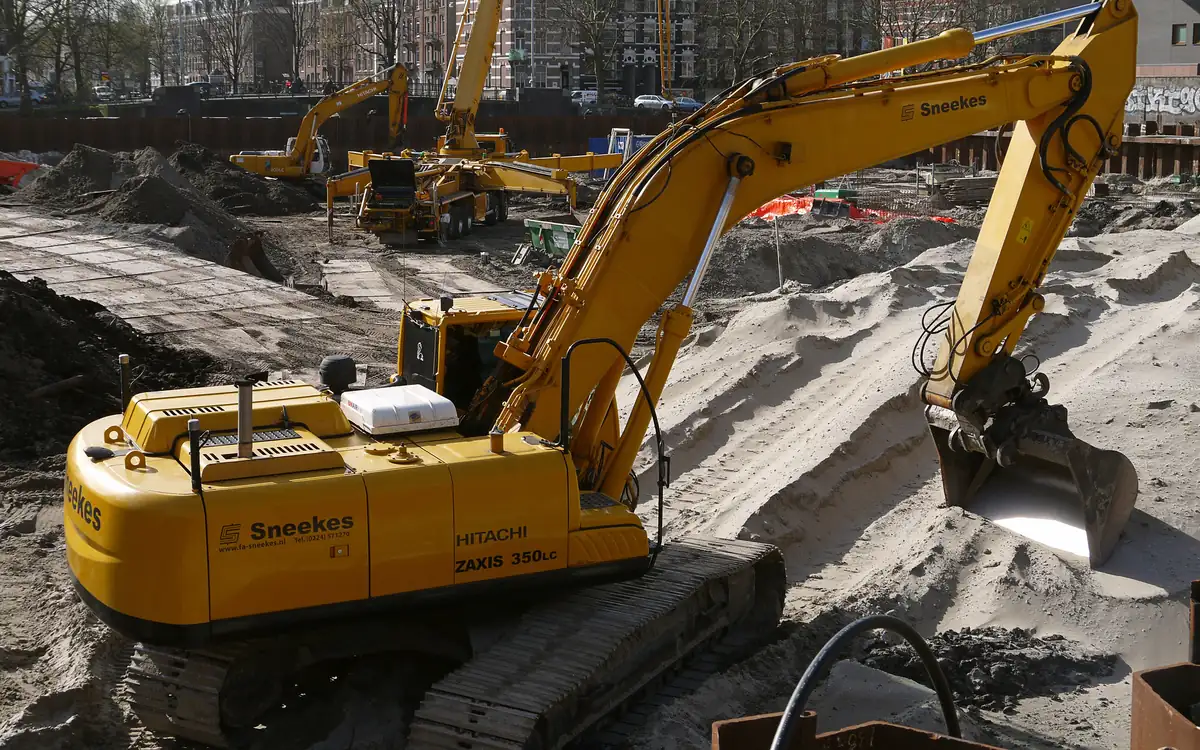
Heavy civil calculations differ from building work in that the governing constraint is usually production rate or loading rather than quantity. A haul fleet is limited by the loader, not by the number of trucks; a pavement is designed around the few percent of traffic that is heavy, not the volume of it. These pages compute the constraint and say which one is binding.
Two calculators in this category are deliberately scoped narrowly. The trench slope page applies published maximum allowable slopes but will not classify soil, because that is a judgement a competent person makes on site. The crane page takes rated capacity from your own load chart rather than deriving it. In both cases, generating the missing number would mean inventing the one figure the safety of the work depends on.
Total lifted load against the rated capacity from your load chart, as a utilisation percentage with the rigging and block included.
Check the ground bearing pressure under a mobile crane outrigger pad or cribbing mat against the site's allowable bearing capacity.
Calculate the total culvert pipe length needed to span a roadway, including end treatment allowances.
The swept path of a turning vehicle: where the inside rear tyre tracks, where the front corner swings, and the band between that must stay clear.
Estimate the steady-state pumping rate a dewatering well can sustain in an unconfined aquifer, using the Dupuit-Forchheimer equation.
How much drive has to sit between the street and the first aisle before a queue at the gate stops backing into traffic.
Rolls and staples for a slope face, counted against the true face area rather than the plan area a drawing shows.
Estimate the lateral active earth pressure a shoring wall or trench box must resist, using the classical Rankine theory for cohesionless soil.
Calculate a flexible culvert pipe's expected deflection under soil cover load, using the well-established Iowa Formula.
Estimate the total geotextile filter fabric needed under a riprap slope, accounting for overlap between adjacent rolls.
What a trapezoidal grassed swale carries at a flow depth by Manning's equation, and its velocity set beside the permissible velocity for the lining.
Convert a traffic stream into equivalent single axle loads over the design life — the number pavement thickness is designed against.
Block-failure capacity of a pile group in clay, set beside the single piles' sum reduced by Converse-Labarre efficiency, and the smaller of the two.
Estimate the reduction in per-pile capacity when piles are installed close together in a group, using the Converse-Labarre formula.
Peak discharge from a small catchment by the rational method (Q = C i A), with the on-site and offsite areas each at its own runoff coefficient.
Sliding factors of safety at each geogrid level of a reinforced segmental wall and at its levelling pad, and the level where the margin is thinnest.
Calculate the stone volume needed for a riprap slope protection layer.
Check whether a bored pile wall's spacing produces true secant overlap or a contiguous gap between piles.
Size a construction sediment basin from the disturbed area draining to it, on the standard storage-per-area rule.
Size a silt fence run: fabric length with its J-hook returns, the posts, and whether the area draining to it stays inside your manual's limit.
What each leg of a multi-leg sling carries at the angle it hangs, and the share the heaviest leg takes when the centre of gravity is off the middle.
Check a soil nail's pull-out safety factor against the standard FHWA minimum of 2.0.
Correct a field Standard Penetration Test (SPT) N-value for overburden pressure, per the Liao-Whitman method.
Check a compacted fill's field density against its laboratory maximum Proctor density.
The force a gust puts on a suspended load's sail area, how far it pushes the load off vertical, and the moment that offset adds at the working radius.
Check how far a tremie pipe can safely be raised during an underwater or drilled-shaft concrete pour without breaking the required embedment seal.
Top width and spoil volume for a sloped excavation, at the maximum allowable slope for a soil type a competent person has classified.
Cycle time, hourly production and fleet size for an earthmoving haul, including the queueing that decides whether extra trucks help.
Compute the area replacement ratio for vibro stone columns on a triangular installation grid.