
SettingsSettings for this calculationUS
Flat width across the base of the swale, before the side slopes begin.
A wide flat bottom spreads the flow into a shallower, slower sheet, which is what a treatment swale wants. A narrow one concentrates it, which is what a conveyance swale wants. The two objectives pull in opposite directions and the section has to pick one.
Horizontal run of each bank for every unit of rise — larger numbers are flatter banks.
A swale that has to be mown wants flat banks, and much steeper than four horizontal to one vertical becomes awkward and then unsafe for a tractor. Flatter banks also add flow area near the top of the section, so they buy capacity as well as maintainability.
Depth of water in the section at the design flow, measured from the invert.
This is the depth being tested, not the depth of the excavation. Freeboard above the water surface is additional, and a swale whose banks are only as high as the design depth has none at all when the storm arrives larger than designed.
Fall along the length of the swale, as a percentage.
Slope drives velocity harder than any other input here, entering as its square root. Below about half a percent a grassed swale tends to stand wet and lose its sward; well above two percent the velocity usually reaches the point where the lining has to be reconsidered.
Roughness of the lining at the retardance class being assumed.
Grass linings span an unusually wide range: short, freshly cut turf behaves nothing like a long, dense sward, and the same channel can move by a factor of several through a growing season. The conservative pairing is to check capacity at the high end of the range and velocity at the low end.
Fastest flow this lining and soil combination is allowed to see, from the governing guidance.
It depends on the cover, on how well established it is, and above all on the erodibility of the soil beneath it. An easily eroded soil under a newly seeded sward tolerates far less than an established cover on a cohesive one, and the first storm after construction is the case that matters.
Swale flow capacity
43.4 ft³/s
Velocity sits inside the permissible figure entered, so the reach can stay grassed on this check. Repeat it at the lowest roughness the sward will ever have — freshly cut turf is faster than the design value most people enter.
- Mean flow velocity
- 3.81 ft/s
- Flow cross-sectional area
- 11.39 ft²
- Wetted perimeter
- 10.95 ft
- Hydraulic radius
- 1.04 ft
- Permissible velocity for the lining
- 4.92 ft/s
- Velocity as a share of the permissible
- 77.47 %
They open the calculator with your figures already in it
Grassed Swale Capacity & Velocity Calculator: 43.42 ft³/s — shown in imperial, US market. The link sets both, so the result they see is the one on your screen.
Show calculation logicHide calculation logic
How this was calculated
Formula source(s)
- Manning's equation for uniform open-channel flow, Q = (1/n) x A x R^(2/3) x S^(1/2) in SI units, applied to a trapezoidal section with equal side slopes
- USDA NRCS grassed waterway guidance is the source for both the permissible velocity of a vegetated lining and Manning's n for it; both vary with the cover species, its condition and the erodibility of the soil, and are entered here rather than assumed by this page
- Manning's n for a grass lining depends on retardance class, which changes through the season as the sward grows and is cut — so one value does not describe a swale all year, and capacity and velocity are conventionally checked at opposite ends of the range
Inputs used
- Channel Bottom Width
- 3.5 ft
- Side Slope (horizontal units per vertical unit)
- 2
- Design Flow Depth
- 20 in
- Longitudinal Slope (%)
- 1
- Manning's Roughness Coefficient
- 0.04
- Permissible Velocity for the Lining
- 4.92 ft/s
Intermediate steps
- Mean flow velocity
- 3.81 ft/s
- Flow cross-sectional area
- 11.39 ft²
- Wetted perimeter
- 10.95 ft
- Hydraulic radius
- 1.04 ft
- Permissible velocity for the lining
- 4.92 ft/s
- Velocity as a share of the permissible
- 77.47 %
Confidence note: Velocity sits inside the permissible figure entered, so the reach can stay grassed on this check. Repeat it at the lowest roughness the sward will ever have — freshly cut turf is faster than the design value most people enter.
What this calculation does not cover
- Uniform steady flow: Manning's equation assumes the depth is constant along the reach, which is untrue near an inlet, an outfall, a bend or a check dam.
- Takes one roughness value. Real grass channels vary along their length and through the season, and the capacity and velocity answers deserve different values of n.
Add the equipment this sizes
This result is a specification — 43.4 ft³/s — not a quantity. Put the thing it sizes into your project: how many, what you call it, and your supplier’s price.
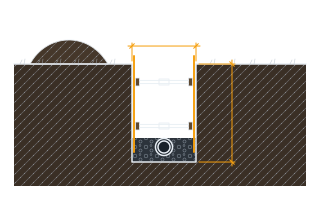
The shaded area is the flow area Manning's equation was solved over, and its outline below the water line is the wetted perimeter. Both come from the bottom width, the side slope and the depth of flow you entered — the section is the figure those formulae are written about.
Computed in your browser — nothing you enter is uploaded. Presented in US customary units and US trade terminology. Where a formula follows a published standard, that standard and its edition are cited beside it on this page; where none governs, the page says so. Local amendments override model codes — verify against the code in force where you build.
Sources checked 2026-08-30 · in the site-wide review of 2026-09-06 · v1.0.0
Regulatory standards & verification citations3
- Manning's equation for uniform open-channel flow, Q = (1/n) x A x R^(2/3) x S^(1/2) in SI units, applied to a trapezoidal section with equal side slopes
- USDA NRCS grassed waterway guidance is the source for both the permissible velocity of a vegetated lining and Manning's n for it; both vary with the cover species, its condition and the erodibility of the soil, and are entered here rather than assumed by this page
- Manning's n for a grass lining depends on retardance class, which changes through the season as the sward grows and is cut — so one value does not describe a swale all year, and capacity and velocity are conventionally checked at opposite ends of the range
Cite this page
Your workspace
Most jobs need more than one number. Add the calculators you need next and they open right here, underneath this one — your figures stay on screen and nothing is lost to a page change.