Amperage to Wire Gauge Calculator
Find the minimum copper wire gauge rated to safely carry a given amp load, per standard NEC ampacity tables.
 Craft Quantities
Calculators
Wire sizing, circuit load, breaker, and outlet-count calculators.
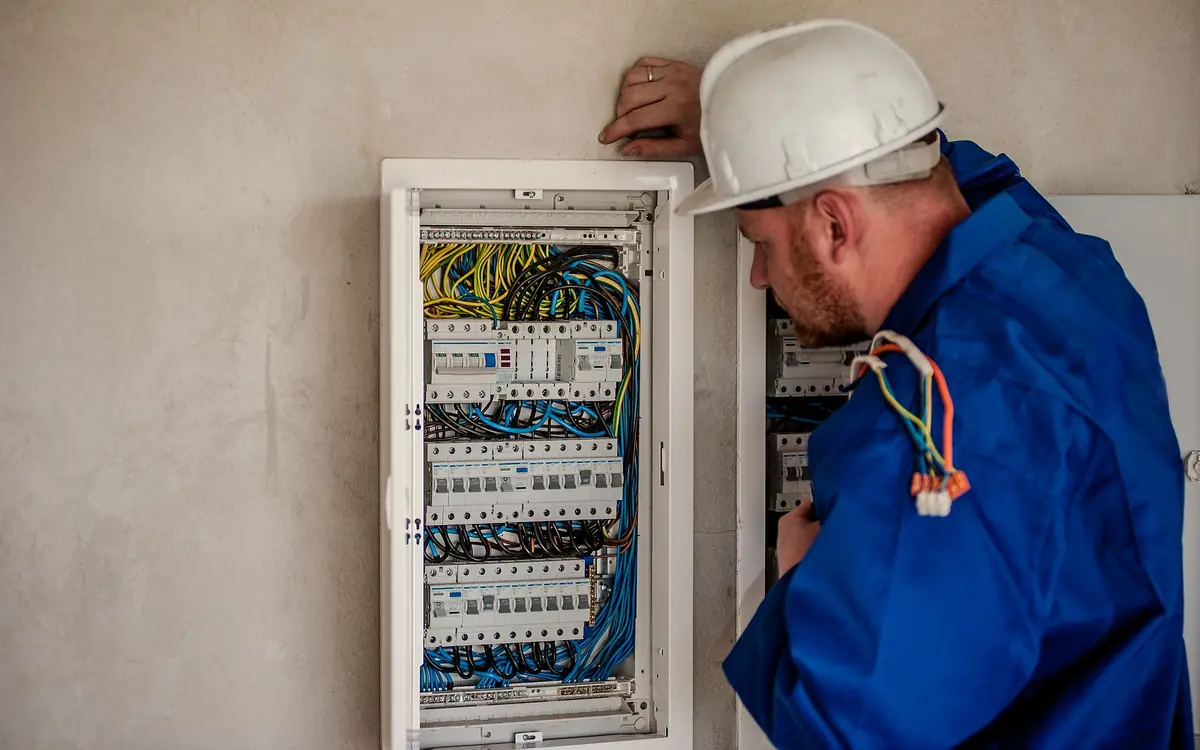
Electrical calculators are only as useful as their scope is honest. Conductor sizing, voltage drop and load calculation are arithmetic with well-defined inputs, and they are done here to the standard's own method. What no calculator can do is inspect an installation, judge a termination, or know what else is already on the circuit — and those are the parts that decide whether work is safe.
Every page states which code or standard its method comes from and when that was last checked, because ampacity tables, correction factors and derating rules differ between jurisdictions and change between editions. Where a figure depends on a table, the table is named. Where a rule varies by market, the page says so instead of quietly picking one.
Find the minimum copper wire gauge rated to safely carry a given amp load, per standard NEC ampacity tables.
Convert a current draw in amps into watts on a standard US 120 V single-phase circuit.
Convert current into power on a 230 V single-phase supply, as used across the UK, Europe and Australia.
Estimate the annual electricity cost of running an appliance based on its wattage and daily usage.
Convert American Wire Gauge to a metric conductor cross-section and back, with the nearest standard size in the other system.
Find the smallest standard breaker rating for a load in watts or amps, with the continuous-load rule applied and the conductor ampacity it then demands.
The voltage a copper or aluminium cable loses on a run, worked from its IEC 60228 resistance at the conductor temperature, single or three phase.
Find the recommended ceiling fan blade diameter for your room size.
Find the maximum number of THHN conductors that fit in a conduit, per the NEC's 40% fill rule.
The smallest aluminum conductor with no more resistance than a given copper one, in AWG and kcmil or mm², and how close the size below it comes.
Add up a US outlet or junction box's conductors, devices, clamps and grounds in NEC 314.16 volume allowances and compare them with the box's volume.
Check how much of a circuit's safe capacity your connected devices are using, based on the NEC 80% continuous-load rule.
Size a dwelling's electrical service by NEC Article 220's standard and optional methods, with the standard service rating that covers the one you choose.
How many emergency luminaires an escape route needs: the spacing that holds EN 1838's minimum on its centre line, plus one at each point of emphasis.
Find the minimum breaker size for a Level 2 EV charger circuit, based on the NEC's 125% continuous-load rule.
Estimate the cost per full charge and per mile of charging an electric vehicle at home.
Find the thinnest extension cord gauge rated for your tool's amp draw that also keeps voltage drop under 3% over the cord length.
How many point smoke or heat detectors a flat ceiling needs so no point is farther from one than BS 5839-1 or NFPA 72 allows, with their spacing.
Estimate how long a generator will run on a tank of fuel at a given load.
Estimate the minimum running-watt capacity a backup generator needs for your household loads.
Convert motor horsepower into kilowatts for metric motor selection, cabling and supply paperwork.
Convert apparent power in kVA into real power in kW at the power factor you enter: 0.8 for a three-phase generator's badge, 1 for a single-phase one's.
Convert real power in kW into the apparent power in kVA a generator, transformer or supply has to carry, at the load's power factor.
Find the recommended transformer wattage for a low-voltage landscape lighting system.
Calculate voltage drop for a 12V landscape lighting run, to check if your wire gauge is adequate for the run length.
Size the power supply (in watts) needed for an LED strip lighting run, with a safety margin.
How many luminaires a room needs for a target average illuminance by the lumen method, with the room index and a grid inside the spacing-to-height ratio.
Enter voltage and resistance to get the current and power that follow from Ohm's Law.
Estimate the total string light length and bulb count needed for a patio or backyard space.
The minimum number of wall outlets one continuous wall space needs under the NEC 12-foot (3.7 m) rule. For a room, add up each wall space's count.
Get a planning estimate of how many general-use receptacles a circuit can support, per NEC load rules.
The running current a single-phase motor draws at full load, from its rating in hp or kW, the voltage, and its efficiency and power factor.
Get a rough minimum smoke detector count based on bedrooms and floors — a planning estimate, not a code inspection.
Calculate real power (kW) for a three-phase electrical load from voltage, current, and power factor.
Estimate the minimum transformer kVA rating needed for a given connected electrical load.
Convert an appliance wattage into the current it draws on a 120 V circuit, for breaker and cable checks.
Convert appliance wattage into current on a 230 V supply for fuse, breaker and cable selection.
Convert watts to amps, amps to watts, or kVA to amps at any voltage — DC, single-phase or three-phase AC, with the power factor you enter.
Look up the NEC allowable ampacity of a copper conductor from its AWG size, at the 60, 75 and 90 °C (140, 167 and 194 °F) insulation ratings.
How much voltage a copper or aluminum run loses over distance — 14 AWG to 1,000 kcmil, single or three phase — against the 3% and 5% the NEC suggests.