
SettingsSettings for this calculationUS
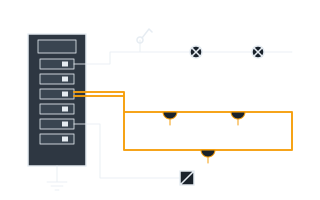
The amp rating printed on the breaker in your panel.
Check the physical label on the breaker switch itself in your electrical panel — don't guess.
Tools needed: Access to your breaker panel
Most household outlets in North America are 120V; large appliances (dryers, ranges, EV chargers) are often 240V.
If you're not sure, 120V is correct for a standard wall outlet. 240V circuits use a different, larger outlet shape.
The sum of the wattage of everything plugged into this circuit at once.
Add up the wattage (printed on the device or its power supply) of every device that could realistically run on this circuit simultaneously.
Current draw
10 A
- Total connected load
- 1,200 W
- Safe continuous limit (80% rule)
- 16 A
- Safe continuous limit
- 1,920 W
- % of safe continuous capacity used
- 62.5 %
They open the calculator with your figures already in it
Electrical Circuit Load Calculator: 10 A — shown in imperial, US market. The link sets both, so the result they see is the one on your screen.
Show calculation logicHide calculation logic
How this was calculated
Formula source(s)
- NEC 210.19(A)(1) and 210.20(A): branch circuit conductors and overcurrent protection must be sized so continuous loads (3+ hours) don't exceed 80% of the breaker's rating (equivalently, the 125% sizing rule)
Inputs used
- Breaker Rating
- 20 A
- Circuit Voltage
- 120 V (US outlet)
- Total Connected Load (W)
- 1200
Intermediate steps
- Total connected load
- 1,200 W
- Safe continuous limit (80% rule)
- 16 A
- Safe continuous limit
- 1,920 W
- % of safe continuous capacity used
- 62.5 %
What this calculation does not cover
- ONE circuit, not the panel. Whether the service and the panel can carry everything together is a separate calculation under the code's demand-factor rules, and a house full of individually compliant circuits can still overload its supply.
- Says nothing about the WIRE. Conductor ampacity is set by the conductor, its insulation, the ambient temperature and how many current-carrying conductors share a raceway — a breaker rating does not guarantee the cable behind it, and a correctly sized breaker on undersized cable is the dangerous combination.
- Voltage drop over the run is not checked here. A circuit inside its current limit can still deliver too little voltage at the far end, which is a separate calculation.
- Motor and compressor loads draw several times their running current at start-up. Nameplate watts describe the running condition and understate what the breaker sees on a cold morning.
- The 80% figure applies to CONTINUOUS loads — three hours or more at full draw. A load that is genuinely intermittent may use more of the breaker's rating, and which of the two a given appliance is can be a judgement.
Add the equipment this sizes
This result is a specification — 10 A — not a quantity. Put the thing it sizes into your project: how many, what you call it, and your supplier’s price.
Computed in your browser — nothing you enter is uploaded. Presented in US customary units and US trade terminology. Where a formula follows a published standard, that standard and its edition are cited beside it on this page; where none governs, the page says so. Local amendments override model codes — verify against the code in force where you build.
Sources checked 2026-09-02 · in the site-wide review of 2026-09-06 · v1.0.1
Regulatory standards & verification citations1
- NEC 210.19(A)(1) and 210.20(A): branch circuit conductors and overcurrent protection must be sized so continuous loads (3+ hours) don't exceed 80% of the breaker's rating (equivalently, the 125% sizing rule)
Which documents these citations point at
- National Electrical Code (NFPA 70) — 210.19(A)(1) (United States)Electrical installations — conductor sizing and protection, load calculation, wiring methods, grounding and working clearances.
A code or standard has force only where a jurisdiction has adopted it, usually with local amendments. This site holds no adoption data for any authority, so check what is in force with the authority where you build. Any section cited above without an edition should be checked against the edition in force where you build. What it would take to know.
Cite this page
Your workspace
Most jobs need more than one number. Add the calculators you need next and they open right here, underneath this one — your figures stay on screen and nothing is lost to a page change.
Code thresholds this tool can check
Code thresholds this tool can check
Checked for United States. Each check below names the body that published the limit it uses. Switching market re-runs them. This is not a code review and has no official standing.
These checks cover only the specific numeric limits listed below. They are not a complete code review: fire separation, egress, structural capacity and accessibility provisions are outside their scope, and only the handful of local amendments offered in the selector are modelled — your municipality may have others. Passing every check here does not make a design compliant. Final approval rests with your local building authority.