
SettingsSettings for this calculationUS
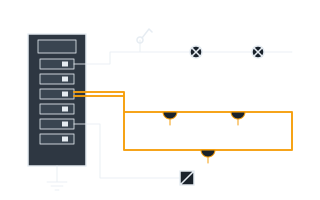
The sum of the wattage of every landscape light fixture on this transformer.
Add up the rated watts (or LED-equivalent watts) of every fixture that will be powered from this one transformer.
Extra headroom for future fixture additions and to avoid running the transformer at its rated maximum.
20% is a common recommendation for landscape lighting transformers.
Recommended transformer size
600 W
- Minimum required capacity
- 360 W
They open the calculator with your figures already in it
Landscape Lighting Transformer Calculator: 600 W — shown in imperial, US market. The link sets both, so the result they see is the one on your screen.
Show calculation logicHide calculation logic
How this was calculated
Formula source(s)
- Recommended transformer wattage = total connected fixture wattage x (1 + safety margin), rounded up to the nearest standard transformer size (150, 300, 600, 900, 1200 W)
Inputs used
- Total Connected Fixture Wattage
- 300
- Safety Margin (%)
- 20
Intermediate steps
- Minimum required capacity
- 360 W
What this calculation does not cover
- Capacity only. A transformer big enough for the total connected load still leaves the far fixtures dim if the cable gauge is too small or the run too long — voltage drop is a separate calculation and nothing here checks it.
- Nothing about the transformer's output side. Most units split the secondary into several terminals or voltage taps, each with its own wattage or fuse limit, so a load that fits the nameplate can still overload the terminal or tap you actually hang it on.
- This is not a branch-circuit load calculation. Whether the 120 V circuit and receptacle feeding the transformer can carry it, and what GFCI protection, enclosure rating, disconnect and burial requirements apply, is decided by the electrical code in force and by a supply-side load calculation — none of which happens here.
- The five sizes it rounds to are a common subset, not the market. Manufacturers sell units below 150 W and between these steps, so the recommendation can be one size larger than what you need to buy. The margin is also applied as an uplift on the load, not as a cap on transformer loading: ask for 20% and a result that lands exactly on a standard size sits at about 83% of nameplate, so set the margin from your manufacturer's stated maximum loading if they give one.
- The wattage you type is taken at face value. It does not verify fixture ratings, add driver or lamp losses, or distinguish an LED fixture's actual current draw from the halogen-equivalent figure printed on its box.
Add the equipment this sizes
This result is a specification — 600 W — not a quantity. Put the thing it sizes into your project: how many, what you call it, and your supplier’s price.
Computed in your browser — nothing you enter is uploaded. Presented in US customary units and US trade terminology. Where a formula follows a published standard, that standard and its edition are cited beside it on this page; where none governs, the page says so. Local amendments override model codes — verify against the code in force where you build.
Sources checked 2026-09-02 · in the site-wide review of 2026-09-06 · v1.0.1
Regulatory standards & verification citations1
- Recommended transformer wattage = total connected fixture wattage x (1 + safety margin), rounded up to the nearest standard transformer size (150, 300, 600, 900, 1200 W)
Cite this page
Your workspace
Most jobs need more than one number. Add the calculators you need next and they open right here, underneath this one — your figures stay on screen and nothing is lost to a page change.