
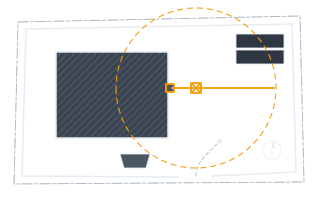
SettingsSettings for this calculationUS
The maximum reaction load this outrigger or crawler track transmits to the ground, from your crane's certified load chart.
This value must come from the crane manufacturer's certified load chart for the specific configuration, boom angle, and load being picked — never estimate or assume it. A qualified rigger or the crane operator determines this before the pick.
The width of the cribbing mat or outrigger pad footprint in contact with the ground.
Measure the actual footprint of the mat, timber crib, or steel plate distributing the outrigger load into the ground — not the outrigger float/pad itself if a larger mat sits beneath it.
The length of the cribbing mat or outrigger pad footprint in contact with the ground.
Measure perpendicular to the width to get the full contact footprint of the mat or crib stack.
The site soil's allowable bearing capacity, from geotechnical data or a competent person's assessment.
OSHA does not publish a universal ground bearing value for crane setups — this must come from an actual geotechnical report or a competent person's site-specific assessment, since bearing capacity varies enormously with soil type, moisture, and compaction. US geotechnical reports and IBC Table 1806.2 state presumptive bearing in pounds per square FOOT, which is exactly what this field shows on an imperial page — type the tabulated figure straight in, with no conversion at all. On a metric page the field is in kPa: multiply psf by 0.04788, so 3,000 psf is 143.6 kPa, 2,000 psf is 95.8 kPa and 1,500 psf is 71.8 kPa. This page states the applied pressure in the same unit, so the two can be read against each other directly.
Applied ground bearing pressure
2,070 psf
The pressure under this mat is at or below the allowable bearing capacity shown with it, which you entered. This checks GROUND bearing pressure only, from a reaction load you supply off your crane's own manufacturer-certified load chart and rigging plan — it calculates no crane capacity, stability, ballast or outrigger reaction, all of which come from the manufacturer's certified data and a qualified rigger or operator per OSHA 29 CFR 1926 Subpart CC, and the allowable figure comes from your own geotechnical data or a competent person's site assessment. Sitting under the figure you entered is not clearance to lift. The chart, the ground, the rigging and the plan are all outside this arithmetic.
- Outrigger reaction force
- 33,081.3 lbf
- Mat contact area
- 16 sq ft
- Allowable bearing capacity (user-supplied)
- 3,132.82 psf
They open the calculator with your figures already in it
Crane Outrigger/Mat Ground-Bearing Pressure Calculator: 2,068 psf — shown in imperial, US market. The link sets both, so the result they see is the one on your screen.
Show calculation logicHide calculation logic
How this was calculated
Formula source(s)
- Applied bearing pressure = Outrigger Reaction Load × 9.81 ÷ Mat Contact Area — the standard bearing-pressure check for temporary crane pick support, using the SAME reaction load the rigger/crane operator reads directly from the crane's own manufacturer-certified load chart (this calculator does not calculate crane capacity, stability, or ballast — it only checks whether the GROUND under a known reaction load, from your own certified chart, can support it).
Inputs used
- Outrigger/Crawler Reaction Load (from Your Crane's Certified Load Chart)
- 33070 lb
- Cribbing Mat/Outrigger Pad Width
- 4 ft
- Cribbing Mat/Outrigger Pad Length
- 4 ft
- Allowable Ground Bearing Capacity (from Geotechnical Data or Competent Person's Assessment)
- 3132.82 psf
Intermediate steps
- Outrigger reaction force
- 33,081.3 lbf
- Mat contact area
- 16 sq ft
- Allowable bearing capacity (user-supplied)
- 3,132.82 psf
Confidence note: The pressure under this mat is at or below the allowable bearing capacity shown with it, which you entered. This checks GROUND bearing pressure only, from a reaction load you supply off your crane's own manufacturer-certified load chart and rigging plan — it calculates no crane capacity, stability, ballast or outrigger reaction, all of which come from the manufacturer's certified data and a qualified rigger or operator per OSHA 29 CFR 1926 Subpart CC, and the allowable figure comes from your own geotechnical data or a competent person's site assessment. Sitting under the figure you entered is not clearance to lift. The chart, the ground, the rigging and the plan are all outside this arithmetic.
What this calculation does not cover
- The load is spread evenly over the whole mat footprint you enter. Nothing checks whether the mat is stiff enough to do that — a small outrigger float on a flexible timber crib concentrates pressure under the float over a fraction of the mat — and the mat's own bending and shear capacity is never checked, so the mat can fail before the ground does.
- The comparison is against one surface bearing number. It does not look at what is under the mat: a stiff crust over soft ground, punching through into a weaker layer, settlement, or capacity lost to rain, saturation, thaw or a nearby trench, excavation, slope or basement wall.
- Buried services, culverts, vaults, backfilled trenches, and setting up on a suspended slab, podium deck or basement roof are not modelled. Where any of those sit under the mat the governing limit is the structure's capacity, not the soil's, and this calculation will not see it.
- Only a static, centred, vertical reaction is modelled. Slewing, boom swing, out-of-level setup, wind and side loading shift the reaction onto one corner and load the mat eccentrically, driving peak edge pressure well above the average this reports.
- This is a screening comparison with no factor of safety applied, not a crane setup design. It does not calculate crane capacity, stability, ballast or the outrigger reaction itself, and it does not replace a competent person's assessment of the actual pad.
Add the equipment this sizes
This result is a specification — 2,070 psf — not a quantity. Put the thing it sizes into your project: how many, what you call it, and your supplier’s price.
Computed in your browser — nothing you enter is uploaded. Presented in US customary units and US trade terminology. Where a formula follows a published standard, that standard and its edition are cited beside it on this page; where none governs, the page says so. Local amendments override model codes — verify against the code in force where you build.
Sources checked 2026-09-06 · in the site-wide review of 2026-09-06 · v1.0.1
Regulatory standards & verification citations1
- Applied bearing pressure = Outrigger Reaction Load × 9.81 ÷ Mat Contact Area — the standard bearing-pressure check for temporary crane pick support, using the SAME reaction load the rigger/crane operator reads directly from the crane's own manufacturer-certified load chart (this calculator does not calculate crane capacity, stability, or ballast — it only checks whether the GROUND under a known reaction load, from your own certified chart, can support it).
Cite this page
Your workspace
Most jobs need more than one number. Add the calculators you need next and they open right here, underneath this one — your figures stay on screen and nothing is lost to a page change.