
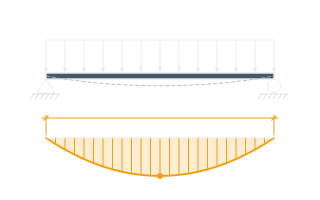
SettingsSettings for this calculationUS
The total load carried by the footing.
Include dead load, live load, and any other applicable loads per your structural design.
The footing's length in plan.
For a square footing this equals the width.
The footing's width in plan.
Measure perpendicular to the length.
The soil's allowable bearing capacity, from a geotechnical report.
150 kPa (about 3,100 psf) is a commonly assumed default for ordinary soil in the absence of a site-specific report — always use an actual geotechnical value for real construction.
Applied bearing pressure
2,660 psf
The pressure this footing puts on the ground is below the allowable bearing pressure shown with it — you entered it from a geotechnical report. Being under the allowable pressure is not the whole ground question: settlement, groundwater and the footings alongside are all untouched here.
- Footing area
- 42.25 sq ft
- Allowable bearing pressure
- 3,132.82 psf
- Safety margin (allowable / applied)
- 1.18
They open the calculator with your figures already in it
Footing Soil Bearing Pressure Checker: 2,660 psf — shown in imperial, US market. The link sets both, so the result they see is the one on your screen.
Show calculation logicHide calculation logic
How this was calculated
Formula source(s)
- Standard geotechnical check: applied bearing pressure = total load / footing area, compared against the site's allowable soil bearing capacity from a geotechnical report
Inputs used
- Applied Load
- 112.4 kip
- Footing Length
- 6.5 ft
- Footing Width
- 6.5 ft
- Allowable Soil Bearing Pressure
- 3132.82 psf
Intermediate steps
- Footing area
- 42.25 sq ft
- Allowable bearing pressure
- 3,132.82 psf
- Safety margin (allowable / applied)
- 1.18
Confidence note: The pressure this footing puts on the ground is below the allowable bearing pressure shown with it — you entered it from a geotechnical report. Being under the allowable pressure is not the whole ground question: settlement, groundwater and the footings alongside are all untouched here.
What this calculation does not cover
- BEARING CAPACITY IS NOT SETTLEMENT. A footing can sit comfortably inside the allowable pressure and still settle more than the structure will tolerate, and on a compressible clay the settlement check is usually the one that governs. Passing here is not permission to stop.
- Assumes the load is concentric and the pressure uniform. Any moment or eccentricity tilts the distribution, and once the resultant leaves the middle third the footing lifts along one edge and the peak pressure climbs far above the average this reports.
- The allowable pressure entered must already carry its geotechnical factor of safety. Entering an ultimate bearing capacity instead over-credits the ground by roughly a factor of three, and nothing here can tell the two apart.
- The footing's own structural design is not checked: punching shear, one-way shear and flexure size the concrete and the reinforcement, and a footing large enough for the ground can still be too thin for the column standing on it.
- Takes no account of adjacent footings whose stress bulbs overlap, of groundwater, of frost depth, or of an excavation planned alongside — each of which can change the allowable pressure without changing anything on this page.
Add the equipment this sizes
This result is a specification — 2,660 psf — not a quantity. Put the thing it sizes into your project: how many, what you call it, and your supplier’s price.
Computed in your browser — nothing you enter is uploaded. Presented in US customary units and US trade terminology. Where a formula follows a published standard, that standard and its edition are cited beside it on this page; where none governs, the page says so. Local amendments override model codes — verify against the code in force where you build.
Sources checked 2026-09-06 · in the site-wide review of 2026-09-06 · v1.0.1
Regulatory standards & verification citations1
- Standard geotechnical check: applied bearing pressure = total load / footing area, compared against the site's allowable soil bearing capacity from a geotechnical report
Cite this page
Your workspace
Most jobs need more than one number. Add the calculators you need next and they open right here, underneath this one — your figures stay on screen and nothing is lost to a page change.