
SettingsSettings for this calculationUS
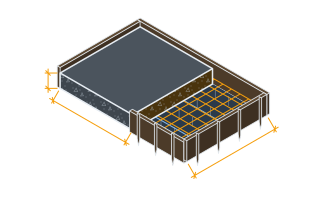
The full vertical height of the SCC pour against the formwork.
Unlike conventional concrete, SCC pressure design uses the FULL height, not just the height reached during the maximum placement rate window.
The unit weight of the fresh SCC mix.
23.6 kN/m³ (150 pcf) is typical for normal-weight concrete; heavyweight or lightweight SCC mixes will differ.
Design lateral pressure
1,500 psf
This is the conservative full-hydrostatic design value ACI recommends by default for SCC. A qualified formwork engineer may justify a lower design pressure using documented field pressure measurements for your specific mix and placement method — real measured pressures have been reported as low as 34-60% of full hydrostatic in some studies, but full hydrostatic remains the required default absent that data.
- Equivalent in psf
- 1,502.32 psf
They open the calculator with your figures already in it
SCC Formwork Lateral Pressure Calculator: 1,502 psf — shown in imperial, US market. The link sets both, so the result they see is the one on your screen.
Show calculation logicHide calculation logic
How this was calculated
Formula source(s)
- ACI PRC-237.2 / ACI 347R guidance: because SCC's high flowability behaves like a true liquid during placement, formwork should be designed for the full hydrostatic pressure of the fresh concrete (unit weight x full pour height) unless a lower value is justified by site-specific measurement or documented experience — unlike conventional slump concrete, which allows reduced pressure formulas based on placement rate and temperature.
Inputs used
- Full Pour Height
- 10 ft
- Fresh Concrete Unit Weight
- 150.23 pcf
Intermediate steps
- Equivalent in psf
- 1,502.32 psf
Confidence note: This is the conservative full-hydrostatic design value ACI recommends by default for SCC. A qualified formwork engineer may justify a lower design pressure using documented field pressure measurements for your specific mix and placement method — real measured pressures have been reported as low as 34-60% of full hydrostatic in some studies, but full hydrostatic remains the required default absent that data.
What this calculation does not cover
- This is the pressure demand only, not a formwork design. It says nothing about whether the sheathing, studs, walers, ties or bracing can carry the figure, and it does not set tie or waler spacing — those checks belong to whoever is responsible for the formwork design.
- The answer is the peak pressure at the base of the pour. It does not give the pressure distribution up the form, the total lateral force per unit length of wall, or the height at which the resultant acts — which is what a tie and waler layout is actually set out from.
- Concrete pressure is the only load included. Wind on the form face, the placing crew and their equipment, impact and surge from discharge, uplift at the base, and the out-of-balance load on a single-sided or sloping form are all excluded. On many forms it is one of those, not the concrete, that governs the bracing.
- Bottom-injection placement is outside this model. Pumping SCC in through a port at the base of the form adds the pump's own pressure to the hydrostatic head, and the pressure in the form can then exceed unit weight times height.
- The two inputs carry no information about rate of placement, concrete temperature, rest period between lifts, form geometry or the mix's thixotropy. The result cannot reflect a mix or a placement method that behaves differently from a static liquid, in either direction.
Add the equipment this sizes
This result is a specification — 1,500 psf — not a quantity. Put the thing it sizes into your project: how many, what you call it, and your supplier’s price.
Computed in your browser — nothing you enter is uploaded. Presented in US customary units and US trade terminology. Where a formula follows a published standard, that standard and its edition are cited beside it on this page; where none governs, the page says so. Local amendments override model codes — verify against the code in force where you build.
Sources checked 2026-09-06 · in the site-wide review of 2026-09-06 · v1.0.1
Regulatory standards & verification citations1
- ACI PRC-237.2 / ACI 347R guidance: because SCC's high flowability behaves like a true liquid during placement, formwork should be designed for the full hydrostatic pressure of the fresh concrete (unit weight x full pour height) unless a lower value is justified by site-specific measurement or documented experience — unlike conventional slump concrete, which allows reduced pressure formulas based on placement rate and temperature.
Which documents these citations point at
Standards referenced: ACI 347R (American Concrete Institute, United States).
Cite this page
Your workspace
Most jobs need more than one number. Add the calculators you need next and they open right here, underneath this one — your figures stay on screen and nothing is lost to a page change.