
SettingsSettings for this calculationUS
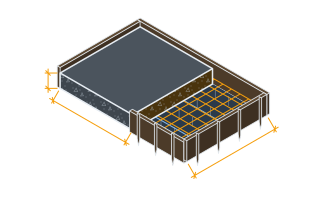
The total liquid volume currently held in the concrete washout basin.
The default of 1892.7 L corresponds to 500 gallons.
The solidifier product's labeled dosage rate, in pounds of product per 100 gallons of washout water.
This rate is product-specific — take it directly from your solidifier product's manufacturer label or data sheet, not a generic assumption.
Solidifier product needed
125 lb
The dosage rate is entirely product-specific — always use the exact rate from your solidifier product's manufacturer label or data sheet, not an assumed default. Regardless of solidifier choice, construction stormwater permits (NPDES general permit requirements) require washout water to be fully contained on-site and never discharged to storm drains or waterways.
- Washout volume
- 500 gal
They open the calculator with your figures already in it
Concrete Washout Basin Solidifier Dosage Calculator: 125 lb — shown in imperial, US market. The link sets both, so the result they see is the one on your screen.
Show calculation logicHide calculation logic
How this was calculated
Formula source(s)
- Product needed = (Washout Liquid Volume ÷ 100 gal) × Manufacturer's Dosage Rate (product amount per 100 gallons). Concrete washout solidifier dosage rates are product-specific and must come from the manufacturer's label/data sheet — this calculator applies whatever rate you supply. Construction stormwater general permits (NPDES) require concrete washout water to be contained on-site and not discharged, which is the regulatory driver for treating/solidifying washout water before disposal.
Inputs used
- Washout Basin Liquid Volume
- 500 gal
- Manufacturer's Dosage Rate (lb per 100 gal of Washout Water)
- 25
Intermediate steps
- Washout volume
- 500 gal
Confidence note: The dosage rate is entirely product-specific — always use the exact rate from your solidifier product's manufacturer label or data sheet, not an assumed default. Regardless of solidifier choice, construction stormwater permits (NPDES general permit requirements) require washout water to be fully contained on-site and never discharged to storm drains or waterways.
What this calculation does not cover
- The dose is only right for the volume in the basin at the moment it is measured. An open washout is also a rain gauge, and every rinse of a chute or a pump adds more, so a quantity weighed out in the morning under-treats by the afternoon. Dose against the liquid present at the time of treatment, and keep enough freeboard that a storm cannot put the basin over the side.
- Solidifying is not neutralizing. Washout water usually sits around pH 11 to 13 from free lime, and a polymer binds the water without moving the pH at all, so what is left is a caustic solid. Where a permit or a receiving facility sets a pH limit, that is a separate treatment with carbon dioxide or acid and a separate measurement.
- This weighs the product going in, not the waste going out. What leaves the site is the water, the settled fines and hardened solids already sitting in the basin, and the polymer together — a considerably heavier load than the liquid alone — and the haul, the container and the landfill's acceptance criteria are all priced against that mass.
Estimated cost — your price
This site holds no price list for this material — local prices vary too much to publish honestly. Enter your supplier's price and the result is costed with it.
Computed in your browser — nothing you enter is uploaded. Presented in US customary units and US trade terminology. Where a formula follows a published standard, that standard and its edition are cited beside it on this page; where none governs, the page says so. Local amendments override model codes — verify against the code in force where you build.
Sources checked 2026-09-06 · in the site-wide review of 2026-09-06 · v1.0.1
Regulatory standards & verification citations1
- Product needed = (Washout Liquid Volume ÷ 100 gal) × Manufacturer's Dosage Rate (product amount per 100 gallons). Concrete washout solidifier dosage rates are product-specific and must come from the manufacturer's label/data sheet — this calculator applies whatever rate you supply. Construction stormwater general permits (NPDES) require concrete washout water to be contained on-site and not discharged, which is the regulatory driver for treating/solidifying washout water before disposal.
Cite this page
Your workspace
Most jobs need more than one number. Add the calculators you need next and they open right here, underneath this one — your figures stay on screen and nothing is lost to a page change.
Tools and safety for this job
To place and finish concrete, erect formwork and saw-cut cured concrete. Generic types, no brands, no prices.
Protection this work requires
- Cutting or grinding concrete, masonry, screed, tile or fibre-cement board releases respirable silica: cut wet or extract at the tool, and wear a P2/N95 respirator at minimum — a nuisance dust mask does not filter it.
- Hardwood dust is a recognised carcinogen: extract at the tool and wear a P2/N95 respirator when cutting or sanding indoors.
- Wet cement and lime burn skin and eyes painlessly until the damage is done: waterproof gloves to EN 374, safety glasses whenever the mix can splash, and never kneel in wet mix in permeable trousers.
- Saws, grinders and breakers run above 85 dB, where hearing damage accumulates and does not recover: defenders or plugs for every cut, not just the long ones.
- Breakers and grinders cause permanent nerve damage: limit continuous trigger time, keep hands warm, and stop if fingers tingle or blanch.
- Boards, blocks and bagged material cause most lasting back injuries on small sites: two people or a lifter for full sheets, and never a bag on one shoulder up a ladder.
Show the 17 tools this job needsHide tools
Essential
Angle grinder
Bull float and edger
Circular saw
Claw hammer
Dust extractor or vacuum with a fine filter
Screed bar or rail
Shovel and spade
Spirit level
String line and pins
Tape measure
Wheelbarrow
Recommended
Chalk line
Cordless drill/driver
Floor or cut-off saw
Plate compactor
SDS rotary hammer
Optional
Power float
Also needed as materials: chalk refill, circular saw blades, cutting and diamond discs, diamond blades, drill and driver bits, SDS bits and chisels.
what each concrete tool is for, and the spec that decides which to buy where one does.