
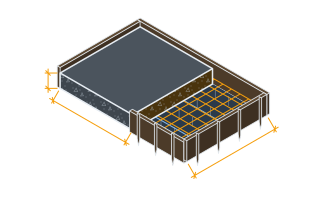
SettingsSettings for this calculationUS
The volume of loose dry material the ratio divides up — not the volume of finished concrete it makes.
The figure here is a batch of unmixed ingredients, not a pour. Sand settles into the voids between the gravel and cement paste fills what is left, so the 27 cubic ft (about 0.76 m³) shown by default mixes down to roughly 18 cubic ft (about 0.5 m³) of placed concrete. Read it the other way to size a batch: for hand-mixed concrete, batch about one and a half times the volume you intend to place. That multiplier is a working allowance rather than a yield calculation — it shifts with the ratio and with the water the mix takes — and past a few barrows, ready-mix sized from the Concrete Calculator is usually the more practical route.
The cement portion of the mix ratio.
A common general-purpose mix is 1:2:3 (cement:sand:gravel).
The sand portion of the mix ratio.
More sand relative to cement generally produces a more workable but weaker mix.
The gravel (coarse aggregate) portion of the mix ratio.
Coarse aggregate is filler, not binder. Every extra part of gravel enlarges the total the ratio is divided by, so cement's share of the batch falls — 1:2:3 is one part cement in six, 1:2:8 is one part in eleven — and the mix gets stiffer to place and leaner and weaker with it. Strength comes from the cement content and the water-cement ratio, not from more stone.
Cement bags needed
5 x 94 lb cement bags
These are mixing proportions, not an order quantity. The figures describe a batch of loose dry cement, sand and gravel measuring the volume entered, and mixed and placed that batch fills roughly two thirds of that volume — so batch about half again to fill the whole of it. For structural work, verify your mix design meets the required strength for its application.
- Sand needed
- 9 ft³
- Gravel needed
- 13.5 ft³
They open the calculator with your figures already in it
Concrete Mix Ratio Calculator: 5 x 94 lb cement bags — shown in imperial, US market. The link sets both, so the result they see is the one on your screen.
Show calculation logicHide calculation logic
How this was calculated
Formula source(s)
- Each component's loose volume = batch volume x (its ratio parts / total ratio parts), with no allowance applied for the volume a batch loses on mixing; a 94 lb bag of portland cement is commonly estimated at about 1 cubic ft loose volume, which is a bulk density of about 1,506 kg/m³ — putting the 25 kg bag stocked in metric markets at about 16.6 litres
Inputs used
- Loose Dry Batch Volume
- 27 ft³
- Cement Parts
- 1
- Sand Parts
- 2
- Gravel Parts
- 3
Intermediate steps
- Sand needed
- 9 ft³
- Gravel needed
- 13.5 ft³
Confidence note: These are mixing proportions, not an order quantity. The figures describe a batch of loose dry cement, sand and gravel measuring the volume entered, and mixed and placed that batch fills roughly two thirds of that volume — so batch about half again to fill the whole of it. For structural work, verify your mix design meets the required strength for its application.
What this calculation does not cover
- No bulking allowance is built in. The ratio divides the figure you type, so the three components add up to exactly it, and what comes out of the mixer is around a third smaller — the mix closes its own voids, fine material taking up the gaps in the coarse and paste taking up the rest. Scaling the input by about one and a half is the usual working allowance for hand-mixed concrete, and it is left to you on purpose: the true factor moves with the richness of the mix and with the water it takes, and water is not an input here, so a single built-in constant would run high on a rich mix and low on a lean one.
- This is a volume split, not a mix design. It does not check that the ratio you entered reaches a specified strength, exposure class or durability requirement, and it does not replace a designed mix with trial batching and cube or cylinder testing on structural, reinforced or inspected work.
- Water is not in the output. A volume ratio says nothing about the water-cement ratio, which is what actually governs strength and durability, and nothing about air entrainment, plasticiser or any other admixture dosage.
- The split ignores everything about the aggregate except its share of the ratio — grading, maximum size, the moisture already in the pile, and sand bulking, which can swell damp sand enough that a measured bucket carries noticeably less sand than a dry one. Volume batching on site is also less repeatable than weigh-batching for the same reason.
- The bag count comes from a standard loose bulk density for portland cement, not from a weigh-batch of the cement you have, and it rounds up to whole bags with no allowance for spillage or part-used bags. Mixes with no coarse aggregate — mortars, screeds, renders — are outside what this page accepts, because it requires at least one part gravel.
Estimated cost — your price
This site holds no price list for this material — local prices vary too much to publish honestly. Enter your supplier's price and the result is costed with it.
Computed in your browser — nothing you enter is uploaded. Presented in US customary units and US trade terminology. Where a formula follows a published standard, that standard and its edition are cited beside it on this page; where none governs, the page says so. Local amendments override model codes — verify against the code in force where you build.
Sources checked 2026-09-05 · in the site-wide review of 2026-09-06 · v1.2.1
Regulatory standards & verification citations1
- Each component's loose volume = batch volume x (its ratio parts / total ratio parts), with no allowance applied for the volume a batch loses on mixing; a 94 lb bag of portland cement is commonly estimated at about 1 cubic ft loose volume, which is a bulk density of about 1,506 kg/m³ — putting the 25 kg bag stocked in metric markets at about 16.6 litres
Cite this page
Your workspace
Most jobs need more than one number. Add the calculators you need next and they open right here, underneath this one — your figures stay on screen and nothing is lost to a page change.
Tools and safety for this job
To place and finish concrete, erect formwork and saw-cut cured concrete. Generic types, no brands, no prices.
Protection this work requires
- Cutting or grinding concrete, masonry, screed, tile or fibre-cement board releases respirable silica: cut wet or extract at the tool, and wear a P2/N95 respirator at minimum — a nuisance dust mask does not filter it.
- Hardwood dust is a recognised carcinogen: extract at the tool and wear a P2/N95 respirator when cutting or sanding indoors.
- Wet cement and lime burn skin and eyes painlessly until the damage is done: waterproof gloves to EN 374, safety glasses whenever the mix can splash, and never kneel in wet mix in permeable trousers.
- Saws, grinders and breakers run above 85 dB, where hearing damage accumulates and does not recover: defenders or plugs for every cut, not just the long ones.
- Breakers and grinders cause permanent nerve damage: limit continuous trigger time, keep hands warm, and stop if fingers tingle or blanch.
- Boards, blocks and bagged material cause most lasting back injuries on small sites: two people or a lifter for full sheets, and never a bag on one shoulder up a ladder.
Show the 17 tools this job needsHide tools
Essential
Angle grinder
Bull float and edger
Circular saw
Claw hammer
Dust extractor or vacuum with a fine filter
Screed bar or rail
Shovel and spade
Spirit level
String line and pins
Tape measure
Wheelbarrow
Recommended
Chalk line
Cordless drill/driver
Floor or cut-off saw
Plate compactor
SDS rotary hammer
Optional
Power float
Also needed as materials: chalk refill, circular saw blades, cutting and diamond discs, diamond blades, drill and driver bits, SDS bits and chisels.
what each concrete tool is for, and the spec that decides which to buy where one does.