
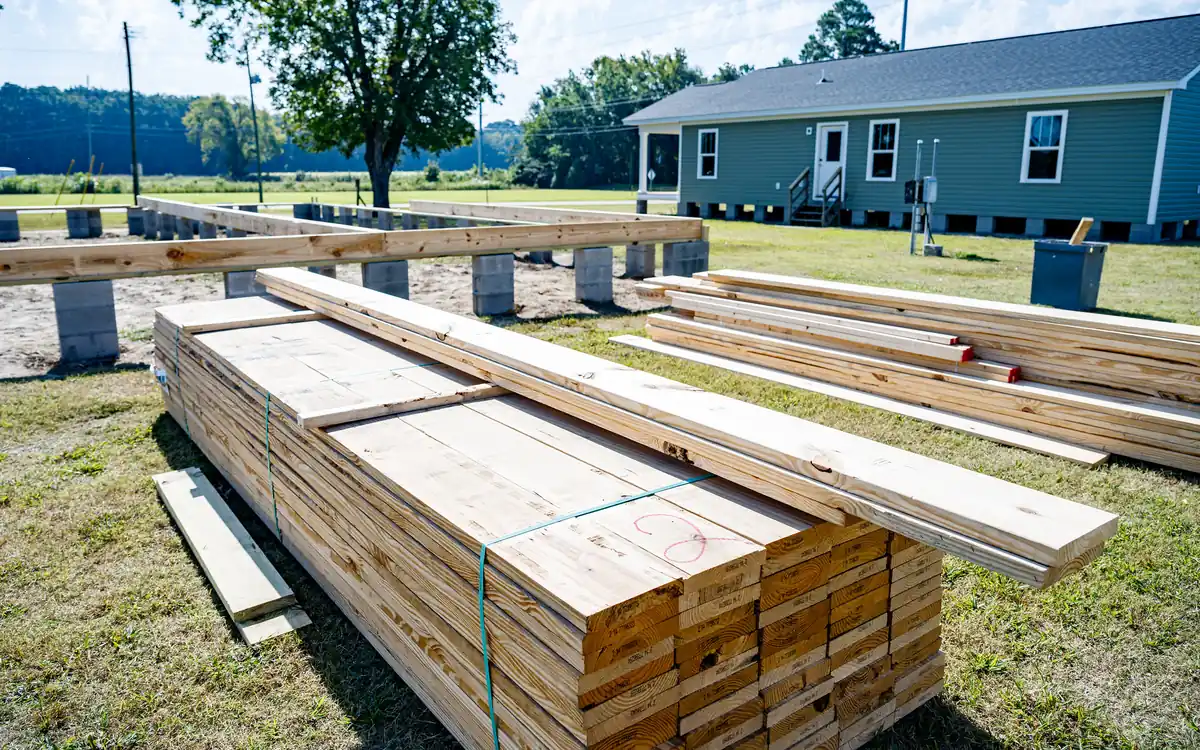
The Pallet Landed Where the Forklift Could Reach
Which was the front drive. The slab is going in behind the house, and between the two there is a side gate 800 millimetres wide, a step down onto grass, and twenty metres of lawn that has been soft since March. Nothing with a drum on it is coming down that. Nothing is coming down that except a barrow and whoever is pushing it.
That single fact turns the usual order of a concrete job inside out. Normally the slab is set out, the volume comes off the formed dimensions, and the volume is ordered. Here the material is already bought, shrink-wrapped on the drive, and it is a fixed quantity that will not grow between now and Saturday morning. The design question is no longer how much concrete the slab needs. It is how much slab this concrete makes, and whether that answer is larger than the rectangle already pegged out on the grass.
Three numbers settle the weekend and none of them is printed on the sack. The first is the area those bags cover at the thickness you are actually permitted to pour. The second is how many loaded barrow trips stand between the drive and the formwork — counting the base stone and the dry bags as separate journeys from the wet concrete, because they are three different problems with three different clocks. The third is how long the mixing takes measured against how long the first batch stays workable, which is the number that quietly decides whether this is one pour or two.
Sold by Weight, Spent by Volume
A bag is priced and lifted by its dry weight and consumed by its yield, and nothing about the relationship can be eyeballed. A standard 80 lb bag of packaged concrete mix makes roughly 0.6 cubic feet of placed concrete — call it 17 litres — and that figure comes off the manufacturers' own literature rather than off any rule of thumb: Quikrete's Concrete Mix (No. 1101) data sheet and Sakrete's Concrete Mix sheet both publish it. Divide 27 by 0.6 and you have the number worth carrying around: forty-five bags to the cubic yard, a shade under sixty to the cubic metre.
It is worth seeing why 80 pounds of dry material becomes 0.6 cubic feet, because that arithmetic is a check on everything downstream of it. The water is part of the product. Quikrete's sheet puts roughly three quarts to the 80 lb bag, which is about six and a quarter pounds of water going into the drum, so the bag discharges something near 86 pounds of fresh concrete into 0.6 cubic feet. That is 144 pounds per cubic foot, and fresh concrete runs between about 140 and 150. The stated yield and the density of the thing it makes agree with each other. When a sack's printed yield fails that check by a wide margin, read the front of the bag again — it is a mortar, a sand mix or a fast-setting post product, and none of those is a concrete mix.
The document behind the sack is ASTM C387/C387M, the standard specification for packaged, dry, combined materials for concrete and high strength mortar. It is what gives the strength claim on the front any meaning at all: the product is proportioned to a specification, mixed at a stated consistency and tested at that consistency, and the number printed there belongs to that consistency and to no other one. C387 says nothing whatever about how many bags a slab takes, which is what the table below is for, and nothing about the water you tip in on the day, which is the one variable on this entire job under your own hand.
| Bag size | Yield per bag | Bags per cubic yard | Bags per cubic metre |
|---|---|---|---|
| 80 lb (36.3 kg) | 0.60 cu ft / 17.0 L | 45 | 59 |
| 60 lb (27.2 kg) | 0.45 cu ft / 12.7 L | 60 | 79 |
| 50 lb (22.7 kg) | 0.375 cu ft / 10.6 L | 72 | 95 |
| 40 lb (18.1 kg) | 0.30 cu ft / 8.5 L | 90 | 118 |
| 25 kg metric sack | printed on the bag; commonly 11 to 12 L | — | typically 85 to 95 |
Running the Sum Backwards
Concrete calculators all run the same direction — dimensions in, volume out, bags out — and that direction is no use to a pallet already paid for. What this job wants is the inverse: a fixed bag count, a thickness that the code rather than the budget has chosen, and the largest area that combination will cover with something honestly left over for the low spots.
The reserve is where the calculation is won or lost, and it is the field nobody touches. Ten per cent is a fair default for concrete going onto a machine-screeded, formed base. A hand-graded sub-base under a hand-mixed pour is not that base. Every hollow left by a rake is paid for in concrete, every barrow leaves a skin of mortar behind on the way back, and the last batch of a hand-mixed job is the one that gets scraped rather than the one that gets stretched. Run the area twice, once at ten per cent and once at fifteen, and read the gap between the two answers as the size of the bet you are placing.
Bags on hand plus the thickness you are allowed to pour, and it returns the largest area that combination covers — run it at a ten per cent reserve and again at fifteen before you commit to a slab size, because on a small pour the difference between the two is a single trip to the merchant.
SettingsSettings for this calculation
The standard allowance most suppliers and estimating guides assume for ordinary work.
The number of 80 lb bags of pre-mixed concrete you already have.
The thickness you plan to pour.
Reserve a portion of your material for spillage and an uneven subgrade.
Maximum slab area pourable
98.2 sq ft pourable
This is a theoretical maximum assuming a perfectly flat, prepared subgrade beyond the waste reserve — an uneven base will reduce the actual area you can cover.
- Usable volume (after waste reserve)
- 32.73 cu ft
- Equivalent in square meters
- 9.12 m²
- Total raw volume (no waste reserve)
- 36 cu ft
They open the calculator with your figures already in it
Reverse Concrete Slab Solver: 98.18 sq ft pourable — shown in imperial, US market. The link sets both, so the result they see is the one on your screen.
Estimated cost — your price
This site holds no price list for this material — local prices vary too much to publish honestly. Enter your supplier's price and the result is costed with it.
What this calculation does not cover
- This is a quantity solver, not a slab design. It does not check that the thickness you entered is adequate for the load the slab will carry, and it sizes no reinforcement, no control joints and no edge thickening.
- The area is a flat prism of constant thickness. Thickened edges, turndowns, haunches, a footing poured monolithically with the slab, and any fall or crossfall all take mix this model never counts, so your real coverage lands below the figure shown.
- The 0.6 cubic feet (17 litres) per bag is a nominal yield for a full, dry 80 lb (36 kg) bag mixed to the manufacturer's water ratio. Bags that have taken up moisture in storage, part-used bags, over-watered batches, and other bag sizes or brands all yield differently — the count you enter is taken at face value.
- The waste factor is a flat percentage, not a measurement of your base. Ruts, soft spots, over-excavation and a subgrade that has not been compacted and screeded to level can swallow far more than the reserve, and the shortfall shows up at the far end of the pour.
- Nothing here tells you whether you can mix and place that many bags in one session. Bagged mix starts setting as it goes down, so an area this size mixed by hand ends in cold joints between batches unless the crew and mixers keep ahead of it.
Thickness Is the One Number You Cannot Shave
When the area comes back smaller than the pegs, the instinctive move is to pour thinner. Mostly that move is not available. The International Residential Code sets out concrete floors on ground in Section R506, with a minimum slab thickness of three and a half inches and a following subsection covering the base course beneath it and where a vapour retarder is required; ACI 332, Residential Code Requirements for Structural Concrete, is what anyone designing a slab that carries more than itself works from. A shed base, a bin store or a bike-shelter pad often sits outside a structural specification altogether, but outside a specification is not the same as unregulated, and the building department is the body that decides which of the two you are in.
Exposure decides the strength grade and, in freezing climates, something the bag may not be able to give you. IRC Table R402.2 sets minimum specified compressive strength against weathering probability, with exterior flatwork, porches and garage floors held to a higher figure than an interior basement slab, and it carries an air-entrainment requirement tied to that same weathering severity. Packaged concrete mixes are not, as a rule, supplied air-entrained, and air content is not something a drum mixer generates by turning for longer — ASTM C387 does not require it and no amount of technique substitutes for it. If the edition your authority has adopted calls for air-entrained concrete at your exposure, that air has to arrive inside the bag. Look for a stated air content or an air-entrained variant on the manufacturer's data sheet, and put the question to whoever will be inspecting before the shrink-wrap comes off, not after the slab has had its first winter.
Thickness also moves the workload more than any other decision left open to you. Twenty-five millimetres of extra depth across a nine square metre base is 0.225 cubic metres, which is thirteen more bags — more than a fifth of the pallet, five more barrow trips of dry sack and four more of wet concrete, and the better part of an extra hour at the mixer. That is the real reason the code minimum matters here in a way it does not on a truck pour: on a bagged job the depth is being paid for in Saturday afternoon.
The table sets sixty 80 lb bags, at the calculator's own ten per cent reserve, against each of the thicknesses that come up on domestic work. The column worth reading first is the third one, because a homeowner rarely thinks in square metres and always thinks in the size of the thing they wanted.
| Slab thickness | Area covered | Largest square | Bags per m² |
|---|---|---|---|
| 89 mm (3½ in, the IRC floor) | 10.42 m² / 112 sq ft | 3.23 m / 10 ft 7 in | 5.8 |
| 100 mm (4 in) | 9.27 m² / 100 sq ft | 3.04 m / 10 ft 0 in | 6.5 |
| 125 mm (5 in) | 7.41 m² / 80 sq ft | 2.72 m / 8 ft 11 in | 8.1 |
| 150 mm (6 in) | 6.18 m² / 67 sq ft | 2.49 m / 8 ft 2 in | 9.7 |
| 200 mm (8 in) | 4.63 m² / 50 sq ft | 2.15 m / 7 ft 1 in | 12.9 |
Two Kilometres of Walking Before Anything Is Level
There are three haulage jobs on this site and only one of them is the concrete. Sub-base stone has to come round to the formwork and the spoil it displaces has to go the other way; sixty sacks have to travel from the pallet to wherever the mixer is standing; and every batch has to get from the drum to the face of the last batch. Only the third of those has a clock running on it, and that is the whole argument for putting the mixer beside the slab rather than beside the pallet. Dry bags keep indefinitely under a sheet. Wet concrete keeps for as long as the weather allows and not one minute more.
Take the three metre square base at 100 millimetres. The slab itself is 0.90 cubic metres, near enough 32 cubic feet. The sub-base under it, at the same depth and allowing for what a compactor takes out of a loose heap, is about 1.13 cubic metres, which at the 1,600 kilograms a cubic metre a loose heap of crushed base weighs is around 1.8 tonnes of stone. Put the compacted figures into the tonnage calculator instead — 0.90 cubic metres at the 1,900 to 2,000 a well-graded base compacts to — and it lands in the same place; its 1,700 default is the number to raise, because that is the one difference between ordering enough stone and ordering a sixth too little. At a realistic three cubic feet of stone in a barrow — 300 pounds, 136 kilograms, and already a serious push over grass — that is fourteen loads of stone. The bags go three to a barrow, which is another twenty runs. The concrete is thirteen. Forty-seven loaded trips, ninety-four traverses of that twenty metre lawn, and just short of two kilometres of walking before a single trowel comes out.
The load-count tool assumes a struck five cubic feet per barrow, and that assumption is a volume assumption borrowed from mulch and topsoil. It does not survive contact with concrete. Five cubic feet of fresh concrete at 145 pounds a cubic foot weighs 725 pounds — 329 kilograms — which is not a barrow, it is a tipping accident. Load two and a half cubic feet instead, around 165 kilograms, and the answer changes from seven trips to thirteen. Take the tool's figure as a floor and scale it by five divided by whatever you can genuinely push up a plank, and do the scaling before you plan the day rather than after the third trip.
Weight is also the reason the pallet itself deserves a plan. Sixty 80 lb bags is 2.18 tonnes; even a part pallet is comfortably over a tonne, and the delivery note rather than any assumption is what tells you the count. The NIOSH revised lifting equation, set out in NIOSH Publication No. 94-110, starts from a load constant of 51 pounds under ideal conditions and multiplies it downward for every departure from ideal — distance from the body, height, twist, frequency. An 80 lb sack exceeds the constant before a single multiplier is applied, and on a drive with a pallet at ankle height none of the multipliers is going to be 1.0. Slide bags rather than lifting them, use a sack truck for the flat run, split the lift between two people at the pallet, and cut the sack open where it lies in the barrow instead of carrying it open.
The dust and the wet material both have their own hazards and both are documented on paper that comes with the product. Emptying dry mix generates respirable crystalline silica, which is the subject of OSHA 29 CFR 1926.1153 and of the Safety Data Sheet on the manufacturer's site; tip low into the drum, stand upwind, and wear the respirator the sheet names rather than a dust mask from the bottom of a drawer. Fresh concrete is strongly alkaline and will burn skin through wet clothing given long enough contact, which is why kneeling in it in ordinary trousers is the classic weekend injury. Waterproof gloves, boots you can hose off, and eye protection at the mixer — the drum flings the first stiff batch further than anyone expects.
Feed it the slab's own placed volume, not the pallet's total yield, and it returns the trips at a struck five cubic feet each — then apply the correction in the paragraph above, because five cubic feet of concrete is a 330 kilogram barrow and you will be moving half of that.
The total material volume to move.
Wheelbarrow loads needed
27 wheelbarrow loads
This assumes a standard 6 cu ft (170 litre) wheelbarrow loaded to a practical, non-spilling level — a smaller or larger wheelbarrow changes the load count proportionally.
- Total volume
- 135 ft³
They open the calculator with your figures already in it
Wheelbarrow Loads Calculator: 27 wheelbarrow loads — shown in imperial, US market. The link sets both, so the result they see is the one on your screen.
Estimated cost — your price
This site holds no price list for this material — local prices vary too much to publish honestly. Enter your supplier's price and the result is costed with it.
What this calculation does not cover
- The count assumes one barrow size - about 5 cu ft of usable volume in a standard 6 cu ft builder's barrow. There is no input for the barrow you actually own, and the trip count scales in direct proportion to its capacity, so a small garden barrow or a large contractor barrow will not match the figure shown.
- It counts volume, not weight. Density is never read, so a load of wet concrete, saturated gravel or wet clay counts the same as a load of bark mulch even though it can be several times heavier. Dense material normally has to be moved in part-loads, which pushes the real trip count above this figure.
- Nothing about the route is modelled: distance, gradient, ramps, steps, gates, ground condition, or how many people are barrowing. This is a trip count, not a time or labour estimate, and on a concrete pour it says nothing about whether the loads can be moved and placed before the mix stiffens.
- The volume you enter is taken at face value. Swell in excavated soil, compaction of delivered material, spillage between loads and material left clinging in the barrow are not added, so a figure lifted from an in-place or compacted volume understates the loose material actually shifted.
- This is not a manual-handling assessment. It does not judge whether a full load is safe for one person to lift, push or tip, how often it can be repeated, or over what distance - that judgement sits with the workplace handling rules applying on your site.
Mixing to a Clock, Not to a Recipe
A hired drum mixer rated at three and a half cubic feet does not mix three and a half cubic feet. The plate on the frame states a batch capacity well under the drum volume, because material has to tumble to combine, and two 80 lb bags — 1.2 cubic feet — is a comfortable working load for a small machine. Sixty bags is therefore thirty batches, and thirty is a number worth writing on the form before starting, because batch nineteen feels exactly like batch nine and nobody counts reliably by then.
A batch cycle honestly kept is five to six minutes: load the sacks, add the water, run the drum three to five minutes after the last of the water goes in, discharge into the barrow, walk back. That is ten batches an hour, twenty bags, twelve cubic feet. Sixty bags is three hours of continuous work by one person who does not stop to answer the door, and something closer to four in practice. Compare that against the other clock. ASTM C403/C403M defines initial setting time by penetration resistance, and ordinary mixes at around twenty degrees reach it commonly within three to five hours, sooner in heat and sooner again in wind. Batch one is therefore at or near initial set when batch thirty leaves the drum.
That overlap is not a reason to abandon the pour. It is the reason to place in a way that keeps a working face genuinely alive: batches go against the edge of the batch before, in an advancing front across the slab, never as separate heaps to be joined up later. It is also the reason to decide in advance where the pour stops if the afternoon slips, which is the next section's subject and needs deciding before anything is opened.
The water is measured, never judged. Fill a bucket to the quantity the bag states, mark the bucket, and use that mark thirty times. A splash extra to make the barrow easier to empty raises the water-cement ratio of that batch alone, and on a bagged pour the symptom is visible rather than theoretical: colour and hardness banding across a finished slab, one batch wide, in stripes that never fade. Mix whole bags only. A part sack does not mix to the proportion on the label, because the coarse aggregate migrates downward in a bag that has been on a lorry, so the top of a split sack is cement and sand and the bottom is stone.
- Stand the mixer next to the formwork on level ground, with the bag stack, the water and the barrow all inside one arc — every metre here is walked thirty times.
- Fill a bucket to the water quantity the bag states, mark it, and use that mark for every batch of the day.
- Load whole bags only, water first, and run the drum three to five minutes after the last water goes in.
- Discharge straight into the barrow and place against the face of the previous batch, never as a separate heap.
- Rod or tamp each batch into the one before it while both are still plastic; that is the operation that makes thirty batches into one slab.
- Hose the drum out during the wait before finishing rather than at the end of the day — a set drum costs more than the hire did.
The Joint You Choose Beats the One the Slab Picks
If the batch arithmetic and the set clock will not fit inside each other, split the pour deliberately. A construction joint formed on a line you selected, with a board left in and a keyway or dowels through it, is a detail. Stopping at teatime wherever the concrete happened to reach is a defect, and it is a defect that shows as a ragged line across the finished surface for as long as the slab exists. The two look nothing alike a year later.
Where that line goes is not free either. Control joints on a slab on ground follow the multiple of slab thickness given in ACI 302.1R, Guide to Concrete Floor and Slab Construction, and the joint-spacing calculator applies that rule to your thickness directly. The point for a bagged pour is narrower: the construction joint has to land on one of those planned lines rather than somewhere between them, because a slab with a stop line at one spacing and saw cuts at another has been given two competing instructions about where to crack and will follow neither. On a three metre base there is usually exactly one sensible place for it. Mark it on the formwork before the first bag is cut.
One Bag Short at Four in the Afternoon
It happens on hand-mixed work far more often than on truck work, because nothing in the process warns you. The pile just gets smaller. The two temptations at that moment are to stretch the remaining batches with extra water, or to bulk them out with a shovel of sand off the sub-base pile. Both destroy the product you paid for. The mix is proportioned to a specification and tested against it; adding water lowers strength and raises shrinkage in the batches that are going to sit at the most visible part of the slab, and adding sand alone changes the aggregate grading and dilutes the cement content of a bag that was formulated as a whole.
The honest options are short and worth having in mind before the day rather than during it. Shrink the pour to the joint line already marked, and place the remainder as a second bay against a properly formed edge. Or send someone for more bags while the crew keeps the working face alive — which only works if the merchant is close, the product is the same one, and preferably the same production lot, because a different lot is a different shade of grey and it will read as a stripe across the finish.
This is why the reserve gets settled at the calculator rather than in the driveway. Sixty bags at 100 millimetres covers 9.27 square metres at a ten per cent reserve and 8.86 at fifteen. A three metre square base is 9.00. You are inside the first figure by not quite two bags and outside the second by one bag — one bag, on a job where a single missing bag is a car journey in the middle of a pour that has a set clock running on it. The two answers are not close enough to average, and the pessimistic one is the one that matches hand-graded ground.
Where the Pallet Stops Being the Right Answer
Forty-five bags to the cubic yard is the sentence that decides this. Somewhere between one and two cubic metres, the bagged route stops being a saving and becomes a weekend, and above that there are options between the pallet and a full mixer truck that people forget exist: a volumetric mix-on-site truck that batches only what you draw, a mini-mix with a chute long enough to reach round a corner, or a conveyor or line pump hired for the hour to solve the access problem the pallet was bought to avoid. This site does not publish prices, because local material and delivery rates vary too much for any published figure to be honest anywhere for long — so count the bags per cubic metre from the table above and put your own merchant's numbers, and their minimum-load charge, against it.
There is also work a pallet simply cannot do, and access has no bearing on it. A slab carrying a structure, footings under a load-bearing wall, anything where an inspector will want evidence rather than a receipt: those need a designed mix, a delivery ticket and a strength result, and the result comes from specimens made and cured to ASTM C31/C31M and tested in a laboratory. Cylinders taken from a hand-mixed pour represent thirty separate batches with thirty separate water contents standing behind them, which is not a sample of anything. Where the slab is structural, the answer is a plant mix and a way to get it there, however unpromising the side gate looks.
Before the shrink-wrap comes off
Run these in the order the weekend actually runs: what the bags cover, what the base costs to bring round, where the pour is allowed to stop, and only then whether the pallet standing on the drive is the right size at all. The area is seeded at the calculator's own ten per cent reserve — raise it before you trust the number.
- Area from the bags you already own — Bag count against the thickness the code allows, run twice — once at a ten per cent reserve and once at fifteen — with the gap between the answers read as the risk being carried.
- Sub-base stone in, spoil out — Base depth over the same footprint, priced in tonnes at the density the stone reaches once compacted — not the lighter figure a loose heap on the drive weighs. This is usually the longest of the three journeys and all of it happens before any concrete is mixed.
- Barrow runs, all three journeys — Sacks to the mixing station, stone to the formwork, concrete to the working face. Only the last has a clock on it, and it is shortened by moving the mixer rather than the concrete.
- Joint line, marked before the first bag — Put the construction joint on a planned control-joint line so that a pour running out of daylight stops somewhere it was always going to be jointed.
- Sanity check against a delivered mix — Bags per cubic metre against a supplier's minimum load, using your own local figures. The crossover is as much about access and daylight as it is about money.
Opens the calculators above on one screen with the dimensions from this article already filled in. Quantities only — this site publishes no price list, because local prices vary too much to publish honestly.