
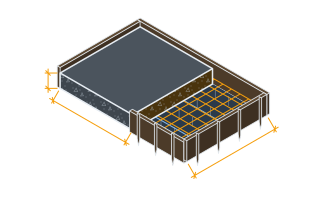
SettingsSettings for this calculationUS
The standard allowance most suppliers and estimating guides assume for ordinary work.
The number of 80 lb bags of pre-mixed concrete you already have.
If your bags are a different size, scale this count by the ratio of volumes first (e.g. a 60 lb bag yields about 0.45 cubic ft, so 60lb-bag-count x 0.75 gives an equivalent 80lb-bag count).
The thickness you plan to pour.
4 in (0.1 m) is standard for a typical residential slab or walkway; footings and structural slabs are often thicker.
Reserve a portion of your material for spillage and an uneven subgrade.
10% is standard — pour surfaces are rarely perfectly flat, so some mix is lost to low spots and spillage.
Maximum slab area pourable
98.2 sq ft pourable
This is a theoretical maximum assuming a perfectly flat, prepared subgrade beyond the waste reserve — an uneven base will reduce the actual area you can cover.
- Usable volume (after waste reserve)
- 32.73 ft³
- Equivalent in square meters
- 9.12 m²
- Total raw volume (no waste reserve)
- 36 ft³
They open the calculator with your figures already in it
Reverse Concrete Slab Solver: 98.18 sq ft pourable — shown in imperial, US market. The link sets both, so the result they see is the one on your screen.
Show calculation logicHide calculation logic
How this was calculated
Formula source(s)
- Inverts the standard concrete volume formula: instead of volume → bags needed, this solves bags on hand → maximum pourable area, using the same 0.6 cubic ft yield per 80 lb bag as the Concrete Calculator.
Inputs used
- 80 lb Bags On Hand
- 60
- Slab Thickness
- 4 in
- Waste Factor (%)
- 10
Intermediate steps
- Usable volume (after waste reserve)
- 32.73 ft³
- Equivalent in square meters
- 9.12 m²
- Total raw volume (no waste reserve)
- 36 ft³
Confidence note: This is a theoretical maximum assuming a perfectly flat, prepared subgrade beyond the waste reserve — an uneven base will reduce the actual area you can cover.
What this calculation does not cover
- This is a quantity solver, not a slab design. It does not check that the thickness you entered is adequate for the load the slab will carry, and it sizes no reinforcement, no control joints and no edge thickening.
- The area is a flat prism of constant thickness. Thickened edges, turndowns, haunches, a footing poured monolithically with the slab, and any fall or crossfall all take mix this model never counts, so your real coverage lands below the figure shown.
- The 0.6 cubic feet (17 litres) per bag is a nominal yield for a full, dry 80 lb (36 kg) bag mixed to the manufacturer's water ratio. Bags that have taken up moisture in storage, part-used bags, over-watered batches, and other bag sizes or brands all yield differently — the count you enter is taken at face value.
- The waste factor is a flat percentage, not a measurement of your base. Ruts, soft spots, over-excavation and a subgrade that has not been compacted and screeded to level can swallow far more than the reserve, and the shortfall shows up at the far end of the pour.
- Nothing here tells you whether you can mix and place that many bags in one session. Bagged mix starts setting as it goes down, so an area this size mixed by hand ends in cold joints between batches unless the crew and mixers keep ahead of it.
Estimated cost — your price
This site holds no price list for this material — local prices vary too much to publish honestly. Enter your supplier's price and the result is costed with it.
Computed in your browser — nothing you enter is uploaded. Presented in US customary units and US trade terminology. Where a formula follows a published standard, that standard and its edition are cited beside it on this page; where none governs, the page says so. Local amendments override model codes — verify against the code in force where you build.
Sources checked 2026-09-02 · in the site-wide review of 2026-09-06 · v1.0.1
Regulatory standards & verification citations1
- Inverts the standard concrete volume formula: instead of volume → bags needed, this solves bags on hand → maximum pourable area, using the same 0.6 cubic ft yield per 80 lb bag as the Concrete Calculator.
Cite this page
Your workspace
Most jobs need more than one number. Add the calculators you need next and they open right here, underneath this one — your figures stay on screen and nothing is lost to a page change.
Tools and safety for this job
To place and finish concrete, erect formwork, fix reinforcement and saw-cut cured concrete. Generic types, no brands, no prices.
Protection this work requires
- Cutting or grinding concrete, masonry, screed, tile or fibre-cement board releases respirable silica: cut wet or extract at the tool, and wear a P2/N95 respirator at minimum — a nuisance dust mask does not filter it.
- Hardwood dust is a recognised carcinogen: extract at the tool and wear a P2/N95 respirator when cutting or sanding indoors.
- Wet cement and lime burn skin and eyes painlessly until the damage is done: waterproof gloves to EN 374, safety glasses whenever the mix can splash, and never kneel in wet mix in permeable trousers.
- Saws, grinders and breakers run above 85 dB, where hearing damage accumulates and does not recover: defenders or plugs for every cut, not just the long ones.
- Breakers and grinders cause permanent nerve damage: limit continuous trigger time, keep hands warm, and stop if fingers tingle or blanch.
- Boards, blocks and bagged material cause most lasting back injuries on small sites: two people or a lifter for full sheets, and never a bag on one shoulder up a ladder.
- Nailing, chiselling and cutting all throw fragments: glasses to EN 166 or ANSI Z87.1, and goggles rather than glasses overhead.
Show the 19 tools this job needsHide tools
Essential
Angle grinder
Bull float and edger
Circular saw
Claw hammer
Dust extractor or vacuum with a fine filter
Screed bar or rail
Shovel and spade
Spirit level
String line and pins
Tape measure
Wheelbarrow
Recommended
Chalk line
Cordless drill/driver
Floor or cut-off saw
Plate compactor
Rebar cutter and bender
Rebar tying tool
SDS rotary hammer
Optional
Power float
Also needed as materials: chalk refill, circular saw blades, cutting and diamond discs, diamond blades, drill and driver bits, SDS bits and chisels, tie wire.
what each concrete tool is for, and the spec that decides which to buy where one does.