
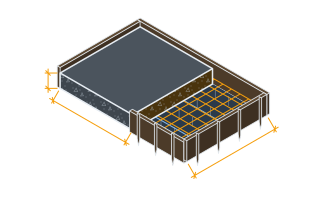
SettingsSettings for this calculationUS
The standard allowance most suppliers and estimating guides assume for ordinary work.
The length of the slab or footing.
Measure the longest straight run of the area you're pouring.
Tools needed: Tape measure, Stakes and string for marking the pour area
The width of the slab or footing.
Measure perpendicular to the length.
Tools needed: Tape measure
How deep the concrete pour is.
4 inches (about 0.1 m) is standard for a patio or walkway. 6 inches (about 0.15 m) is common for a driveway that will carry vehicle weight.
Tools needed: Tape measure, Level
Extra concrete for spillage, uneven subgrade, and forming imprecision.
10% is standard. Order slightly more than the bare minimum — running short mid-pour with concrete already mixed is a serious problem.
Estimated concrete needed
1.358 yd³
- Volume (no waste)
- 1.23 yd³
- Volume with waste factor
- 1.36 yd³
- Cubic feet
- 36.67 ft³
- 80 lb bags needed
- 62 bags
They open the calculator with your figures already in it
Concrete Calculator: 1.36 yd³ — shown in imperial, US market. The link sets both, so the result they see is the one on your screen.
Show calculation logicHide calculation logic
How this was calculated
Formula source(s)
- Standard formula: cubic yards = length (ft) x width (ft) x thickness (ft) / 27
- An 80 lb bag of pre-mixed concrete yields approximately 0.6 cubic feet once mixed
Inputs used
- Slab Length
- 10 ft
- Slab Width
- 10 ft
- Slab Thickness
- 4 in
- Waste Factor (%)
- 10
Intermediate steps
- Volume (no waste)
- 1.23 yd³
- Volume with waste factor
- 1.36 yd³
- Cubic feet
- 36.67 ft³
- 80 lb bags needed
- 62 bags
What this calculation does not cover
- Geometry is one rectangular prism: length x width x a single uniform thickness. Thickened edges, integral footings, haunches, steps, curbs and any non-rectangular outline are not in the figure, and nothing is subtracted for block-outs or openings. Take those off as separate volumes and add them.
- It assumes a flat, compacted subgrade sitting at exactly the depth you entered. Ruts, soft spots, over-excavation and a base that dishes in the middle all take concrete the geometry never sees, and a flat waste percentage is not a measurement of that. On a rough base, check depth across the whole pour rather than trusting the allowance.
- This is a volume take-off, not a structural decision. It accepts whatever thickness you type without sizing it, and says nothing about mix strength, aggregate size, air entrainment, fibre, or rebar and mesh. Slabs carrying vehicles, footings, and anything supporting a structure are a code and engineering question.
- The bag count assumes an 80 lb (36 kg) bag yields about 0.6 cubic feet (17 litres) of mixed concrete, and rounds up to whole bags. Real yield shifts with the product and with how much water goes in, and no other bag size is converted for you.
- The volume is not an order quantity. Ready-mix is sold in fixed increments with a minimum load and its own short-load charges, and concrete left in the drum, the chute or the pump line is not counted. The waste factor covers spillage and forming slop, not the plant's ordering rules.
Estimated cost — your price
This site holds no price list for this material — local prices vary too much to publish honestly. Enter your supplier's price and the result is costed with it.
Part of bigger jobs
This trade is one line of several job takeoffs. Run the whole job and every other trade comes back with it, off the same measurements.
Or plan the space itself: measure it once, doors and windows included, and this figure comes back worked out on that space, with what goes with it.
also measuresRebarConcrete Formwork
also measures12 other trades
also measuresRebarWall Formwork and Shuttering (Form Area, Ties, Wales and Studs for a Poured Wall)Basement Wall Waterproofing Coating CoveragePerimeter Weeping Tile Pipe Segment
also measures19 other trades
also measures24 other trades
also measures25 other trades
Computed in your browser — nothing you enter is uploaded. Presented in US customary units and US trade terminology. Where a formula follows a published standard, that standard and its edition are cited beside it on this page; where none governs, the page says so. Local amendments override model codes — verify against the code in force where you build.
Sources checked 2026-09-02 · in the site-wide review of 2026-09-06 · v1.0.1
Regulatory standards & verification citations2
- Standard formula: cubic yards = length (ft) x width (ft) x thickness (ft) / 27
- An 80 lb bag of pre-mixed concrete yields approximately 0.6 cubic feet once mixed
Cite this page
Your workspace
Most jobs need more than one number. Add the calculators you need next and they open right here, underneath this one — your figures stay on screen and nothing is lost to a page change.
Tools and safety for this job
To place and finish concrete, erect formwork and saw-cut cured concrete. Generic types, no brands, no prices.
Protection this work requires
- Cutting or grinding concrete, masonry, screed, tile or fibre-cement board releases respirable silica: cut wet or extract at the tool, and wear a P2/N95 respirator at minimum — a nuisance dust mask does not filter it.
- Hardwood dust is a recognised carcinogen: extract at the tool and wear a P2/N95 respirator when cutting or sanding indoors.
- Wet cement and lime burn skin and eyes painlessly until the damage is done: waterproof gloves to EN 374, safety glasses whenever the mix can splash, and never kneel in wet mix in permeable trousers.
- Saws, grinders and breakers run above 85 dB, where hearing damage accumulates and does not recover: defenders or plugs for every cut, not just the long ones.
- Breakers and grinders cause permanent nerve damage: limit continuous trigger time, keep hands warm, and stop if fingers tingle or blanch.
- Boards, blocks and bagged material cause most lasting back injuries on small sites: two people or a lifter for full sheets, and never a bag on one shoulder up a ladder.
Show the 17 tools this job needsHide tools
Essential
Angle grinder
Bull float and edger
Circular saw
Claw hammer
Dust extractor or vacuum with a fine filter
Screed bar or rail
Shovel and spade
Spirit level
String line and pins
Tape measure
Wheelbarrow
Recommended
Chalk line
Cordless drill/driver
Floor or cut-off saw
Plate compactor
SDS rotary hammer
Optional
Power float
Also needed as materials: chalk refill, circular saw blades, cutting and diamond discs, diamond blades, drill and driver bits, SDS bits and chisels.
what each concrete tool is for, and the spec that decides which to buy where one does.
Code thresholds this tool can check
Code thresholds this tool can check
Checked for United States. Each check below names the body that published the limit it uses. Switching market re-runs them. This is not a code review and has no official standing.
These checks cover only the specific numeric limits listed below. They are not a complete code review: fire separation, egress, structural capacity and accessibility provisions are outside their scope, and only the handful of local amendments offered in the selector are modelled — your municipality may have others. Passing every check here does not make a design compliant. Final approval rests with your local building authority.
WITHIN LIMIT — Concrete floor slabs on ground: minimum 3.5 in (89 mm) thick.
Slab thickness 4.00 in meets the 3.5 in IRC floor-slab minimum. Expansive soils are handled separately under IRC R403.1.8, and any slab carrying vehicles or point loads should be designed rather than taken from the code minimum.
ICC · IRC R506.1