
SettingsSettings for this calculationUS
The total area to be covered with gravel base.
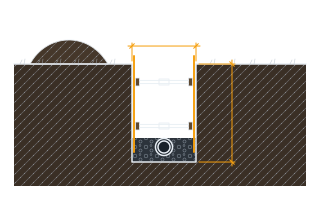
The base is LARGER than what sits on it. A granular base is normally extended past the edge of the paving so that the edge restraint bears on compacted material rather than on the subgrade, and that extension is real area that has to be ordered. Leaving it out under-orders on every job of this kind, and it shows up later as an edge that settles while the middle stays put.
The target compacted thickness of the base layer.
4-8 in (0.1-0.2m) is common for driveways and light-duty pavement bases.
The in-place density of the base once it is compacted.
2,200 kg/m³ (about 137 pcf) is a compacted dense-graded base — crushed stone with its fines, sold as crusher run, DGA, road base or Type 1. Wisconsin DOT converts completed dense-graded base at 1.85 US tons per cubic yard, about 2,195 kg/m³. A clean, open-graded stone with no fines packs far less densely, nearer its loose weight of about 1,550 to 1,650 kg/m³ (97 to 103 pcf): enter the quarry's figure for it.
Gravel base needed
73.8 tons
Actual density varies by material gradation and compaction — confirm with your supplier's specific product density for a precise order quantity.
- Volume
- 39.81 yd³
- Equivalent in US (short) tons
- 73.82 tons
They open the calculator with your figures already in it
Gravel Base Layer Tonnage Calculator: 73.82 tons — shown in imperial, US market. The link sets both, so the result they see is the one on your screen.
Show calculation logicHide calculation logic
How this was calculated
Formula source(s)
- Mass = area x thickness x in-place compacted density
- Wisconsin DOT Standard Specifications for Highway and Structure Construction (2025), §305.4(2): completed in-place dense-graded base converts at 1.85 US tons per cubic yard, about 2,195 kg/m³ (137 pcf)
Inputs used
- Base Area
- 2150 sq ft
- Compacted Thickness
- 6 in
- Compacted Gravel Density
- 137.34 pcf
Intermediate steps
- Volume
- 39.81 yd³
- Equivalent in US (short) tons
- 73.82 tons
Confidence note: Actual density varies by material gradation and compaction — confirm with your supplier's specific product density for a precise order quantity.
What this calculation does not cover
- This is a take-off, not a pavement design. It multiplies out whatever compacted thickness you enter; nothing here derives that depth from traffic loading, subgrade strength, drainage or frost depth, which come from a pavement design or your local road authority's standard.
- Geometry is a flat plan area at one uniform depth. Crown and cross-fall, a formation that steps between thicknesses, a dig that deepens where the subgrade was soft, and edge thickening or haunching at the perimeter all fall outside area x thickness.
- No waste, spillage or subgrade-loss allowance is applied. The figure is the exact in-place mass, so stone lost into a soft or uneven formation, over-excavation, haul and spread losses, and the tail end of a part-load all sit on top of it.
- The density field is an in-place compacted density. A supplier's loose bulk density and a weighbridge ticket carrying free moisture are different quantities, and substituting either moves the tonnage: the wetter the delivered material, the less dry stone a given delivered weight puts on the ground.
- It covers one layer of one material. A base and sub-base of different gradations, a bedding or blinding course, and the geotextile or separation membrane between stone and subgrade are not counted here.
Estimated cost — your price
This site holds no price list for this material — local prices vary too much to publish honestly. Enter your supplier's price and the result is costed with it.
Part of bigger jobs
This trade is one line of several job takeoffs. Run the whole job and every other trade comes back with it, off the same measurements.
also measuresRetaining Wall BlockRetaining Wall Drainage GravelGeogrid Reinforcement Layer Count
also measures12 other trades
also measures19 other trades
also measures24 other trades
also measures24 other trades
Computed in your browser — nothing you enter is uploaded. Presented in US customary units and US trade terminology. Where a formula follows a published standard, that standard and its edition are cited beside it on this page; where none governs, the page says so. Local amendments override model codes — verify against the code in force where you build.
Sources checked 2026-09-02 · in the site-wide review of 2026-09-06 · v1.1.1
Regulatory standards & verification citations2
- Mass = area x thickness x in-place compacted density
- Wisconsin DOT Standard Specifications for Highway and Structure Construction (2025), §305.4(2): completed in-place dense-graded base converts at 1.85 US tons per cubic yard, about 2,195 kg/m³ (137 pcf)
Cite this page
Your workspace
Most jobs need more than one number. Add the calculators you need next and they open right here, underneath this one — your figures stay on screen and nothing is lost to a page change.
Tools and safety for this job
To lay and compact the hardcore. Generic types, no brands, no prices.
Protection this work requires
- Saws, grinders and breakers run above 85 dB, where hearing damage accumulates and does not recover: defenders or plugs for every cut, not just the long ones.
- Breakers and grinders cause permanent nerve damage: limit continuous trigger time, keep hands warm, and stop if fingers tingle or blanch.
- Boards, blocks and bagged material cause most lasting back injuries on small sites: two people or a lifter for full sheets, and never a bag on one shoulder up a ladder.
Show the 4 tools this job needsHide tools
Essential
Plate compactor
Shovel and spade
Wheelbarrow
Recommended
Laser level
what each groundwork tool is for, and the spec that decides which to buy where one does.