
SettingsSettings for this calculationUS
The standard allowance most suppliers and estimating guides assume for ordinary work.
The total length of the retaining wall.
Use the same length as the Retaining Wall Block Calculator.
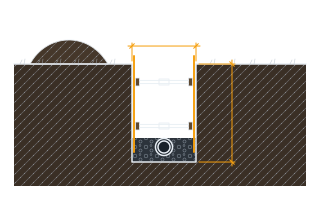
The full height of the drainage zone — top of wall down to the base course, buried courses included.
This is not the EXPOSED height. The drainage gravel runs the full height behind the wall, down to the base, so a wall with buried courses needs those courses counted here or the gravel comes up short by exactly the embedment — commonly a tenth of the wall on a segmental block job, and it is the bottom of the zone that has to drain.
The thickness of the gravel backfill zone directly behind the wall.
12 in (30 cm) is a commonly recommended minimum drainage zone width for segmental retaining walls.
Extra stone for what spills from the barrow and what settles as it is placed in lifts.
Clean angular stone settles a little as it is placed and tamped behind the wall, and some always ends up in front of it. An excavation cut wider than the zone width you entered takes the difference on top of this, so measure the cut rather than raising the allowance to cover it.
Drainage gravel needed
7.82 yd³
This estimates the gravel backfill zone only — it doesn't include the base/leveling gravel beneath the first course, which the Retaining Wall Block Calculator's related base prep may separately account for.
- Drainage zone volume (before waste)
- 7.11 yd³
They open the calculator with your figures already in it
Retaining Wall Drainage Gravel Calculator: 7.82 yd³ — shown in imperial, US market. The link sets both, so the result they see is the one on your screen.
Show calculation logicHide calculation logic
How this was calculated
Formula source(s)
- Drainage zone volume = wall length x wall height x drainage zone width
Inputs used
- Wall Length
- 49 ft
- Wall Height
- 4 ft
- Drainage Zone Width
- 11.75 in
- Spillage and Settlement Allowance (%)
- 10
Intermediate steps
- Drainage zone volume (before waste)
- 7.11 yd³
Confidence note: This estimates the gravel backfill zone only — it doesn't include the base/leveling gravel beneath the first course, which the Retaining Wall Block Calculator's related base prep may separately account for.
What this calculation does not cover
- Fills a gravel zone at whatever height you type, including heights past what an unreinforced segmental wall can hold. Above roughly 4 ft (1.2 m) of exposed wall, or at any height with a slope, a driveway or a structure loading the ground behind it, the wall wants an engineered design with geogrid — and geogrid layers reach several feet back into compacted structural fill, a different material in a far larger volume than the 12 in (305 mm) stone chimney costed here.
- The zone only keeps draining if silt is kept out of it. With no filter fabric between the drainage stone and the retained soil, fines wash into the voids over a few seasons and the stone locks up; a clogged zone holds water exactly as if there were no zone at all, and from the outside the failed wall looks like one that was built with drainage. That fabric runs roughly the area of the wall's back face and is not counted here.
Estimated cost — your price
This site holds no price list for this material — local prices vary too much to publish honestly. Enter your supplier's price and the result is costed with it.
Part of bigger jobs
This trade is one line of a job takeoff. Run the whole job and every other trade comes back with it, off the same measurements.
Or plan the space itself: measure it once, doors and windows included, and this figure comes back worked out on that space, with what goes with it.
Computed in your browser — nothing you enter is uploaded. Presented in US customary units and US trade terminology. Where a formula follows a published standard, that standard and its edition are cited beside it on this page; where none governs, the page says so. Local amendments override model codes — verify against the code in force where you build.
Sources checked 2026-09-17 · v1.1.0
Regulatory standards & verification citations1
- Drainage zone volume = wall length x wall height x drainage zone width
Cite this page
Your workspace
Most jobs need more than one number. Add the calculators you need next and they open right here, underneath this one — your figures stay on screen and nothing is lost to a page change.
Tools and safety for this job
To lay the drainage behind a retaining wall. Generic types, no brands, no prices.
Protection this work requires
- Boards, blocks and bagged material cause most lasting back injuries on small sites: two people or a lifter for full sheets, and never a bag on one shoulder up a ladder.
- Knives cause more site injuries than any power tool: cut away from your body, change blades often, and wear cut-resistant gloves to EN 388 level C for repeated cutting.
Lay the drainage behind a retaining wall: The drainage a retaining wall needs (how deep the stone goes behind it, whether it is wrapped in fabric, the pipe at its foot and where the water goes) is part of the wall's design, from the block maker's guide or an engineer, and this site never designs it. A wall that holds back more ground than the maker's guide covers is an engineer's to design before anything is built.
Show the 4 tools this job needsHide tools
Essential
Shovel and spade
Wheelbarrow
Recommended
Spirit level
Utility knife
Also needed as materials: replacement blades.
what each landscaping tool is for, and the spec that decides which to buy where one does.