
SettingsSettings for this calculationUS
The total length of the drain trench.
Measure along the planned trench path, including any bends.
The width of the trench, typically wide enough to work in comfortably.
12 in (30 cm) is a common minimum width for hand-digging and placing pipe.
The depth of the trench, below the frost line in cold climates if the drain must run year-round.
18-24 in (46-61 cm) is typical for a residential yard drain.
The outer diameter of the perforated drain pipe.
4 in (10 cm) perforated pipe is the most common size for residential French drains.
Gravel backfill needed
2.758 yd³
- Trench volume
- 2.67 yd³
- Pipe volume (subtracted)
- 0.16 yd³
They open the calculator with your figures already in it
French Drain Gravel Calculator: 2.76 yd³ — shown in imperial, US market. The link sets both, so the result they see is the one on your screen.
Show calculation logicHide calculation logic
How this was calculated
Formula source(s)
- Trench volume = length x width x depth; the perforated pipe's own volume (length x pi x radius²) is subtracted since gravel doesn't fill the space the pipe itself occupies
- 10% waste is standard for gravel to account for trench irregularities and settling
Inputs used
- Trench Length
- 49 ft
- Trench Width
- 11.75 in
- Trench Depth
- 18 in
- Drain Pipe Diameter
- 4 in
Intermediate steps
- Trench volume
- 2.67 yd³
- Pipe volume (subtracted)
- 0.16 yd³
What this calculation does not cover
- The trench is modelled as a constant-depth rectangular prism, so a run laid to fall is only covered if the depth entered is the average depth over the whole length. A 15 m (49 ft) run at the usual 1 per cent fall finishes 150 mm (6 in) deeper than it starts, and a trench entered at its shallow upstream depth actually holds about 16 per cent more gravel than the figure returned.
- Gravel is taken as filling the trench to the full depth entered, from the trench floor to ground level. Any soil or turf cap placed over the stone has to come off the depth before it is entered — a 100 mm (4 in) topsoil cap on a 460 mm (18 in) trench is more than a fifth of the volume this page returns.
- The answer is a volume, not a tonnage, and the 10 per cent added covers ragged trench walls and settlement rather than compaction to a stated density. A quarry weighs stone out rather than measuring it, so converting needs the bulk density of the material actually supplied; clean drainage gravel is commonly quoted near 1.5 tonnes (1.7 tons) per cubic metre, which puts the default 2.81 yd³ order at roughly 3.2 tonnes (3.5 tons).
- No check is made that the pipe fits the trench. A 200 mm (8 in) pipe entered against a 100 mm (4 in) trench width is accepted and answered normally at 0.31 yd³, and where the pipe would displace more than the trench holds, the result is floored at zero rather than reported as impossible geometry.
- Pipe diameter enters this calculation only as displaced gravel, never as capacity. Whether the drain carries the water depends on the catchment area feeding it, rainfall intensity, the gradient and the infiltration rate of the surrounding soil — stepping from a 100 mm to a 150 mm pipe over 15 m moves this order by about 0.21 yd³ and settles none of those questions.
Estimated cost — your price
This site holds no price list for this material — local prices vary too much to publish honestly. Enter your supplier's price and the result is costed with it.
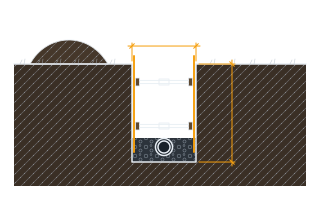
The pipe is drawn to scale inside the trench, because the gravel quantity above is the trench volume minus that circle. On a narrow trench with a big pipe the subtraction is a large share of the answer, and this is where you see that.
Computed in your browser — nothing you enter is uploaded. Presented in US customary units and US trade terminology. Where a formula follows a published standard, that standard and its edition are cited beside it on this page; where none governs, the page says so. Local amendments override model codes — verify against the code in force where you build.
Sources checked 2026-09-02 · in the site-wide review of 2026-09-06 · v1.0.1
Regulatory standards & verification citations2
- Trench volume = length x width x depth; the perforated pipe's own volume (length x pi x radius²) is subtracted since gravel doesn't fill the space the pipe itself occupies
- 10% waste is standard for gravel to account for trench irregularities and settling
Cite this page
Your workspace
Most jobs need more than one number. Add the calculators you need next and they open right here, underneath this one — your figures stay on screen and nothing is lost to a page change.
Tools and safety for this job
To cut and join plastic pipe. Generic types, no brands, no prices.
Protection this work requires
- Knives cause more site injuries than any power tool: cut away from your body, change blades often, and wear cut-resistant gloves to EN 388 level C for repeated cutting.
Cut and join plastic pipe: Push-fit and solvent-weld plumbing is within reach of a competent DIYer. The regulated parts of the system — gas, unvented hot water, and anything notifiable — are not, whatever tools are to hand.
Show the 3 tools this job needsHide tools
Essential
Plastic pipe shears
Tape measure
Recommended
Deburring tool and wire wool
what each plumbing tool is for, and the spec that decides which to buy where one does.