
SettingsSettings for this calculationUS
The pipe's inside diameter, not the nominal or outside size.
Nominal pipe sizes (e.g. '3/4 inch pipe') don't always match the actual inside diameter exactly — check your pipe's specification sheet for precision, especially for larger commercial pipe.
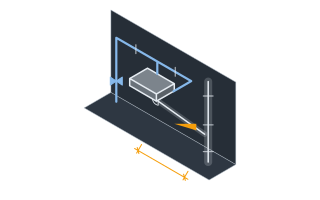
The total length of pipe run.
Measure or add up the total run length, including vertical sections.
Tools needed: Tape measure
Estimated pipe volume needed
0.7573 gallons
- Volume (liters)
- 2.87 liters
- Volume (in³)
- 174.95 in³
They open the calculator with your figures already in it
Pipe Volume Calculator: 0.7573 gallons — shown in imperial, US market. The link sets both, so the result they see is the one on your screen.
Show calculation logicHide calculation logic
How this was calculated
Formula source(s)
- Standard cylinder volume formula: V = pi x r² x length
Inputs used
- Inside Diameter
- 0.75 in
- Pipe Length
- 33 ft
Intermediate steps
- Volume (liters)
- 2.87 liters
- Volume (in³)
- 174.95 in³
What this calculation does not cover
- The figure is the contents of a straight bore and nothing else. Fittings, valve bodies, meters, strainers and any water standing in a cylinder or tank at the end of the run are not counted, and the pipe wall is excluded — so this is not the volume of pipe material, and not the space the pipe occupies in a chase or trench.
- Volume scales with the square of the bore, so an inside diameter that is 9 per cent out produces a volume 19 per cent out. Published inside diameters differ by material, schedule and class for the same nominal size, and the calculator takes whatever figure you type at face value — it has no way of knowing that a half-inch pipe was entered at half an inch.
- It assumes the run is completely full of liquid over its whole length. Gravity drains, waste stacks and sewers are designed to flow part full, and a system that has not been purged holds air at its high points, so both contain less than this number says.
- It answers how much the run holds, not how long the wait is. Turning that volume into a hot-water delay needs the fixture's flow rate as well, and the real delay runs longer because the first hot water gives up heat to the pipe wall and to whatever surrounds it. No time calculation happens on this page.
- Nothing here is a sizing or a support check. Velocity, friction loss and pressure drop are separate calculations, and a long run that holds a comfortable volume can still be too small to deliver flow. The contents also weigh whatever that volume of water weighs, which bears on hanger spacing and is not assessed.
Estimated cost — your price
This site holds no price list for this material — local prices vary too much to publish honestly. Enter your supplier's price and the result is costed with it.
Computed in your browser — nothing you enter is uploaded. Presented in US customary units and US trade terminology. Where a formula follows a published standard, that standard and its edition are cited beside it on this page; where none governs, the page says so. Local amendments override model codes — verify against the code in force where you build.
Sources checked 2026-09-02 · in the site-wide review of 2026-09-06 · v1.0.1
Regulatory standards & verification citations1
- Standard cylinder volume formula: V = pi x r² x length
Cite this page
Your workspace
Most jobs need more than one number. Add the calculators you need next and they open right here, underneath this one — your figures stay on screen and nothing is lost to a page change.
Tools and safety for this job
To cut and prepare copper pipe and cut and join plastic pipe. Generic types, no brands, no prices.
Protection this work requires
- Knives cause more site injuries than any power tool: cut away from your body, change blades often, and wear cut-resistant gloves to EN 388 level C for repeated cutting.
Cut and prepare copper pipe: Cutting and joining pipe is within reach of a competent DIYer; the system it joins may not be. Work on a gas supply, an unvented cylinder, or a sealed heating system is restricted to a registered installer in most markets, and a tool list is not a qualification.
Cut and join plastic pipe: Push-fit and solvent-weld plumbing is within reach of a competent DIYer. The regulated parts of the system — gas, unvented hot water, and anything notifiable — are not, whatever tools are to hand.
Show the 5 tools this job needsHide tools
Essential
Copper pipe cutter
Deburring tool and wire wool
Plastic pipe shears
Tape measure
Recommended
Adjustable spanner and grips
Also needed as materials: cutting wheels.
what each plumbing tool is for, and the spec that decides which to buy where one does.