
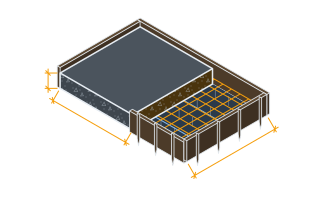
SettingsSettings for this calculationUS
The total length of the curb-and-gutter run.
Measure the full length of the roadway edge the combined curb-and-gutter section will follow.
The vertical height of the curb face above the gutter.
The EXPOSED face only — the part standing above the gutter line. What continues below it is buried and belongs to the section's own thickness rather than to this. Face height is not a free choice either: it is set by the crossfall and by the flow the channel has to carry, and reducing it to save concrete reduces the capacity of the gutter at the same time.
The thickness of the curb section itself.
Measured through the curb, front to back. On a combined curb and gutter this is where most of the concrete actually is, and it is set by the mould or the form rather than chosen — an extruded profile is whatever the machine makes, and a cast one is whatever the formwork was built for. Check it against the profile drawing rather than scaling it off a section.
The full width of the gutter pan, measured from the BACK of the curb across the pan — not from the curb face.
The cross-section is taken as the curb block plus a pan of this width at the pan thickness, and those two rectangles have to tile the section without a gap. Measuring the pan from the curb FACE leaves the block of concrete underneath the curb out of the take-off entirely, which on a standard 150 mm curb over a 600 mm pan is around a fifth of the pour. Take the dimension off the section detail from the back of the curb, the way the formwork is set out.
The thickness of the gutter pan slab.
The pan, which is the part vehicles cross. That is what governs it: a gutter thick enough for water is not necessarily thick enough for a wheel, and the usual answer is to thicken the pan locally at crossings rather than to carry a heavy section along the whole run. Thickening everything to suit a few accesses is a large amount of concrete bought for a small length of road.
Curb and gutter concrete volume
7.639 yd³
- Combined cross-sectional area
- 1.25 sq ft
They open the calculator with your figures already in it
Concrete Curb and Gutter Volume Calculator: 7.64 yd³ — shown in imperial, US market. The link sets both, so the result they see is the one on your screen.
Show calculation logicHide calculation logic
How this was calculated
Formula source(s)
- Combined cross-sectional area = (curb height × curb width) + (gutter width × gutter thickness); volume = run length × combined cross-sectional area
Inputs used
- Total Run Length
- 165 ft
- Curb Height
- 0.5 ft
- Curb Width
- 0.5 ft
- Gutter Width
- 2 ft
- Gutter Thickness
- 0.5 ft
Intermediate steps
- Combined cross-sectional area
- 1.25 sq ft
What this calculation does not cover
- Carries no allowance for what the ground takes. The section is placed on a trimmed subgrade, and over-excavation, a soft spot, or a trimmed line running 10 mm (0.39 in) low along the whole job all add concrete that no theoretical cross-section contains. Ordering the calculated volume for a continuous pour is how a run comes up short, and a short load part-way along a curb line leaves a cold joint that stays visible.
- The concrete only. The compacted granular base under the section, the tie bars or dowels at construction joints, and the filler at expansion joints are all taken off this same run length and are the items most often left off the order — the base course alone is often as large a volume as the concrete sitting on it.
Estimated cost — your price
This site holds no price list for this material — local prices vary too much to publish honestly. Enter your supplier's price and the result is costed with it.
Computed in your browser — nothing you enter is uploaded. Presented in US customary units and US trade terminology. Where a formula follows a published standard, that standard and its edition are cited beside it on this page; where none governs, the page says so. Local amendments override model codes — verify against the code in force where you build.
Sources checked 2026-09-06 · in the site-wide review of 2026-09-06 · v1.0.1
Regulatory standards & verification citations1
- Combined cross-sectional area = (curb height × curb width) + (gutter width × gutter thickness); volume = run length × combined cross-sectional area
Cite this page
Your workspace
Most jobs need more than one number. Add the calculators you need next and they open right here, underneath this one — your figures stay on screen and nothing is lost to a page change.