
SettingsSettings for this calculationUS
The total area of the ICF wall to be built.
Measure the total face area of the wall, including openings if you plan to cut blocks on site rather than order pre-cut units.
The face coverage area of a single ICF block — a standard 16 × 48 in form covers 5.33 sq ft, about 0.495 m².
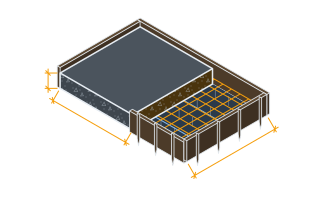
Most flat-wall ICF systems use a 16 in tall by 48 in long form, which covers 5.33 sq ft (0.4955 m²) of wall per block. Larger forms exist — Nudura's standard unit is 18 in by 96 in, or 12 sq ft (1.11 m²) — and half-height units cover roughly half a standard block, so confirm the coverage figure from your product's data sheet.
ICF blocks needed
122 blocks
They open the calculator with your figures already in it
Insulated Concrete Form (ICF) Block Count Calculator: 122 blocks — shown in imperial, US market. The link sets both, so the result they see is the one on your screen.
Show calculation logicHide calculation logic
How this was calculated
Formula source(s)
- Block count = ceil(wall area ÷ single block coverage area), the same coverage method used for CMU block, applied to the standard flat-wall ICF form size of 16 in × 48 in — 5.33 sq ft (0.4955 m²) of wall face per block
Inputs used
- Wall Area
- 650 sq ft
- Single Block Coverage Area (per Manufacturer)
- 5.33 sq ft
What this calculation does not cover
- Walls are built in whole courses, and an area division cannot see them. Standard forms stack at 16 in, so a 2.6 m wall is 6.4 courses — you either build seven and cut the top or bring in half-height units, and each choice changes the order. Set wall height against course height first; pour lifts and the horizontal rebar layout follow the same courses.
- Straight blocks alone will not build a corner. Corner forms are a separate item counted per corner per course rather than by area, and any brick-ledge, taper-top or T-form for an intersecting wall is separate again — those specials are also the long-lead part of an ICF order. Count corners × wall height ÷ course height and order them alongside the straight count above.
- The blocks are formwork, not the wall. What fills them is set by core thickness — a 152 mm core takes about 0.15 m³ (0.20 yd³) of concrete per square meter of wall and a 203 mm core about 0.20, so an identical block count can differ by a third in concrete — and on top of that sit the vertical and horizontal reinforcement, and the alignment bracing and working platform, which are hired by the linear meter of wall rather than by the block.
Estimated cost — your price
This site holds no price list for this material — local prices vary too much to publish honestly. Enter your supplier's price and the result is costed with it.
Computed in your browser — nothing you enter is uploaded. Presented in US customary units and US trade terminology. Where a formula follows a published standard, that standard and its edition are cited beside it on this page; where none governs, the page says so. Local amendments override model codes — verify against the code in force where you build.
Sources checked 2026-09-06 · in the site-wide review of 2026-09-06 · v1.2.1
Regulatory standards & verification citations1
- Block count = ceil(wall area ÷ single block coverage area), the same coverage method used for CMU block, applied to the standard flat-wall ICF form size of 16 in × 48 in — 5.33 sq ft (0.4955 m²) of wall face per block
Cite this page
Your workspace
Most jobs need more than one number. Add the calculators you need next and they open right here, underneath this one — your figures stay on screen and nothing is lost to a page change.
Tools and safety for this job
To lay block. Generic types, no brands, no prices.
Protection this work requires
- Cutting or grinding concrete, masonry, screed, tile or fibre-cement board releases respirable silica: cut wet or extract at the tool, and wear a P2/N95 respirator at minimum — a nuisance dust mask does not filter it.
- Wet cement and lime burn skin and eyes painlessly until the damage is done: waterproof gloves to EN 374, safety glasses whenever the mix can splash, and never kneel in wet mix in permeable trousers.
- Boards, blocks and bagged material cause most lasting back injuries on small sites: two people or a lifter for full sheets, and never a bag on one shoulder up a ladder.
Show the 6 tools this job needsHide tools
Essential
Brick trowel and jointer
Spirit level
String line and pins
Wheelbarrow
Recommended
Block splitter
Cement mixer
what each masonry tool is for, and the spec that decides which to buy where one does.