
SettingsSettings for this calculationUS
Waste is set to 5% by hand. Pick a tier above to replace it, or keep your own figure.
The length of the CMU wall.
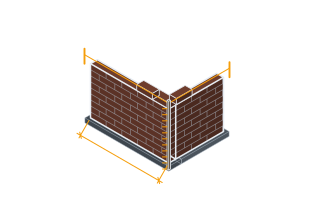
Along the face of the wall, end to end, measured on the course you are laying rather than off a drawing's centreline — a 200 mm wall differs from its centreline by 200 mm at every corner. Where the wall turns, run one leg to the outside corner and stop the other at the face of the first. Openings are not deducted: the count is gross, and the waste allowance below is for cuts and breakage, not for a door.
The height of the CMU wall.
From the top of the footing or slab the first course beds on, to the top of the last course — not to the underside of the plate, and not to a soffit. A partly grouted top course is still a course and still takes blocks; what changes is the grouted cell fraction, not this. If the wall steps with the site, work each step as its own run: one average height across a stepped wall under-counts the tall end, and the tall end is the one that runs out.
The actual (not nominal) face length of your CMU block.
15.625 in is standard for a nominal 16 in (8x8x16) CMU block with a 3/8 in joint.
The actual (not nominal) face height of your CMU block.
7.625 in is standard for a nominal 8 in high CMU block.
The mortar joint thickness between blocks.
3/8 in (0.375 in) is standard for CMU construction.
Extra blocks for cuts and breakage.
Five per cent covers a straightforward rectangular wall on a flat site. Push it up for many openings, short returns or a rake — every cut is a whole block off the pallet and the offcut is rarely the size the next cut needs. Push it up again where access is awkward, because damage on site is the part of waste nobody budgets for. It covers cuts and breakage only, and no allowance substitutes for measuring the wall.
The hollow cavity volume per block, from the manufacturer's spec sheet.
8.5 L is a reasonable estimate for a standard 8x8x16 in two-cell CMU — check your specific product for an accurate value.
The percentage of cells that will be filled with grout.
100% for fully grouted reinforced walls; lower for partially grouted walls where only reinforced cells are filled (e.g. every other cell).
Courses laid in bond-beam units and grouted solid, within the wall height above.
Count courses, not beams: a beam two units deep is two courses. They stay inside the block count, one row of units per course at the wall length divided by the nominal block length, rounded up, and every one of them is grouted solid whatever the grouted cell fraction, because a bond beam is filled along its whole length. An entry above the whole courses the wall height holds is cut to that number, and the breakdown says so. Leave it at 0 for a wall with no bond beams, or where you count them on the bond beam block page instead.
CMU blocks needed
185 blocks
Grout volume assumes uniform void geometry across all cells — face-shell-bedded (ungrouted) cells and webs reduce the actual grout consumption if only some cells are filled.
- Wall area
- 156 sq ft
- Coverage rate (from your dimensions)
- 1.12 blocks/sq ft
- Grout volume needed
- 394.87 gal
- Mortar volume (face-shell bedding, joints only, no waste)
- 16.83 gal
They open the calculator with your figures already in it
Concrete CMU Block Counter & Grout Infill Calculator: 185 blocks — shown in imperial, US market. The link sets both, so the result they see is the one on your screen.
Show calculation logicHide calculation logic
How this was calculated
Formula source(s)
- Block coverage rate is derived geometrically from nominal face dimensions (actual block size + mortar joint width), the same dynamic method used by the Brick Calculator, rather than a single fixed rate
- Grout volume = block count before waste x void volume per block (a whole block, not one cell) x grouted cell fraction as a decimal, i.e. the percentage you enter divided by 100, for reinforced CMU construction. Block count before waste is the breakdown's wall area multiplied by its coverage rate; wall height carries no separate term because it is already inside the wall area. Bond-beam units (wall length / nominal block length, rounded up, x bond-beam courses) are taken out of that count and grouted solid at the same void volume, whatever the fraction.
- Face-shell mortar bedding: mortar on the two face shells only, in the bed joints and the head joints (NCMA TEK 4-2A, Estimating Concrete Masonry Materials, 2004, whose rules of thumb assume it). Face shell taken as 32 mm (1¼ in), ASTM C90's minimum for units 8 in (203 mm) nominal and wider. The same TEK's Table 2 rules, which include nominal waste, are given in bags and in sand rather than as a mortar volume: one 80 lb (36.3 kg) bag of preblended mortar for about 16 conventional units, or 4½ ft³ (0.13 m³) of sand for about 46 units of Type S site-mixed mortar. The 0.66 ft³ (19 L) bag yield in the same TEK belongs to its preblended GROUT tables (Tables 4 and 5), used here only for the bond-beam limitation.
Inputs used
- Wall Length
- 19.5 ft
- Wall Height
- 8 ft
- Block Actual Face Length
- 15.63 in
- Block Actual Face Height
- 7.63 in
- Mortar Joint Width
- 0.38 in
- Waste Factor (%)
- 5
- Void Volume per Block
- 2.25 gal
- Grouted Cell Fraction (%)
- 100
- Bond-Beam Courses
- 0
Intermediate steps
- Wall area
- 156 sq ft
- Coverage rate (from your dimensions)
- 1.12 blocks/sq ft
- Grout volume needed
- 394.87 gal
- Mortar volume (face-shell bedding, joints only, no waste)
- 16.83 gal
Confidence note: Grout volume assumes uniform void geometry across all cells — face-shell-bedded (ungrouted) cells and webs reduce the actual grout consumption if only some cells are filled.
What this calculation does not cover
- Block count is gross wall area divided by one block's nominal face. Openings are not deducted, and nothing is set aside for the half, corner, lintel or sash units a real course layout needs. Bond-beam courses you enter are named inside the count, not added to it, and cut to the whole courses the wall height holds: a 2.4 m (7 ft 10½ in) wall of 8 in (203 mm) courses holds 11. Every other block is a plain stretcher.
- The grout figure is the theoretical void volume with no waste allowance of any kind. Mortar squeezing into the cells reduces it; spillage, overpour, cleanout blocks and lintel courses filled solid increase it. The waste factor you enter moves the block count only, never the grout.
- Grouted cell fraction is applied as a flat percentage of the void volume of every block that is not in a bond-beam course. It does not know which cells your drawings call for or where the vertical bars land — a 50% entry is an average, not a layout. Bond-beam courses are grouted solid only if you enter them; at 0 a partially grouted wall's bond beams are grouted at the same fraction as everything else.
- One void volume is applied to every block in the wall, bond-beam units included. A knock-out bond-beam unit holds more than a stretcher's cores, because the webs are cut down to form the channel: NCMA's preblended-grout yield for an 8 in (203 mm) bond beam, 2.0 ft (0.61 m) of beam per 80 lb (36.3 kg) bag of about 0.66 ft³ (19 L), is about 12.5 L (0.44 ft³) a unit against the 8.5 L (0.30 ft³) default, so the bond-beam share is a floor. Mixed units in the same wall — a thicker base course, half-high or solid bottom units, two-core against three-core block — are not handled; run those areas separately.
- The mortar row is the joint volume only: bed and head joints on the two face shells, at the joint width you enter and a fixed face shell of 32 mm (1¼ in), for the blocks before waste. It is not an order. Beds spread wider than the shell, mortar lost into the cores, droppings and mixer tails all come on top. NCMA TEK 4-2A's site-mixed rules of thumb, 4¼ to 4½ ft³ (0.12 to 0.13 m³) of sand for 46 to 62 units and a ton (907 kg) of sand for 240, come to about 2 to 3 L (0.07 to 0.1 ft³) of sand a block, and a batch yields roughly its sand volume in mortar: about five to eight times this row at the default joint. Its preblended rule, one 80 lb (36.3 kg) bag for about 16 units, is given in bags, not volume. A first course in full bedding, and any wall laid with the webs mortared, take more again.
- This is a quantity take-off, not a masonry design. Which cells must be grouted, the grout strength and lift height, the reinforcement, and whether the wall carries its load all come from the structural drawings and the governing masonry code. Nothing here checks any of them.
Estimated cost — your price
This site holds no price list for this material — local prices vary too much to publish honestly. Enter your supplier's price and the result is costed with it.
Part of bigger jobs
This trade is one line of several job takeoffs. Run the whole job and every other trade comes back with it, off the same measurements.
also measures18 other trades
also measuresCavity Wall Weep Hole SpacingBrickBrick Veneer Anchor SpacingBrick Movement Joint Spacing
also measures19 other trades
also measures24 other trades
Computed in your browser — nothing you enter is uploaded. Presented in US customary units and US trade terminology. Where a formula follows a published standard, that standard and its edition are cited beside it on this page; where none governs, the page says so. Local amendments override model codes — verify against the code in force where you build.
Sources checked 2026-09-26 · v1.2.0
Regulatory standards & verification citations3
- Block coverage rate is derived geometrically from nominal face dimensions (actual block size + mortar joint width), the same dynamic method used by the Brick Calculator, rather than a single fixed rate
- Grout volume = block count before waste x void volume per block (a whole block, not one cell) x grouted cell fraction as a decimal, i.e. the percentage you enter divided by 100, for reinforced CMU construction. Block count before waste is the breakdown's wall area multiplied by its coverage rate; wall height carries no separate term because it is already inside the wall area. Bond-beam units (wall length / nominal block length, rounded up, x bond-beam courses) are taken out of that count and grouted solid at the same void volume, whatever the fraction.
- Face-shell mortar bedding: mortar on the two face shells only, in the bed joints and the head joints (NCMA TEK 4-2A, Estimating Concrete Masonry Materials, 2004, whose rules of thumb assume it). Face shell taken as 32 mm (1¼ in), ASTM C90's minimum for units 8 in (203 mm) nominal and wider. The same TEK's Table 2 rules, which include nominal waste, are given in bags and in sand rather than as a mortar volume: one 80 lb (36.3 kg) bag of preblended mortar for about 16 conventional units, or 4½ ft³ (0.13 m³) of sand for about 46 units of Type S site-mixed mortar. The 0.66 ft³ (19 L) bag yield in the same TEK belongs to its preblended GROUT tables (Tables 4 and 5), used here only for the bond-beam limitation.
Which documents these citations point at
Standards referenced: ASTM C90 (ASTM International, United States).
Cite this page
Your workspace
Most jobs need more than one number. Add the calculators you need next and they open right here, underneath this one — your figures stay on screen and nothing is lost to a page change.
Tools and safety for this job
To lay block and mix mortar. Generic types, no brands, no prices.
Protection this work requires
- Cutting or grinding concrete, masonry, screed, tile or fibre-cement board releases respirable silica: cut wet or extract at the tool, and wear a P2/N95 respirator at minimum — a nuisance dust mask does not filter it.
- Wet cement and lime burn skin and eyes painlessly until the damage is done: waterproof gloves to EN 374, safety glasses whenever the mix can splash, and never kneel in wet mix in permeable trousers.
- Boards, blocks and bagged material cause most lasting back injuries on small sites: two people or a lifter for full sheets, and never a bag on one shoulder up a ladder.
Show the 8 tools this job needsHide tools
Essential
Brick trowel and jointer
Shovel and spade
Spirit level
String line and pins
Wheelbarrow
Recommended
Block splitter
Cement mixer
Mixing bucket or tub
what each masonry tool is for, and the spec that decides which to buy where one does.