
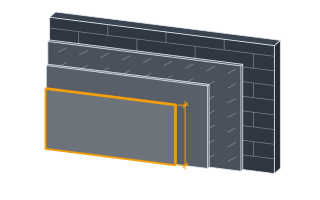
SettingsSettings for this calculationUS
The total wall area to receive the 3-coat stucco system.
Measure the actual substrate area that will be plastered, excluding openings.
The applied thickness of the first (scratch) coat.
The scratch coat keys into the lath or masonry substrate and is typically the thickest of the three coats.
The applied thickness of the second (brown) leveling coat.
The brown coat true's up the wall plane before the finish coat is applied.
The applied thickness of the final texture/finish coat.
The finish coat is thin and provides the final texture and color, so it uses far less material than the scratch or brown coats.
The wet density of the mixed stucco material.
A portland cement stucco mix commonly weighs around 1800 kg/m³; check your specific product's data sheet for an exact figure.
Total stucco mass needed
4,541 lb
- Total plaster volume
- 1.5 yd³
- Combined coat thickness
- 0.9 in
They open the calculator with your figures already in it
Traditional 3-Coat Stucco Plaster Volume & Mass Calculator: 4,541 lb — shown in imperial, US market. The link sets both, so the result they see is the one on your screen.
Show calculation logicHide calculation logic
How this was calculated
Formula source(s)
- 3-coat stucco system volume = wall area × combined coat thickness (scratch + brown + finish); mass = volume × stucco mix density (commonly ~1800 kg/m³ for a portland cement stucco mix)
Inputs used
- Wall Area
- 540 sq ft
- Scratch Coat Thickness
- 0.39 in
- Brown Coat Thickness
- 0.39 in
- Finish Coat Thickness
- 0.12 in
- Stucco Mix Density
- 112.37 pcf
Intermediate steps
- Total plaster volume
- 1.5 yd³
- Combined coat thickness
- 0.9 in
What this calculation does not cover
- The thickness fields will accept a system thinner than the standard allows. ASTM C926 sets nominal totals by substrate — about 22 mm (7/8 in) over metal lath, 16 mm (5/8 in) over unit masonry, 12 mm (1/2 in) over cast concrete — and a three-coat build of the kind priced here belongs over lath. Enter thin coats to save material and the quantity is correct for a plaster that will not pass inspection and does not carry the fire rating the assembly was tested at.
- Area × thickness measures the plaster in front of the lath and none of the plaster inside it. Self-furring lath stands about 6 mm off the sheathing precisely so the scratch coat can be forced through the mesh and key behind it, and that embedment is material a face thickness never counts — which is why the same nominal build takes noticeably more over lath than over a masonry wall needing only a bond coat.
- One mass figure is not an order. The 1800 kg/m³ (112 pcf) density describes wet, mixed plaster on the wall, gauge water included, while what gets delivered is cement, lime and sand in a volume proportion, or pre-blended bags with a stated yield. Splitting this mass back into sand and bags of cement takes the mix ratio, and the water in it is not something anyone delivers.
Estimated cost — your price
This site holds no price list for this material — local prices vary too much to publish honestly. Enter your supplier's price and the result is costed with it.
Computed in your browser — nothing you enter is uploaded. Presented in US customary units and US trade terminology. Where a formula follows a published standard, that standard and its edition are cited beside it on this page; where none governs, the page says so. Local amendments override model codes — verify against the code in force where you build.
Sources checked 2026-09-06 · in the site-wide review of 2026-09-06 · v1.1.1
Regulatory standards & verification citations1
- 3-coat stucco system volume = wall area × combined coat thickness (scratch + brown + finish); mass = volume × stucco mix density (commonly ~1800 kg/m³ for a portland cement stucco mix)
Cite this page
Your workspace
Most jobs need more than one number. Add the calculators you need next and they open right here, underneath this one — your figures stay on screen and nothing is lost to a page change.
Tools and safety for this job
To skim a plaster finish. Generic types, no brands, no prices.
Protection this work requires
- Wet cement and lime burn skin and eyes painlessly until the damage is done: waterproof gloves to EN 374, safety glasses whenever the mix can splash, and never kneel in wet mix in permeable trousers.
- Most fatal falls on small jobs are from under three metres: use a tower or a ladder tied at the top, and never work off the top two rungs.
Show the 4 tools this job needsHide tools
Essential
Mixing bucket or tub
Paddle mixer
Plastering trowel and hawk
Recommended
Step ladder
what each plastering tool is for, and the spec that decides which to buy where one does.