
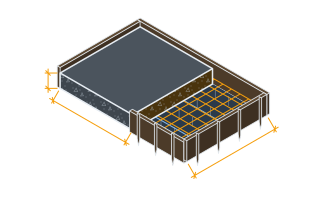
SettingsSettings for this calculationUS
Waste is set to 5% by hand. Pick a tier above to replace it, or keep your own figure.
Solid steps fill down to the ground; a waist-slab flight spans between landings on a sloping slab.
Garden and entrance steps poured against the ground are solid. A flight spanning between a base and a landing, formed on a soffit, is a waist slab with the steps on top of it.
The number of risers in the flight.
Count risers, not treads: a flight arriving on a landing has one more riser than treads.
The height of each step.
The total rise divided by the number of risers; every riser in a flight should be the same.
The depth of each step, nosing to nosing.
Measured on plan from the face of one riser to the face of the next.
The width of the steps, cheek to cheek.
The full cast width, including any part hidden under a wall or cheek that is poured with the steps.
How much deeper the top step is than an ordinary tread, where it forms a landing.
The top of a solid flight is often a platform at a door; enter only the depth beyond one going, which the steps already count.
An allowance for over-dig, spillage and what stays in the barrow.
Small pours lose a larger share than slabs. Steps cast against dug ground take more than the drawing, because the ground is never cut to the line.
Concrete to order, waste included
0.8318 yd³
Each step is a block running down to the ground, which is how steps poured against dug ground fill. A toe beam under the bottom riser, or a haunch behind the risers of a masonry flight, is a separate prism to add.
- The steps down to the ground
- 0.79 yd³
- Concrete before waste
- 0.79 yd³
- Total rise
- 2.33 ft
They open the calculator with your figures already in it
Concrete Steps Volume Calculator (Solid and Waist-Slab Flights): 0.8318 yd³ — shown in imperial, US market. The link sets both, so the result they see is the one on your screen.
Show calculation logicHide calculation logic
How this was calculated
Formula source(s)
- Solid steps on the ground as a sum of prisms: step i, counted from the bottom, stands i risers high and one going deep, so n steps hold width × riser × going × n(n + 1)/2, plus a landing deeper than one going at the top step's height
- A cast flight on a waist slab: each step adds a triangle of riser × going ÷ 2, and the waist adds its thickness times the sloping length √(riser² + going²) per step, all times the width
Inputs used
- Kind of Flight
- Solid steps cast on the ground
- Number of Steps (risers)
- 4
- Riser Height
- 7 in
- Going (tread depth)
- 11 in
- Width of the Flight
- 4 ft
- Top Landing Depth Beyond One Going (0 if none)
- 0 ft
- Waist Slab Thickness
- 6 in
- Waste Allowance (%)
- 5
Intermediate steps
- The steps down to the ground
- 0.79 yd³
- Concrete before waste
- 0.79 yd³
- Total rise
- 2.33 ft
Confidence note: Each step is a block running down to the ground, which is how steps poured against dug ground fill. A toe beam under the bottom riser, or a haunch behind the risers of a masonry flight, is a separate prism to add.
What this calculation does not cover
- Rectangular steps of equal riser and going. Winders, curved flights and steps with a sloping underside at the back are shaped differently and are better taken as prisms one at a time.
- It is the concrete, not the rest of the flight: formwork, reinforcement and any finish or nosing are separate lines.
- Steps in a freezing climate need air-entrained concrete to a named exposure class, which is specified when the concrete is ordered; the batcher cannot add air on site.
Estimated cost — your price
This site holds no price list for this material — local prices vary too much to publish honestly. Enter your supplier's price and the result is costed with it.
Part of a bigger job
This trade is one line of a job takeoff. Run the whole job and every other trade comes back with it, off the same measurements.
Computed in your browser — nothing you enter is uploaded. Presented in US customary units and US trade terminology. Where a formula follows a published standard, that standard and its edition are cited beside it on this page; where none governs, the page says so. Local amendments override model codes — verify against the code in force where you build.
Sources checked 2026-09-22 · v1.0.0
Regulatory standards & verification citations2
- Solid steps on the ground as a sum of prisms: step i, counted from the bottom, stands i risers high and one going deep, so n steps hold width × riser × going × n(n + 1)/2, plus a landing deeper than one going at the top step's height
- A cast flight on a waist slab: each step adds a triangle of riser × going ÷ 2, and the waist adds its thickness times the sloping length √(riser² + going²) per step, all times the width
Cite this page
Your workspace
Most jobs need more than one number. Add the calculators you need next and they open right here, underneath this one — your figures stay on screen and nothing is lost to a page change.
Tools and safety for this job
To place and finish concrete, erect formwork and saw-cut cured concrete. Generic types, no brands, no prices.
Protection this work requires
- Cutting or grinding concrete, masonry, screed, tile or fibre-cement board releases respirable silica: cut wet or extract at the tool, and wear a P2/N95 respirator at minimum — a nuisance dust mask does not filter it.
- Hardwood dust is a recognised carcinogen: extract at the tool and wear a P2/N95 respirator when cutting or sanding indoors.
- Wet cement and lime burn skin and eyes painlessly until the damage is done: waterproof gloves to EN 374, safety glasses whenever the mix can splash, and never kneel in wet mix in permeable trousers.
- Saws, grinders and breakers run above 85 dB, where hearing damage accumulates and does not recover: defenders or plugs for every cut, not just the long ones.
- Breakers and grinders cause permanent nerve damage: limit continuous trigger time, keep hands warm, and stop if fingers tingle or blanch.
- Boards, blocks and bagged material cause most lasting back injuries on small sites: two people or a lifter for full sheets, and never a bag on one shoulder up a ladder.
Show the 17 tools this job needsHide tools
Essential
Angle grinder
Bull float and edger
Circular saw
Claw hammer
Dust extractor or vacuum with a fine filter
Screed bar or rail
Shovel and spade
Spirit level
String line and pins
Tape measure
Wheelbarrow
Recommended
Chalk line
Cordless drill/driver
Floor or cut-off saw
Plate compactor
SDS rotary hammer
Optional
Power float
Also needed as materials: chalk refill, circular saw blades, cutting and diamond discs, diamond blades, drill and driver bits, SDS bits and chisels.
what each concrete tool is for, and the spec that decides which to buy where one does.