
SettingsSettings for this calculationUS
The floor being covered.
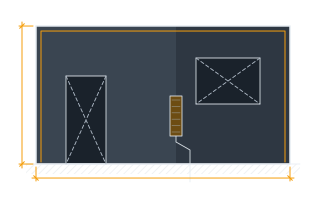
Cover the whole floor, not the part under the ladder. Most of the mess on a decorating job is walked around rather than dropped, and a part-covered floor is a floor that gets paint on it.
Once around the room at floor level.
A 4 × 3 m room is 14 m. This is the figure that decides the tape, and it is why area is the wrong basis: a 6 × 2 m room has the same 12 m² of floor and 16 m of perimeter, so it wants more tape for the same paint.
How many times the tape goes round — skirting, ceiling line, a picture rail.
Two is usual: once along the top of the skirting and once at the ceiling line. Put one where the ceiling is being painted in the same colour and needs no line, and three where a picture rail or a dado adds another. Cutting in by hand instead of taping is a legitimate answer to this field: put zero.
Each frame is masked all the way round.
Count doors, windows and any other opening with a frame. Each is a fixed amount of work regardless of the room's size, which is why they are counted as items rather than folded into the perimeter.
Once around one frame — both jambs and the head.
A 2 m × 0.8 m door frame is two jambs and a head, about 4.8 m, and a window with a sill and a reveal is similar once the glass line is included. Raise it where the glazing itself is being masked, which on a multi-pane sash can be several times the frame.
The area one sheet usefully covers once it is overlapped.
Sheets overlap in use, so the useful coverage is less than the nominal size — the default here is already a little under the 9.7 m² a 3.6 × 2.7 m sheet measures. Rolls of self-adhesive carpet film and corrugated board are sold by length instead; enter the area one roll actually covers.
As sold. Check the roll rather than assuming.
Low-tack tape for fresh paint and delicate surfaces often comes in shorter rolls than general-purpose tape, so check the roll rather than assuming. Tape also has a shelf life: an old roll tears and leaves adhesive, which costs more time than a new roll costs money.
Protection materials
3 items
2 sheet(s) and 1 roll(s). Openings are 35% of the tape here — they do not scale with the room, so a small room full of frames takes more than a big empty one.
- Dust sheets
- 2 sheets
- Tape rolls
- 1 roll
- Tape along the room
- 92 ft
- Tape around openings
- 49.5 ft
- Tape in total
- 141.5 ft
They open the calculator with your figures already in it
Masking and Protection Materials Calculator: 3 items — shown in imperial, US market. The link sets both, so the result they see is the one on your screen.
Show calculation logicHide calculation logic
How this was calculated
Formula source(s)
- Floor protection is an area: the floor divided by one sheet's coverage, rounded up to whole sheets
- Masking tape follows edges rather than area — the perimeter lines being cut in, plus a length for each door and window frame, which does not scale with the room
- Tape is sold in rolls of a stated length, so the order is the total edge divided by the roll length, rounded up
Inputs used
- Floor area
- 130 sq ft
- Room perimeter
- 46 ft
- Taped lines around the room
- 2
- Doors and windows
- 3
- Tape per opening
- 16.5 ft
- One dust sheet covers
- 120 sq ft
- Tape roll length
- 180 ft
Intermediate steps
- Dust sheets
- 2 sheets
- Tape rolls
- 1 roll
- Tape along the room
- 92 ft
- Tape around openings
- 49.5 ft
- Tape in total
- 141.5 ft
Confidence note: 2 sheet(s) and 1 roll(s). Openings are 35% of the tape here — they do not scale with the room, so a small room full of frames takes more than a big empty one.
What this calculation does not cover
- Tape follows edges and sheeting follows area, so the two answers move independently. A long narrow room and a square one of the same floor area take the same sheets and noticeably different tape.
- Nothing here covers what the room holds. Furniture that cannot be removed needs its own sheeting, and a fitted kitchen or a bathroom suite is masked item by item — neither is a function of the floor.
- Dust sheets are reused and tape is not. A decorator already owning sheets needs none of the first figure and all of the second, which is why they are reported separately rather than as a single kit.
- Tape type is not a quantity question and matters more than the quantity. General-purpose tape lifts fresh emulsion and can pull paper from plasterboard; low-tack or delicate-surface tape exists for that, and any tape left on through sunlight becomes far harder to remove.
- Floor protection for trades other than decorating is a different product. Corrugated board, hardboard and heavy-duty film protect against impact and traffic; a cotton dust sheet protects against drips and nothing else.
Part of bigger jobs
This trade is one line of several job takeoffs. Run the whole job and every other trade comes back with it, off the same measurements.
also measuresPlaster Angle and Stop BeadSkim Coat PlasterDrywall Joint Tape
also measuresPaint PrimerCeiling PaintPaintWoodwork Paint
also measures11 other trades
also measures3 other trades
also measures8 other trades
also measures4 other trades
also measures9 other trades
also measures24 other trades
also measures10 other trades
also measures6 other trades
also measures9 other trades
also measures9 other trades
also measures5 other trades
also measures5 other trades
also measures1 other trade
also measures10 other trades
also measures7 other trades
also measures5 other trades
also measures4 other trades
also measures2 other trades
also measures7 other trades
also measures4 other trades
also measures2 other trades
Computed in your browser — nothing you enter is uploaded. Presented in US customary units and US trade terminology. Where a formula follows a published standard, that standard and its edition are cited beside it on this page; where none governs, the page says so. Local amendments override model codes — verify against the code in force where you build.
Sources checked 2026-09-23 · v1.0.0
Regulatory standards & verification citations3
- Floor protection is an area: the floor divided by one sheet's coverage, rounded up to whole sheets
- Masking tape follows edges rather than area — the perimeter lines being cut in, plus a length for each door and window frame, which does not scale with the room
- Tape is sold in rolls of a stated length, so the order is the total edge divided by the roll length, rounded up
Cite this page
Your workspace
Most jobs need more than one number. Add the calculators you need next and they open right here, underneath this one — your figures stay on screen and nothing is lost to a page change.
Tools and safety for this job
To protect retained finishes. Generic types, no brands, no prices.
Protection this work requires
- Knives cause more site injuries than any power tool: cut away from your body, change blades often, and wear cut-resistant gloves to EN 388 level C for repeated cutting.
- Loose sheeting, trailing leads and offcuts turn every trip across a room into a fall: tape protection down at every edge, run leads along the walls, and keep the way in clear of waste.
Show the 3 tools this job needsHide tools
Essential
Dust sheets and masking
Utility knife
Recommended
Tape measure
Also needed as materials: masking tape, plastic sheeting, replacement blades.
what each site-management tool is for, and the spec that decides which to buy where one does.