
SettingsSettings for this calculationUS
The total surface area to prime.
Use the same area you'd use for the Paint Calculator.
The area one unit of your primer covers — printed on the tin.
How far primer goes depends on what it is going onto. Bare plaster, new plasterboard and raw timber soak it up, and the default 200 sq ft (19 m²) per US gallon (3.8 L) suits them; a sealed or previously painted surface takes far less and a primer tin often rates it at 300 to 400 sq ft per gallon. Use the figure your tin gives for your surface.
Primer needed
2.5 gallons
- Area to prime
- 430 sq ft
They open the calculator with your figures already in it
Paint Primer Calculator: 2.5 gallons — shown in imperial, US market. The link sets both, so the result they see is the one on your screen.
Show calculation logicHide calculation logic
How this was calculated
Formula source(s)
- Primer typically covers about 200 sq ft per gallon, lower than topcoat paint's ~350-400 sq ft, since it's formulated to seal and bond rather than spread thin
- Primer needed = area ÷ spread rate for one coat — the loss-free coating identity, with the spread rate taken from the product's own tin or data sheet
Inputs used
- Wall Area
- 430 sq ft
- Spread rate
- 200 ft²/gal
Intermediate steps
- Area to prime
- 430 sq ft
What this calculation does not cover
- PRIMER IS CHOSEN FOR WHAT IT MUST DO, and coverage follows from that. A stain-blocking shellac, a high-build masonry sealer, a bonding primer for glossy substrates and a general-purpose acrylic differ in spread rate by more than the difference between primer and topcoat, and the default 200 sq ft (19 m²) per US gallon (3.8 L) is a general-purpose figure for a porous surface — enter your product's own rate.
- New plaster and new plasterboard are the case this most often gets wrong. Fresh plaster wants a thinned mist coat that soaks in and covers far less area than the tin claims, and priming it as though it were a sound painted wall is how paint comes back off with the tape.
- Whether primer is needed at all is not answered here. A sound, previously painted surface in a similar colour often needs none, and a sealer coat on a porous substrate may need two — so a quantity for one coat can be the wrong question.
- The gallons figure covers a single pass over the area you enter; there is no coat count anywhere in the arithmetic, so knots, water stains or a strong existing colour that want two prime coats mean doubling it yourself.
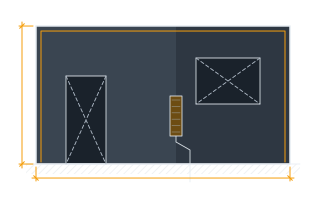
- Doors, windows and other openings are not deducted — every square foot you type is treated as primeable surface, so take them off before entering the area if you want the leaner number.
- How the primer goes on changes nothing in the sum: sprayed work loses material to overspray and to charging the hose where brush and roller work does not, and one spread rate stands for the whole area even where bare patches sit among sealed ones.
- Rounding up to the next half gallon is the only margin the result carries, and on an area that lands just past a step it amounts to a splash — nothing is added for the tray, the roller sleeve or spillage.
- Half gallons are a step in the arithmetic rather than a size you can buy — a 2.5-gallon answer means two gallon cans plus two quarts — and because the step applies to any non-zero area, half a gallon is the smallest result the tool will show, even for a single patch.
Estimated cost — your price
This site holds no price list for this material — local prices vary too much to publish honestly. Enter your supplier's price and the result is costed with it.
Part of bigger jobs
This trade is one line of several job takeoffs. Run the whole job and every other trade comes back with it, off the same measurements.
Or plan the space itself: measure it once, doors and windows included, and this figure comes back worked out on that space, with what goes with it.
Computed in your browser — nothing you enter is uploaded. Presented in US customary units and US trade terminology. Where a formula follows a published standard, that standard and its edition are cited beside it on this page; where none governs, the page says so. Local amendments override model codes — verify against the code in force where you build.
Sources checked 2026-09-17 · v1.1.0
Regulatory standards & verification citations2
- Primer typically covers about 200 sq ft per gallon, lower than topcoat paint's ~350-400 sq ft, since it's formulated to seal and bond rather than spread thin
- Primer needed = area ÷ spread rate for one coat — the loss-free coating identity, with the spread rate taken from the product's own tin or data sheet
Cite this page
Your workspace
Most jobs need more than one number. Add the calculators you need next and they open right here, underneath this one — your figures stay on screen and nothing is lost to a page change.
Protection this work requires
- Stop and check first. Paint under later coats in older housing can be lead-based, and sanding or heat-stripping it produces lead dust that is especially harmful to children and to anyone pregnant. Test before you disturb it — this is a job for a tested, controlled method, not a better mask.
Tools and safety for this job
To roll and cut in two coats, prepare a surface for paint and mist-coat or prime the new surface. Generic types, no brands, no prices.
- Joint-compound dust is very fine and travels: a P1/FFP1 mask is the minimum, and a damp-sponge finish avoids most of it.
- A dust mask does nothing about solvent vapour: ventilate through, and use an organic-vapour (A1) cartridge respirator in an enclosed room.
- Most fatal falls on small jobs are from under three metres: use a tower or a ladder tied at the top, and never work off the top two rungs.
Show the 12 tools this job needsHide tools
Essential
Brushes
Dust sheets and masking
Filling knife
Roller frame, sleeves and tray
Scraper
Recommended
Caulking gun
Extension pole
Mixing bucket or tub
Pole sander
Random orbital sander
Step ladder
Optional
Dust extractor or vacuum with a fine filter
Also needed as materials: abrasive discs, caulk and sealant cartridges, masking tape, plastic sheeting, roller sleeves, sanding screens or paper.
what each painting tool is for, and the spec that decides which to buy where one does.