
SettingsSettings for this calculationUS
The area of the ceiling — for a flat ceiling, the room's floor area.
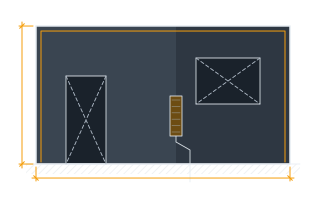
A flat ceiling covers the floor beneath it, so length × width of the room is the ceiling area. A sloping ceiling is larger than the floor under it: measure along the slope. Skylights and roof windows are small enough that they are usually painted round rather than taken off.
Tools needed: Tape measure or laser measure
Two coats is the usual finish for a ceiling.
One coat of the same white over a sound white ceiling can be enough. A stained ceiling needs a stain-blocking primer first rather than a third coat, and new plaster needs a mist coat, which is counted with the primer.
The area one unit of your paint covers per coat — printed on the tin.
North American ceiling paints are commonly rated at about 300 to 450 sq ft per gallon (7.4 to 11 m² per litre); UK and European matt emulsions often state up to 13 to 17 m² per litre. The default, 10 m² per litre (about 400 sq ft per gallon), sits inside the first range and below the second. The tin's own figure is the one to use; a textured or artexed ceiling takes noticeably more than it states.
Ceiling paint needed
0.8 gal
- Ceiling area
- 160 ft²
- Area to coat, all coats
- 320 ft²
They open the calculator with your figures already in it
Ceiling Paint Calculator: 0.8 gal — shown in imperial, US market. The link sets both, so the result they see is the one on your screen.
Show calculation logicHide calculation logic
How this was calculated
Formula source(s)
- Paint needed = area × coats ÷ spread rate — the loss-free identity every coating quantity starts from, with the spread rate taken from the product's own data sheet or tin
- Ceiling paints are rated per coat on a smooth, sealed surface: commonly about 300 to 450 sq ft per gallon (7.4 to 11 m² per litre) in North America, and often up to 13 to 17 m² per litre for UK and European matt emulsions; a porous or textured surface takes more
Inputs used
- Ceiling area
- 160 sq ft
- Number of coats
- 2
- Spread rate
- 400 ft²/gal
Intermediate steps
- Ceiling area
- 160 ft²
- Area to coat, all coats
- 320 ft²
What this calculation does not cover
- The figure is paint that reaches the ceiling. Rolling overhead flicks more onto the floor and the roller than wall work does, and nothing is added for that, for the tray or for touching up — add it as an allowance.
- One spread rate stands for every coat, though the first coat onto a porous or newly plastered ceiling soaks in and covers less than the second.
- A mist coat on new plaster, and a stain-blocking primer over water marks, are separate products and are not part of this figure.
- Coving, beams and the tops of cornices are painted with the ceiling but are not in a floor-area measurement; on a room with deep beams they add noticeably to the area.
- Preparing an old ceiling is where the risk is, not painting it. A textured or popcorn coating applied before 2000 can contain asbestos, and paint under later coats in older housing can be lead-based; scraping, sanding or drilling either releases it, while painting over a sound coating does not. Have it tested before disturbing it. No quantity on this page depends on it.
Estimated cost — your price
This site holds no price list for this material — local prices vary too much to publish honestly. Enter your supplier's price and the result is costed with it.
Part of bigger jobs
This trade is one line of several job takeoffs. Run the whole job and every other trade comes back with it, off the same measurements.
Or plan the space itself: measure it once, doors and windows included, and this figure comes back worked out on that space, with what goes with it.
also measuresDrywallCeiling Plasterboard (Gypsum Board) SheetDrywall Joint CompoundPaintFlooringBaseboard & Trim
also measuresMasking and Protection MaterialsPaint PrimerPaintWoodwork Paint
also measures11 other trades
also measures18 other trades
also measures11 other trades
also measures24 other trades
also measures10 other trades
also measures24 other trades
also measures24 other trades
Computed in your browser — nothing you enter is uploaded. Presented in US customary units and US trade terminology. Where a formula follows a published standard, that standard and its edition are cited beside it on this page; where none governs, the page says so. Local amendments override model codes — verify against the code in force where you build.
Sources checked 2026-09-17 · v1.0.0
Regulatory standards & verification citations2
- Paint needed = area × coats ÷ spread rate — the loss-free identity every coating quantity starts from, with the spread rate taken from the product's own data sheet or tin
- Ceiling paints are rated per coat on a smooth, sealed surface: commonly about 300 to 450 sq ft per gallon (7.4 to 11 m² per litre) in North America, and often up to 13 to 17 m² per litre for UK and European matt emulsions; a porous or textured surface takes more
Cite this page
Your workspace
Most jobs need more than one number. Add the calculators you need next and they open right here, underneath this one — your figures stay on screen and nothing is lost to a page change.
Protection this work requires
- Stop and check first. Paint under later coats in older housing can be lead-based, and sanding or heat-stripping it produces lead dust that is especially harmful to children and to anyone pregnant. Test before you disturb it — this is a job for a tested, controlled method, not a better mask.
Tools and safety for this job
To roll and cut in two coats, prepare a surface for paint and mist-coat or prime the new surface. Generic types, no brands, no prices.
- Joint-compound dust is very fine and travels: a P1/FFP1 mask is the minimum, and a damp-sponge finish avoids most of it.
- A dust mask does nothing about solvent vapour: ventilate through, and use an organic-vapour (A1) cartridge respirator in an enclosed room.
- Most fatal falls on small jobs are from under three metres: use a tower or a ladder tied at the top, and never work off the top two rungs.
Show the 12 tools this job needsHide tools
Essential
Brushes
Dust sheets and masking
Filling knife
Roller frame, sleeves and tray
Scraper
Recommended
Caulking gun
Extension pole
Mixing bucket or tub
Pole sander
Random orbital sander
Step ladder
Optional
Dust extractor or vacuum with a fine filter
Also needed as materials: abrasive discs, caulk and sealant cartridges, masking tape, plastic sheeting, roller sleeves, sanding screens or paper.
what each painting tool is for, and the spec that decides which to buy where one does.