
SettingsSettings for this calculationUS
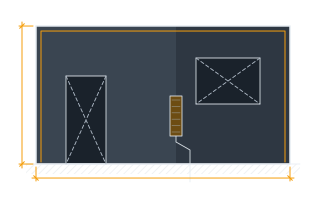
Only the new plaster — old painted surfaces do not take a mist coat.
Where a room is part new plaster and part sound old paint, measure just the new. Mist coating a surface that is already sealed does nothing useful and leaves a thin, patchy coat that the next one has to cover.
How far a unit of the thinned mix goes on fresh plaster.
Lower than the tin's own figure, because the point of the coat is that the plaster drinks it. Tins commonly rate contract matt around 12 to 14 m² per litre on a sealed wall; on new plaster the mix gets nearer 10, and on a very thirsty skim less again. If the first wall takes noticeably more than this, use what it actually took for the rest.
20% means one part water to five parts paint — what the tin means.
Most contract and vinyl matt emulsions are thinned 10 to 20% for a mist coat, and the tin's own wording is the one to follow. Read it as a share of the paint, not of the mixture: at 20% every five parts of paint take one part of water and make six parts of mix, rather than five parts of mix holding one part of water. Some paints are sold ready for new plaster and must not be thinned at all — put zero here for those.
One is normal; a very porous skim sometimes takes two.
Where the first coat dries back to a patchy, still-thirsty-looking surface, the plaster has taken it all and a second is worth doing. Two thin mist coats seal better than one heavy one, which starts to behave like the unthinned coat the exercise is avoiding.
Paint needed for the mist coat
0.896 gal
Buy the paint; the water is free. Make the mix up from the two figures below, and check the can before thinning — some emulsions must not be.
- Mixed volume to make up
- 1.08 gal
- Water to add
- 0.18 gal
- Gallon cans of paint
- 1 can
They open the calculator with your figures already in it
Mist Coat Calculator: 0.8958 gal — shown in imperial, US market. The link sets both, so the result they see is the one on your screen.
Show calculation logicHide calculation logic
How this was calculated
Formula source(s)
- The coating identity: the mixed volume for one coat is the area divided by the spread rate, multiplied by the number of coats
- Dilution is stated on the tin as water added as a proportion of the paint — 20% means one part water to five parts paint, so a litre of paint yields 1.2 litres of mix
- New plaster is porous and alkaline; a full-strength emulsion films over before the surface can take it and fails to key, which is the defect a thinned coat exists to prevent
Inputs used
- Area of new plaster
- 430 sq ft
- Spread rate of the mix
- 400 ft²/gal
- Water added, as a share of the paint
- 20
- Mist coats
- 1
Intermediate steps
- Mixed volume to make up
- 1.08 gal
- Water to add
- 0.18 gal
- Gallon cans of paint
- 1 can
Confidence note: Buy the paint; the water is free. Make the mix up from the two figures below, and check the can before thinning — some emulsions must not be.
What this calculation does not cover
- A mist coat is not a primer and not a substitute for one. It seals suction on new plaster; it does not block stains, it does not cover a strong existing colour, and it does not prepare a glossy or powdery surface.
- Plaster has to be dry first — right through, not just on the face. That is commonly a week or more for a skim and considerably longer for a wet undercoat behind it. Sealing damp plaster traps the moisture and the coat fails whatever the quantity.
- Not every emulsion may be thinned. Some are formulated for new plaster and say not to add water, and some contain additives that break down when over-thinned. The tin overrules the default here.
- The spread rate is the figure that moves this answer, and on fresh plaster it is a genuine unknown until the first wall is coated. Treat the result as a starting figure and correct it from what that wall actually took.
- Only the paint is a purchase. The water is free, so the tins to buy follow the paint figure, not the mixed one — buying to the mixed volume over-orders by the dilution.
Estimated cost — your price
This site holds no price list for this material — local prices vary too much to publish honestly. Enter your supplier's price and the result is costed with it.
Computed in your browser — nothing you enter is uploaded. Presented in US customary units and US trade terminology. Where a formula follows a published standard, that standard and its edition are cited beside it on this page; where none governs, the page says so. Local amendments override model codes — verify against the code in force where you build.
Sources checked 2026-09-23 · v1.0.0
Regulatory standards & verification citations3
- The coating identity: the mixed volume for one coat is the area divided by the spread rate, multiplied by the number of coats
- Dilution is stated on the tin as water added as a proportion of the paint — 20% means one part water to five parts paint, so a litre of paint yields 1.2 litres of mix
- New plaster is porous and alkaline; a full-strength emulsion films over before the surface can take it and fails to key, which is the defect a thinned coat exists to prevent
Cite this page
Your workspace
Most jobs need more than one number. Add the calculators you need next and they open right here, underneath this one — your figures stay on screen and nothing is lost to a page change.
Tools and safety for this job
To mist-coat or prime the new surface. Generic types, no brands, no prices.
Protection this work requires
- Most fatal falls on small jobs are from under three metres: use a tower or a ladder tied at the top, and never work off the top two rungs.
Show the 6 tools this job needsHide tools
Essential
Brushes
Dust sheets and masking
Roller frame, sleeves and tray
Recommended
Extension pole
Mixing bucket or tub
Step ladder
Also needed as materials: masking tape, plastic sheeting, roller sleeves.
what each painting tool is for, and the spec that decides which to buy where one does.