
SettingsSettings for this calculationUS
Waste is set to 15% by hand. Pick a tier above to replace it, or keep your own figure.
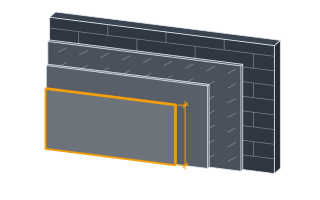
The masonry surface taking both coats.
Measure the wall, and take out openings only where they are large — a window in a small room is a real deduction on an 11 mm undercoat, which is the coat where a square metre is a third of a bag.
The levelling coat, at the nominal thickness its coverage is quoted for.
11 mm on walls and 8 mm on soffits are the thicknesses gypsum undercoats quote their coverage at. What a wall actually takes depends on how true it is: an old brick wall out by 10 mm in its length is being levelled by this coat, and the average thickness is what to enter, not the thinnest point.
Lightweight, because it has to hold at a levelling thickness without slumping.
850 kg/m³ sits in the middle of what published undercoat coverage implies. Where the bag gives its own coverage, divide the bag weight by (area × thickness) to get that product's figure — a sand-and-cement float is far heavier, nearer 1,900 kg/m³, and is a different order again.
The setting coat over the float, at its own nominal thickness.
The finish is a thin skim laid in two passes over the levelled undercoat, and 2 mm is what its coverage is published at. It is not a levelling coat: anything the float left out of true stays out of true.
Denser than the undercoat, and the reason the two are ordered separately.
1,250 kg/m³ is what the common published finish coverage implies — about 10 m² per 25 kg bag at 2 mm. It is roughly half as heavy again as the undercoat per unit of volume, while the coat is five times thinner.
What sets in the bucket and falls to the floor, on both coats.
Both coats have a working time and both are mixed in batches, so both lose material the same way. Fifteen per cent is normal for a room; raise it where the wall is rough enough that the undercoat is being pushed in rather than laid on.
Plaster needed, both coats
888.2 lb
About 14 bag(s) of undercoat and 4 of finish. Order them separately — they are different products.
- Undercoat
- 699.73 lb
- Undercoat, 50 lb bags
- 14 bags
- Finish
- 188.43 lb
- Finish, 50 lb bags
- 4 bags
- Allowance at 15%
- 115.85 lb
They open the calculator with your figures already in it
Float and Set Plaster Calculator: 888 lb — shown in imperial, US market. The link sets both, so the result they see is the one on your screen.
Show calculation logicHide calculation logic
How this was calculated
Formula source(s)
- Geometry, coat by coat: each coat's plaster is the area times that coat's thickness, and its mass is that volume times that product's applied density
- Gypsum undercoat plasters publish coverage at a nominal 11 mm — commonly 2.5 to 3 m² per 25 kg bag, an applied density of about 760 to 900 kg/m³ — while finish plaster covers about 10 m² per 25 kg bag at 2 mm, about 1,250 kg/m³
Inputs used
- Area to plaster
- 320 sq ft
- Undercoat thickness
- 0.43 in
- Undercoat applied density
- 53.06 pcf
- Finish thickness
- 0.08 in
- Finish applied density
- 78.03 pcf
- Waste allowance
- 15
Intermediate steps
- Undercoat
- 699.73 lb
- Undercoat, 50 lb bags
- 14 bags
- Finish
- 188.43 lb
- Finish, 50 lb bags
- 4 bags
- Allowance at 15%
- 115.85 lb
Confidence note: About 14 bag(s) of undercoat and 4 of finish. Order them separately — they are different products.
What this calculation does not cover
- The two coats are different products and are bought separately. The headline here is their combined weight; the bag counts in the breakdown are what to order, and they cannot be added together.
- The undercoat thickness is an average over the wall. A wall that is badly out of true takes far more than its nominal 11 mm, or 7/16 in, and the only honest way to know is to string a line across it before ordering.
- A sand-and-cement float is not this. It is mixed on site from separate materials at a density more than twice the gypsum figure here, and the render and plaster mix calculator is the page for it.
- Beads, scrim, bonding agents and the preparation the background needs are not counted. On a masonry wall the beads alone are a real line: every external angle and every stop.
Estimated cost — your price
This site holds no price list for this material — local prices vary too much to publish honestly. Enter your supplier's price and the result is costed with it.
Part of bigger jobs
This trade is one line of several job takeoffs. Run the whole job and every other trade comes back with it, off the same measurements.
also measuresPlaster Angle and Stop BeadMasking and Protection MaterialsSkim Coat PlasterDrywall Joint Tape
also measuresMasking and Protection MaterialsBrickWindow Opening Flashing MembranePlaster Angle and Stop BeadPaintSkip & Dumpster Size
also measures10 other trades
also measuresMasking and Protection MaterialsScaffold Face Area and Hire QuantityCeiling Plasterboard (Gypsum Board) SheetSkim Coat PlasterPaintCeiling PaintSkip & Dumpster Size
also measures24 other trades
Computed in your browser — nothing you enter is uploaded. Presented in US customary units and US trade terminology. Where a formula follows a published standard, that standard and its edition are cited beside it on this page; where none governs, the page says so. Local amendments override model codes — verify against the code in force where you build.
Sources checked 2026-09-23 · v1.0.0
Regulatory standards & verification citations2
- Geometry, coat by coat: each coat's plaster is the area times that coat's thickness, and its mass is that volume times that product's applied density
- Gypsum undercoat plasters publish coverage at a nominal 11 mm — commonly 2.5 to 3 m² per 25 kg bag, an applied density of about 760 to 900 kg/m³ — while finish plaster covers about 10 m² per 25 kg bag at 2 mm, about 1,250 kg/m³
Cite this page
Your workspace
Most jobs need more than one number. Add the calculators you need next and they open right here, underneath this one — your figures stay on screen and nothing is lost to a page change.
Tools and safety for this job
To skim a plaster finish. Generic types, no brands, no prices.
Protection this work requires
- Wet cement and lime burn skin and eyes painlessly until the damage is done: waterproof gloves to EN 374, safety glasses whenever the mix can splash, and never kneel in wet mix in permeable trousers.
- Most fatal falls on small jobs are from under three metres: use a tower or a ladder tied at the top, and never work off the top two rungs.
Show the 4 tools this job needsHide tools
Essential
Mixing bucket or tub
Paddle mixer
Plastering trowel and hawk
Recommended
Step ladder
what each plastering tool is for, and the spec that decides which to buy where one does.