
SettingsSettings for this calculationUS
The standard allowance most suppliers and estimating guides assume for ordinary work.
The total wall, foundation, or roof deck area to cover.
Measure the surface area you're insulating.
Offcuts from fitting boards between framing, around openings and at corners.
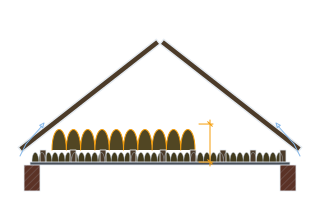
A continuous layer over a flat wall with few openings cuts cleanly, and the offcut often starts the next row. Boards fitted between rafters or studs, around many penetrations or on a hipped roof leave strips too narrow for the next bay, and that is where fifteen or more is honest.
Foam board sheets needed
15 sheets (4x8 ft)
- Area to cover (with waste)
- 473 sq ft
They open the calculator with your figures already in it
Foam Board Insulation Calculator: 15 sheets (4x8 ft) — shown in imperial, US market. The link sets both, so the result they see is the one on your screen.
Show calculation logicHide calculation logic
How this was calculated
Formula source(s)
- Standard rigid foam board sheet size is 4 ft x 8 ft (32 sq ft) in North America and 2400 x 1200 mm (2.88 m²) in metric markets; sheet count = area / one board's area, rounded up with a waste allowance
Inputs used
- Area to Insulate
- 430 sq ft
- Cutting Waste (%)
- 10
Intermediate steps
- Area to cover (with waste)
- 473 sq ft
What this calculation does not cover
- This counts sheets to cover an area. It does not choose a thickness or R-value, check your climate zone's requirement for continuous insulation, or confirm the board's compressive strength grade suits a load-bearing position under a slab or screed.
- The count is for a single layer. A staggered two- or three-layer build-up is a separate full-area order for each layer, so run the area through once per layer rather than entering the combined thickness.
- The waste allowance is a flat uplift on area, not a cutting layout. Rafter bays, hips, curved walls and dense penetrations throw off more offcuts than that, and offcuts from one bay are often unusable in the next. A wall whose window and door openings you did not deduct is over-ordered by roughly their area.
- It assumes every board is the market's standard full sheet. It does not cover the 2 ft wide XPS or 1200 x 600 mm half boards some ranges are sold in, and it does not deduct the overlap on tongue-and-groove or shiplap edges, which cover less than the board's nominal face area.
- Nothing beyond the boards is counted: seam tape, adhesive or foam, fixings and washers sized to the board thickness, furring, and any separate vapour or air control layer. Rigid foam is also combustible, and building codes generally require a thermal or ignition barrier between it and an occupied space. This calculator neither sizes nor includes that.
Estimated cost — your price
This site holds no price list for this material — local prices vary too much to publish honestly. Enter your supplier's price and the result is costed with it.
Part of bigger jobs
This trade is one line of several job takeoffs. Run the whole job and every other trade comes back with it, off the same measurements.
also measuresVapor BarrierLaminate/Vinyl Plank Floor Underlayment Roll
also measures18 other trades
also measures11 other trades
also measures9 other trades
also measures24 other trades
also measures19 other trades
also measures24 other trades
also measures24 other trades
also measuresRadiant Floor PEX TubingPipe Insulation
also measuresMasking and Protection MaterialsRadiant Floor PEX TubingSelf-Leveling Underlayment (SLU) VolumeFloor & Wall TileThinset & Tile AdhesiveFloor Transition StripSkip & Dumpster Size
Computed in your browser — nothing you enter is uploaded. Presented in US customary units and US trade terminology. Where a formula follows a published standard, that standard and its edition are cited beside it on this page; where none governs, the page says so. Local amendments override model codes — verify against the code in force where you build.
Sources checked 2026-09-17 · v1.1.0
Regulatory standards & verification citations1
- Standard rigid foam board sheet size is 4 ft x 8 ft (32 sq ft) in North America and 2400 x 1200 mm (2.88 m²) in metric markets; sheet count = area / one board's area, rounded up with a waste allowance
Cite this page
Your workspace
Most jobs need more than one number. Add the calculators you need next and they open right here, underneath this one — your figures stay on screen and nothing is lost to a page change.
Tools and safety for this job
To cut and fit rigid insulation board. Generic types, no brands, no prices.
Protection this work requires
- Mineral and glass wool irritate skin, eyes and airways: cover your arms, wear a P2/N95 respirator while cutting, and rinse in cold water — hot water drives fibres in.
- Knives cause more site injuries than any power tool: cut away from your body, change blades often, and wear cut-resistant gloves to EN 388 level C for repeated cutting.
Show the 4 tools this job needsHide tools
Essential
Tape measure
Utility knife
Recommended
Hand saw
Optional
Caulking gun
Also needed as materials: caulk and sealant cartridges, replacement blades.
what each insulation tool is for, and the spec that decides which to buy where one does.