
SettingsSettings for this calculationUS
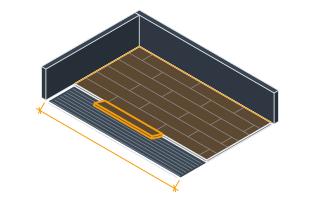
The total subfloor area to be leveled.
Measure the room's length x width, or add up multiple sections for an irregular floor plan.
The average thickness of the self-leveling compound pour across the floor.
Self-leveling underlayment naturally flows thicker in low spots and thinner over high spots — estimate the average depth across the whole floor, not just the deepest point.
SLU volume needed
42.1 gal
Actual SLU consumption depends on subfloor roughness/low spots — an uneven subfloor will consume more material than this average-depth estimate suggests. Order 10-15% extra for irregular subfloors.
They open the calculator with your figures already in it
Self-Leveling Underlayment (SLU) Volume Calculator: 42.08 gal — shown in imperial, US market. The link sets both, so the result they see is the one on your screen.
Show calculation logicHide calculation logic
How this was calculated
Formula source(s)
- SLU volume = floor area × average pour depth, the standard method for a self-leveling compound poured at a roughly uniform average thickness
Inputs used
- Floor Area
- 270 sq ft
- Average Pour Depth
- 0.25 in
Confidence note: Actual SLU consumption depends on subfloor roughness/low spots — an uneven subfloor will consume more material than this average-depth estimate suggests. Order 10-15% extra for irregular subfloors.
What this calculation does not cover
- Litres do not buy anything. SLU is sold by the bag, and turning this volume into a bag count needs the product's own yield — the litres one bag makes at its specified water ratio — which runs roughly 12 to 16 litres (3.2 to 4.2 gal) from a 25 kg (55 lb) bag and varies enough between products to shift the bag count by 10% or more on the same floor. Take the yield off the data sheet rather than assuming a density.
- The high spot sets the datum for the whole floor, and this takes an average instead. Every SLU has a minimum thickness it will flow and cure at, and you cannot pour thinner than that over the highest point — so nothing on the floor ends up thinner than that minimum and the low corner takes the minimum plus the whole deviation. There is also a maximum lift, above which the pour must be split or extended with aggregate, and adding aggregate changes the yield again.
- Primer is a separate material with its own coverage rate, and skipping it is how a pour fails rather than how it saves money. A porous slab pulls water out of the compound and pinholes; a sealed or non-porous substrate gives it nothing to grip. Porous slabs often take two coats, and the primer rate per square metre has no relationship to the pour depth calculated above.
Estimated cost — your price
This site holds no price list for this material — local prices vary too much to publish honestly. Enter your supplier's price and the result is costed with it.
Part of bigger jobs
This trade is one line of several job takeoffs. Run the whole job and every other trade comes back with it, off the same measurements.
Or plan the space itself: measure it once, doors and windows included, and this figure comes back worked out on that space, with what goes with it.
also measuresLVP, Laminate & Engineered FloorLaminate/Vinyl Plank Floor Underlayment Roll
also measures12 other trades
also measures10 other trades
also measures7 other trades
also measuresEpoxy Floor Coating
Computed in your browser — nothing you enter is uploaded. Presented in US customary units and US trade terminology. Where a formula follows a published standard, that standard and its edition are cited beside it on this page; where none governs, the page says so. Local amendments override model codes — verify against the code in force where you build.
Sources checked 2026-09-06 · in the site-wide review of 2026-09-06 · v1.0.1
Regulatory standards & verification citations1
- SLU volume = floor area × average pour depth, the standard method for a self-leveling compound poured at a roughly uniform average thickness
Cite this page
Your workspace
Most jobs need more than one number. Add the calculators you need next and they open right here, underneath this one — your figures stay on screen and nothing is lost to a page change.
Tools and safety for this job
To lay a floor screed. Generic types, no brands, no prices.
Protection this work requires
- Cutting or grinding concrete, masonry, screed, tile or fibre-cement board releases respirable silica: cut wet or extract at the tool, and wear a P2/N95 respirator at minimum — a nuisance dust mask does not filter it.
- Wet cement and lime burn skin and eyes painlessly until the damage is done: waterproof gloves to EN 374, safety glasses whenever the mix can splash, and never kneel in wet mix in permeable trousers.
- Boards, blocks and bagged material cause most lasting back injuries on small sites: two people or a lifter for full sheets, and never a bag on one shoulder up a ladder.
Show the 6 tools this job needsHide tools
Essential
Mixing bucket or tub
Screed bar or rail
Shovel and spade
Spirit level
Recommended
Moisture meter
Paddle mixer
what each flooring tool is for, and the spec that decides which to buy where one does.