
SettingsSettings for this calculationUS
The total length of the trench.
Centre to centre of the structures at each end — a manhole, a chamber, a building face — measured along the pipe run rather than as the crow flies. Bends add length; a run that doglegs round an obstruction is longer than the plan dimension between its ends. If the trench changes depth or width along its length, work it in sections: an average depth under-counts the deep end, which is where the volume is.
The width of the trench.
Typically the pipe diameter plus 12-18 in of working clearance on each side.
The depth of the trench.
Depends on frost line, pipe type, and local code requirements.
The outer diameter of the pipe being laid; 0 for a trench with no pipe.
Its volume is subtracted from the backfill needed, since the pipe occupies space in the trench. Enter 0 for a trench with nothing in it — a footing trench, or the fill above a footing — and nothing is deducted.
Depth of bedding material under the pipe; 0 if the pipe sits on the trench bottom.
The granular bed the pipe is laid on, from the trench bottom to the underside of the pipe — commonly 100 to 150 mm (4 to 6 in), deeper in rock, and set by the pipe maker or the utility's specification. With this or the cover above set above 0, the bed, the sides of the pipe and the cover over it become their own row, and come out of the backfill.
Depth of the same bedding material over the top of the pipe; 0 for none.
The selected fill carried over the crown before ordinary backfill starts — often 150 to 300 mm (6 to 12 in). The bedding row is the full trench width from the trench bottom to this depth over the crown, less the pipe itself; everything above it is backfill.
Extra loose material needed to achieve full compaction in the void.
15-20% is common for granular backfill compacted in lifts.
Loose backfill material needed
50.9 yd³
Assumes the excavated soil itself isn't reused as backfill (e.g. importing clean granular fill) — if reusing native soil, account for its own swell factor separately.
- Excavation volume (the depth entered)
- 48.89 yd³
- Pipe volume (subtracted)
- 4.6 yd³
- Compacted backfill void
- 44.29 yd³
They open the calculator with your figures already in it
Trench Excavation & Backfill Volume Calculator: 50.93 yd³ — shown in imperial, US market. The link sets both, so the result they see is the one on your screen.
Show calculation logicHide calculation logic
How this was calculated
Formula source(s)
- Backfill volume = trench excavation volume minus the pipe's own volume, minus any bedding and surround zone (trench width x (bed below + pipe diameter + cover above) x length, less the pipe it holds); loose material ordered accounts for the extra volume lost when compacting loose fill back into a denser state
Inputs used
- Trench Length
- 165 ft
- Trench Width
- 24 in
- Trench Depth
- 4 ft
- Pipe Diameter
- 11.75 in
- Bedding Below the Pipe
- 0 in
- Surround Cover Above the Pipe
- 0 in
- Compaction Loose-Volume Factor (%)
- 15
Intermediate steps
- Excavation volume (the depth entered)
- 48.89 yd³
- Pipe volume (subtracted)
- 4.6 yd³
- Compacted backfill void
- 44.29 yd³
Confidence note: Assumes the excavated soil itself isn't reused as backfill (e.g. importing clean granular fill) — if reusing native soil, account for its own swell factor separately.
What this calculation does not cover
- The trench is modelled as a plain rectangular prism — vertical faces, one width and one depth over the whole run. Battered or benched sides, the extra width a trench box needs, over-break outside the drawn line, and a bottom that falls with the pipe's gradient are all outside it. A run cut back to a safe slope holds considerably more than this figure, and the shortfall rises with the square of the depth rather than in proportion to it.
- This is a quantity take-off, not an excavation safety assessment. Nothing here classifies the soil, checks the depth against sloping, benching or shoring requirements, or sizes a protective system — that comes from a competent person on site, and past the depths the rules set, from an engineer.
- Only the single pipe you enter is deducted. A second pipe or duct sharing the trench, cable bundles, manholes, chambers, valve boxes, thrust blocks and concrete surround all displace backfill and are not subtracted. No check is made that the pipe fits the trench you described either: where its volume exceeds the excavation, the answer is floored at zero rather than reported as impossible geometry.
- At most two materials: a bedding and surround zone when you enter a bed or a cover, and one backfill above it at one flat percentage. The bedding row is an in-place volume across the full trench width, capped at the trench depth, with no compaction or waste allowance, so add your own for a graded bedding that is compacted. Marker tape or protective tiles, and the sub-base, blacktop or topsoil at the surface are further materials in further thicknesses and are not split out. The percentage is a loose-volume allowance on the backfill and nothing else — it is not a density or Proctor specification, and it says nothing about lift thickness or how many passes the plant makes.
- Nothing is said about the spoil. The excavation row is a bank volume measured in place, not the loose volume that leaves in the truck, and the calculation does not judge whether the arisings can go back, how much of the void they would fill, or what has to be carted away. Rock, groundwater and dewatering, and over-excavation to remove unsuitable ground are all excluded.
Estimated cost — your price
This site holds no price list for this material — local prices vary too much to publish honestly. Enter your supplier's price and the result is costed with it.
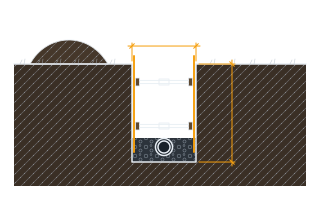
The pipe is drawn to scale inside the trench. Backfill is everything else in the section, which is why the pipe diameter changes the answer at all.
Part of bigger jobs
This trade is one line of several job takeoffs. Run the whole job and every other trade comes back with it, off the same measurements.
also measuresContinuous Footing / Grade Beam VolumeRebar
also measuresPipe, Conduit and Cable Run (Length, Fittings and Supports from a Measured Route)
also measures19 other trades
also measures24 other trades
also measures24 other trades
also measuresMasking and Protection MaterialsEMT Conduit Bend Length
also measuresSprinkler Head Spacing and CountIrrigation Zone
Computed in your browser — nothing you enter is uploaded. Presented in US customary units and US trade terminology. Where a formula follows a published standard, that standard and its edition are cited beside it on this page; where none governs, the page says so. Local amendments override model codes — verify against the code in force where you build.
Sources checked 2026-09-26 · v1.1.0
Regulatory standards & verification citations1
- Backfill volume = trench excavation volume minus the pipe's own volume, minus any bedding and surround zone (trench width x (bed below + pipe diameter + cover above) x length, less the pipe it holds); loose material ordered accounts for the extra volume lost when compacting loose fill back into a denser state
Cite this page
Your workspace
Most jobs need more than one number. Add the calculators you need next and they open right here, underneath this one — your figures stay on screen and nothing is lost to a page change.
Tools and safety for this job
To excavate by hand and excavate by machine. Generic types, no brands, no prices.
Protection this work requires
- Boards, blocks and bagged material cause most lasting back injuries on small sites: two people or a lifter for full sheets, and never a bag on one shoulder up a ladder.
- Digging blind strikes gas, water and power every day: get the plans, scan with a cable avoidance tool, and hand-dig trial holes over anything you find.
Excavate by machine: Operating an excavator is a trained and, in most markets, formally certified activity, and hiring one does not include that training. Underground services must be traced before any machine dig. This list covers the tools, not the competence.
Show the 6 tools this job needsHide tools
Essential
Cable and pipe detector
Shovel and spade
Tape measure
Wheelbarrow
Recommended
Spirit level
String line and pins
what each groundwork tool is for, and the spec that decides which to buy where one does.