
SettingsSettings for this calculationUS
Every level part of the route added together, along the path it will really take.
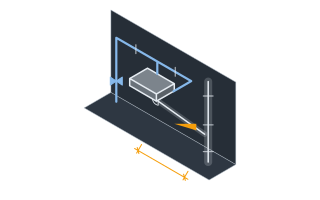
Measure along joists, walls and ceilings where the run will be fixed, round the obstructions in its way, not straight across the plan. A drawing's route can be scaled off and added up the same way.
Tools needed: Tape measure or laser measure
Every rise and drop added together.
Up a wall to a ceiling, down to a fixture or a box, between floors. Vertical lengths take their own support spacing below.
How many straight pieces of route there are between bends and ends.
Each straight run takes a support near each of its ends, which is what the codes ask for near every box, fitting or termination; a route with three bends usually has four straight runs.
How many times the route turns, each an elbow or a bend.
Each is counted as one fitting. A conduit bent on site needs no fitting; the conduit bend page gives the length a bend takes.
Where the run starts, stops or connects.
Each end takes the tail below on top of the route, for the connection itself.
What you allow at each end to make the connection.
A cable needs free conductor in each box and a pipe a little into each fitting; enter what your trade allows. It opens at 300 mm (11.8 in) as an example to replace.
The length one piece or one coil comes in at your merchant.
Rigid pipe and conduit come in straight lengths, cable and soft pipe in coils; enter whichever you buy. It opens at 3 m as an example to replace.
Supports for a run fixed to walls, joists or ceilings; none for a pipe or duct laid in a trench.
A buried service is carried by its bedding along its whole length, so the support rows read nothing; the trench and its bedding are the trench page's to count.
The most your code allows between supports for this product, laid level.
Read it from your code for the product and size. The page opens on the IPC's 4 ft (1219 mm) for PVC pipe; the same table gives 6 ft (1829 mm) for copper tube up to 1 1/4 in and 32 in (813 mm) for PEX, and the NEC gives 10 ft (3 m) for EMT, 4 1/2 ft (1.4 m) for NM cable (and for UF cable run as NM) and 6 ft (1.8 m) for MC cable. Steel wire armoured cable's spacing depends on its overall diameter: read it from the IET On-Site Guide's table or the cable maker's data.
The most your code allows between supports on a rise or drop.
The IPC asks for plastic, copper and PEX stacks to be supported at least every 10 ft (3048 mm), and cast iron every 15 ft (4572 mm); read your own product's figure.
Length to buy
70.96 ft
The route plus a tail at each of 2 ends; supports at both ends of each of the 4 straight runs and at the spacing between, which is the code's for your product, entered by you.
- Route measured
- 69 ft
- Tails at the ends
- 1.96 ft
- Stock lengths or coils
- 8 pieces
- Joints between lengths on a rigid run
- 4 joints
- Bend fittings
- 3 fittings
- Supports on level runs
- 19 supports
- Supports on rises and drops
- 1 support
- Supports in all
- 20 supports
They open the calculator with your figures already in it
Pipe, Conduit and Cable Run Calculator (Length, Fittings and Supports from a Measured Route): 70.96 ft — shown in imperial, US market. The link sets both, so the result they see is the one on your screen.
Show calculation logicHide calculation logic
How this was calculated
Formula source(s)
- International Plumbing Code Table 308.5, hanger spacing, as summarised by Open Exam Prep's ICC commercial plumbing guide: PVC and ABS horizontal at no more than 4 feet (1219 mm), vertical at least every 10 feet (3048 mm); copper tubing 1 1/4 in and smaller 6 feet (1829 mm) horizontal; PEX 32 inches (813 mm); cast iron 5 feet (1524 mm)
- NEC (NFPA 70) 358.30, electrical metallic tubing: securely fastened at intervals not exceeding 3 m (10 ft), and within 3 feet of each outlet box, junction box, device box, cabinet, conduit body or other tubing termination (ExpertCE)
- NEC 2023 334.30, nonmetallic-sheathed cable: supported at intervals not exceeding 1.4 m (4 1/2 ft) and secured within 300 mm (12 in) of each box, cabinet, conduit body or other termination (ElectricianU)
- NEC 340.10(4), UF cable: where it is installed as nonmetallic-sheathed cable, the installation must comply with Parts II and III of Article 334, so 334.30's support at intervals not exceeding 4 1/2 ft (1.4 m) applies to it (EC&M Code Q&A, permitted uses of UF cable)
- NEC 330.30(B), MC cable: secured at intervals not exceeding 1.8 m (6 ft), and within 300 mm (12 in) of every box, cabinet, fitting or other cable termination (EC&M Code Quiz, securing requirements for MC cable)
Inputs used
- Horizontal Route Length
- 59 ft
- Vertical Route Length (rises and drops)
- 10 ft
- Straight Runs
- 4
- Bends (changes of direction)
- 3
- Ends (fixtures, boxes and connections)
- 2
- Extra Length at Each End
- 11.75 in
- Stock Length or Coil
- 10 ft
- How the Run Is Held
- Fixed to the building, on supports
- Support Spacing, Horizontal
- 48 in
- Support Spacing, Vertical
- 120 in
Intermediate steps
- Route measured
- 69 ft
- Tails at the ends
- 1.96 ft
- Stock lengths or coils
- 8 pieces
- Joints between lengths on a rigid run
- 4 joints
- Bend fittings
- 3 fittings
- Supports on level runs
- 19 supports
- Supports on rises and drops
- 1 support
- Supports in all
- 20 supports
Confidence note: The route plus a tail at each of 2 ends; supports at both ends of each of the 4 straight runs and at the spacing between, which is the code's for your product, entered by you.
What this calculation does not cover
- Nothing here sizes the pipe, conduit, cable or duct, or says it may be used where you are running it. The size comes from the sizing pages, and the support spacing from the code your trade works to for that product and size.
- Supports are worked from totals: every straight run gets one at each end, and the rest at the spacing over the whole horizontal length. A route of many short runs can need a few more than this where a run's own length does not divide evenly.
- Fittings are the bends you count, one each. Tees, reducers, boxes, cleanouts, valves and the connectors at each end are separate items.
- Joints assume rigid lengths butted end to end along a straight run. A coil of cable or flexible pipe has none, and its pieces are the coils to buy.
- The tail at each end is the length you allow for the connection; nothing else is added for waste, for offsets round obstructions you have not measured, or for slope.
Estimated cost — your price
This site holds no price list for this material — local prices vary too much to publish honestly. Enter your supplier's price and the result is costed with it.
Part of a bigger job
This trade is one line of a job takeoff. Run the whole job and every other trade comes back with it, off the same measurements.
also measuresTrench Excavation & Backfill Volume
Computed in your browser — nothing you enter is uploaded. Presented in US customary units and US trade terminology. Where a formula follows a published standard, that standard and its edition are cited beside it on this page; where none governs, the page says so. Local amendments override model codes — verify against the code in force where you build.
Sources checked 2026-10-11 · v1.0.0
Regulatory standards & verification citations5
- International Plumbing Code Table 308.5, hanger spacing, as summarised by Open Exam Prep's ICC commercial plumbing guide: PVC and ABS horizontal at no more than 4 feet (1219 mm), vertical at least every 10 feet (3048 mm); copper tubing 1 1/4 in and smaller 6 feet (1829 mm) horizontal; PEX 32 inches (813 mm); cast iron 5 feet (1524 mm)
- NEC (NFPA 70) 358.30, electrical metallic tubing: securely fastened at intervals not exceeding 3 m (10 ft), and within 3 feet of each outlet box, junction box, device box, cabinet, conduit body or other tubing termination (ExpertCE)
- NEC 2023 334.30, nonmetallic-sheathed cable: supported at intervals not exceeding 1.4 m (4 1/2 ft) and secured within 300 mm (12 in) of each box, cabinet, conduit body or other termination (ElectricianU)
- NEC 340.10(4), UF cable: where it is installed as nonmetallic-sheathed cable, the installation must comply with Parts II and III of Article 334, so 334.30's support at intervals not exceeding 4 1/2 ft (1.4 m) applies to it (EC&M Code Q&A, permitted uses of UF cable)
- NEC 330.30(B), MC cable: secured at intervals not exceeding 1.8 m (6 ft), and within 300 mm (12 in) of every box, cabinet, fitting or other cable termination (EC&M Code Quiz, securing requirements for MC cable)
Which documents these citations point at
- International Plumbing Code — Table 308.5 (United States)Plumbing systems — fixtures, water supply, sanitary drainage, venting and storm drainage.
- National Electrical Code (NFPA 70) — 2023 334.30, 340.10(4), 330.30(B) (United States)Electrical installations — conductor sizing and protection, load calculation, wiring methods, grounding and working clearances.
A code or standard has force only where a jurisdiction has adopted it, usually with local amendments. This site holds no adoption data for any authority, so check what is in force with the authority where you build. Any section cited above without an edition should be checked against the edition in force where you build. What it would take to know.
Cite this page
Your workspace
Most jobs need more than one number. Add the calculators you need next and they open right here, underneath this one — your figures stay on screen and nothing is lost to a page change.
Tools and safety for this job
To cut and join plastic pipe. Generic types, no brands, no prices.
Protection this work requires
- Knives cause more site injuries than any power tool: cut away from your body, change blades often, and wear cut-resistant gloves to EN 388 level C for repeated cutting.
Cut and join plastic pipe: Push-fit and solvent-weld plumbing is within reach of a competent DIYer. The regulated parts of the system — gas, unvented hot water, and anything notifiable — are not, whatever tools are to hand.
Show the 3 tools this job needsHide tools
Essential
Plastic pipe shears
Tape measure
Recommended
Deburring tool and wire wool
what each plumbing tool is for, and the spec that decides which to buy where one does.