
SettingsSettings for this calculationUS
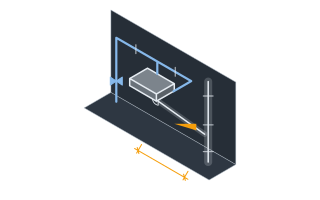
The total length of the pipe run needing support.
Measure the full straight run of pipe between anchor points that hangers will support.
The maximum spacing between hangers allowed by code for this pipe's material and size.
Look up the applicable maximum spacing in your plumbing/mechanical code's hanger spacing table (e.g. IPC Table 308.5) for the specific pipe material and diameter.
Pipe hangers needed
10 hangers
Maximum hanger spacing depends on your pipe's material and size per the applicable plumbing/mechanical code table (e.g. IPC Table 308.5) — confirm the correct maximum spacing for your specific pipe before finalizing hanger count.
- Bays along the pipe run
- 9
- Hanger centres along the pipe
- 7.33 ft
They open the calculator with your figures already in it
Pipe Hanger Spacing Calculator: 10 hangers — shown in imperial, US market. The link sets both, so the result they see is the one on your screen.
Show calculation logicHide calculation logic
How this was calculated
Formula source(s)
- Hanger count = ceil(pipe run length ÷ maximum hanger spacing) + 1, the standard layout method for spacing pipe supports at or within the maximum spacing permitted by plumbing/mechanical code for the pipe's material and size
Inputs used
- Pipe Run Length
- 66 ft
- Maximum Hanger Spacing (Per Code, by Pipe Size/Material)
- 8 ft
Intermediate steps
- Bays along the pipe run
- 9
- Hanger centres along the pipe
- 7.33 ft
Confidence note: Maximum hanger spacing depends on your pipe's material and size per the applicable plumbing/mechanical code table (e.g. IPC Table 308.5) — confirm the correct maximum spacing for your specific pipe before finalizing hanger count.
What this calculation does not cover
- The +1 in the count assumes a hanger sits at each end of the length you typed, so a line measured and entered in sections will be over-counted by one hanger at every join where two sections meet and share a single support.
- One spacing figure is divided into the whole run, which means a line that steps down in bore partway, changes material at a transition, or turns from a horizontal leg into a riser has to be entered as separate runs and the counts added — the arithmetic cannot hold two permitted spacings at once.
- Weight never enters the calculation: no bore, wall thickness, contained water or insulation is asked for, so the answer gives the number of support points and says nothing about rod diameter, hanger type, or whether the structure overhead can carry a filled line.
- The centres reported are an even division, which is why they come out under the maximum rather than on it: a 20 m run at a 2.4 m maximum is nine bays at roughly 2.22 m. Marking from one end at the full maximum instead is the other way to do it, and it leaves a short final bay to absorb — the page does not price that choice, and on a line with a fixed anchor at one end it may not be yours to make.
- The spacing box refuses anything above 4 m (about 13 ft) and the run length stops at 200 m (about 656 ft), so a longer continuous line, or a support interval wider than that ceiling, has to be broken into pieces and counted piece by piece.
Estimated cost — your price
This site holds no price list for this material — local prices vary too much to publish honestly. Enter your supplier's price and the result is costed with it.
Computed in your browser — nothing you enter is uploaded. Presented in US customary units and US trade terminology. Where a formula follows a published standard, that standard and its edition are cited beside it on this page; where none governs, the page says so. Local amendments override model codes — verify against the code in force where you build.
Sources checked 2026-09-05 · in the site-wide review of 2026-09-06 · v1.0.1
Regulatory standards & verification citations1
- Hanger count = ceil(pipe run length ÷ maximum hanger spacing) + 1, the standard layout method for spacing pipe supports at or within the maximum spacing permitted by plumbing/mechanical code for the pipe's material and size
Cite this page
Your workspace
Most jobs need more than one number. Add the calculators you need next and they open right here, underneath this one — your figures stay on screen and nothing is lost to a page change.