
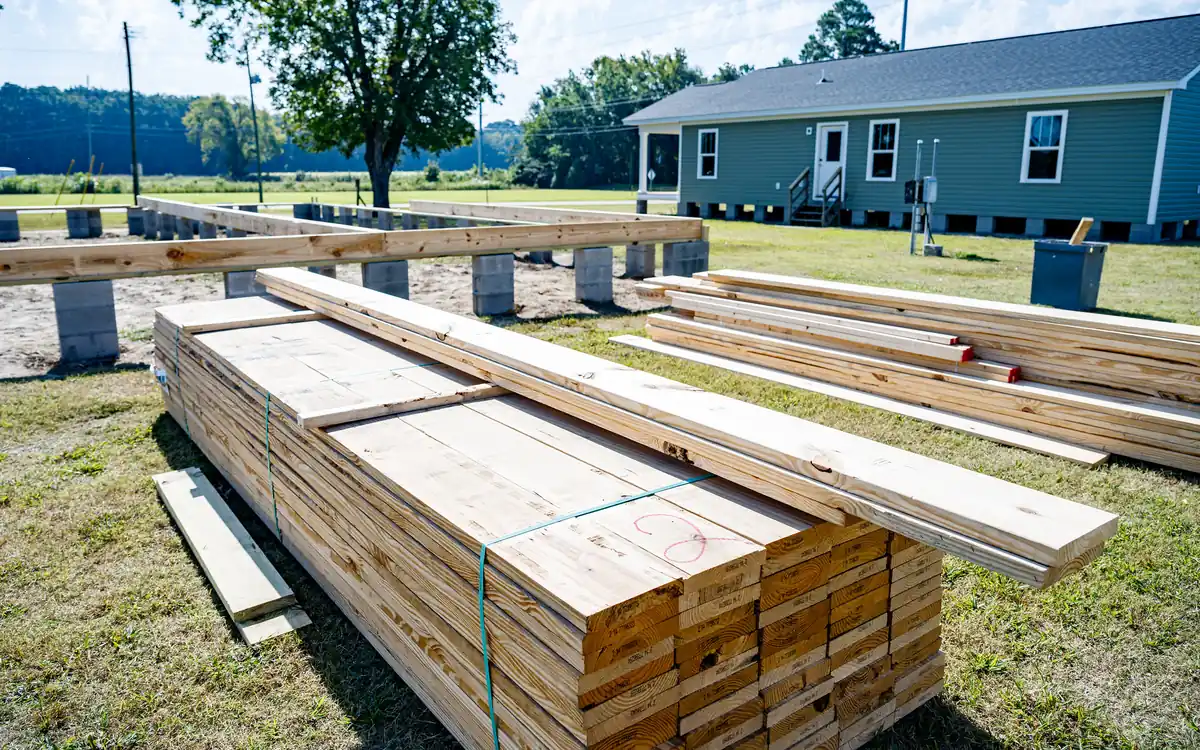
The quote had one line for it and the line said allow
A side-return infill on a Victorian terrace: L-shaped, twenty-four square metres of new floor, the back wall of the kitchen coming out, a strip footing round three sides, the old flag patio lifting to make room. The subcontract quote carries one line for the spoil and it reads muck away — allow. That line is doing four jobs at once, three settled before a machine is booked and one capable of doubling the whole figure on the strength of a sample nobody took.
There are two digs here and they are not the same shape of problem. The footing trench is seventeen metres at 600 wide and 1.1 deep, which is 11.2 cubic metres, and all of it leaves because concrete arrives to take its place. The reduced-level dig is the twenty-four square metres of floor taken down 350 to make room for hardcore, insulation and slab — 8.4 cubic metres, and the quantity most often left off a domestic price altogether, because it appears on no drawing as a line. It is implied by two levels, and implied quantities do not get priced.
Then there is the part that makes this a small-site job rather than an earthworks job. There is no rear access. The street is the yard, the side gate is 900 wide, the neighbour's car is on the shared drive by half past five, and whatever leaves has to leave past all three. On a site with a haul road the spoil question is a rate per cubic metre. Here it is a question about how many times a vehicle can stop outside a terraced house on a weekday, and that count is set by weight far more often than by cube.
The turf goes first and it must not go with the soil
Before any of the arithmetic there is a strip: the lawn across the footprint, the border along the boundary, the shrubs in the way of the barrow run, and the root mat under all of it. It is a trivial volume next to the dig — a few cubic metres here — and the easiest way on the job to turn a cheap load into an expensive one, because a soil load with green material in it stops being clean soil the moment somebody at the tip looks into the skip.
Measure it as any other strip is measured, area times an average depth, but take the depth honestly rather than calling it 100 millimetres because that is what topsoil is supposed to be. Under an old privet hedge the fibrous mat runs deeper than under a lawn, and the access strip you are about to barrow down for three weeks is different again from the border nobody has touched. Two or three small patches with a measured depth each beat one figure for the garden.
Where a strip covers real ground rather than a back garden the vegetation becomes the dominant stream and the job changes character; that version — brush volumes, stump tallies, what a green waste facility will and will not take — is worked through in the clearing and grubbing guide rather than here. On an extension this quantity has one job: stay in its own pile from the first hour, because it is the cheapest stream on site and it is standing next to the most expensive one.
Area times a measured mat depth, run once per patch rather than once for the garden — the footprint, the access strip and the border under the hedge are three different depths and the total is the pile that has to stay separate.
The total site area being cleared and grubbed.
The average depth of brush, vegetation, and root mat being removed across the area.
Estimated clearing debris volume
1,590 yd³
Vegetation density and root mat depth vary significantly across a site (denser in tree lines/hedgerows, shallower in open grass) — this uses a single average depth across the whole area; break large sites into sub-areas with different average depths for a more accurate estimate.
They open the calculator with your figures already in it
Land Clearing & Grubbing Debris Volume Calculator: 1,595 yd³ — shown in imperial, US market. The link sets both, so the result they see is the one on your screen.
Estimated cost — your price
This site holds no price list for this material — local prices vary too much to publish honestly. Enter your supplier's price and the result is costed with it.
What this calculation does not cover
- This is the mat as it stands, and nothing leaves site in that state. Torn-out brush and root mat bulks up hard once it is loaded — commonly two to four times the in-situ figure loose in a truck — so haulage is priced against a number several times this one. Chipping brings it most of the way back down and mulching in place removes it from the haul entirely, so the same result supports three completely different quantities depending on the disposal route chosen.
- An average depth spread over an area cannot see individual trees. A mature stump and its root ball is a volume in its own right sitting well below any brush-mat depth, and the trunk and canopy above ground are not a depth at all — a treed strip or a hedgerow yields a multiple of what its footprint suggests. Count anything much over 150 mm at the butt separately and add it on.
- Grubbings come out with soil attached, and that decides both what it costs and where it can go. Root mat holds a heavy fraction of dirt, which is what the weighbridge charges on, and it is also what stops the load being accepted as clean green waste at a composting site — mixed organic-and-soil material usually ends up at landfill on the higher rate.
One hole gets replaced, the other gets refilled, and only one of them is a haul
Not every trench on this job produces spoil that leaves. The footing trench does, completely, because concrete goes in behind the bucket and there is nothing to put the clay back into. The drain run out to the existing inspection chamber does not, or rather it does and then something else has to arrive to fill the void, because a 110 pipe wants a granular bed and surround and the specification for that comes from BS EN 1610 and Approved Document H, not from what happened to come out of the hole.
So the drain trench is a double movement, and it is the one people net off to zero in their heads. Nine metres at 500 wide and 800 deep is 3.6 cubic metres out. The pipe displaces less than a tenth of that, so the void is close to 3.5, and filling it needs more than 3.5 of loose stone because granular material consolidates as it is punned in layers. Around four cubic metres of shingle arrives on the same twelve metres of kerb a spoil wagon needs. Two movements, opposite directions, and if they are not sequenced somebody spends an afternoon shovelling stone off the pavement.
Run each trench with the pipe you are actually laying and read both halves of the answer: the excavation line in the breakdown is what leaves, and the headline is what has to arrive. On a job with a drain run, a water service and a duct to the garden room that pair repeats three times at three different sections, and the arriving side is the easy one to under-order, because it appears on no muck-away quote at all.
- Measure the footing trench as designed and treat all of it as leaving — concrete is replacing it, so nothing goes back.
- Measure each service trench separately with its own width, depth and pipe, because a 110 drain and a 25 water service do not share a section.
- Decide per trench whether the specification lets the arisings go back or calls for imported granular, and put the import on the delivery schedule the day you book the removal.
- Book the two movements on different days where there is only one place on the street to stop.
Nine metres of drain run at 500 wide and 800 deep with a 110 pipe: the breakdown's excavation line is what leaves site, and the headline is the loose granular that has to arrive to replace it.
The total length of the trench.
The width of the trench.
The depth of the trench.
The outer diameter of the pipe being laid; 0 for a trench with no pipe.
Depth of bedding material under the pipe; 0 if the pipe sits on the trench bottom.
Depth of the same bedding material over the top of the pipe; 0 for none.
Extra loose material needed to achieve full compaction in the void.
Loose backfill material needed
50.9 yd³
Assumes the excavated soil itself isn't reused as backfill (e.g. importing clean granular fill) — if reusing native soil, account for its own swell factor separately.
- Excavation volume (the depth entered)
- 48.89 yd³
- Pipe volume (subtracted)
- 4.6 yd³
- Compacted backfill void
- 44.29 yd³
They open the calculator with your figures already in it
Trench Excavation & Backfill Volume Calculator: 50.93 yd³ — shown in imperial, US market. The link sets both, so the result they see is the one on your screen.
Estimated cost — your price
This site holds no price list for this material — local prices vary too much to publish honestly. Enter your supplier's price and the result is costed with it.
The pipe is drawn to scale inside the trench. Backfill is everything else in the section, which is why the pipe diameter changes the answer at all.
What this calculation does not cover
- The trench is modelled as a plain rectangular prism — vertical faces, one width and one depth over the whole run. Battered or benched sides, the extra width a trench box needs, over-break outside the drawn line, and a bottom that falls with the pipe's gradient are all outside it. A run cut back to a safe slope holds considerably more than this figure, and the shortfall rises with the square of the depth rather than in proportion to it.
- This is a quantity take-off, not an excavation safety assessment. Nothing here classifies the soil, checks the depth against sloping, benching or shoring requirements, or sizes a protective system — that comes from a competent person on site, and past the depths the rules set, from an engineer.
- Only the single pipe you enter is deducted. A second pipe or duct sharing the trench, cable bundles, manholes, chambers, valve boxes, thrust blocks and concrete surround all displace backfill and are not subtracted. No check is made that the pipe fits the trench you described either: where its volume exceeds the excavation, the answer is floored at zero rather than reported as impossible geometry.
- At most two materials: a bedding and surround zone when you enter a bed or a cover, and one backfill above it at one flat percentage. The bedding row is an in-place volume across the full trench width, capped at the trench depth, with no compaction or waste allowance, so add your own for a graded bedding that is compacted. Marker tape or protective tiles, and the sub-base, blacktop or topsoil at the surface are further materials in further thicknesses and are not split out. The percentage is a loose-volume allowance on the backfill and nothing else — it is not a density or Proctor specification, and it says nothing about lift thickness or how many passes the plant makes.
- Nothing is said about the spoil. The excavation row is a bank volume measured in place, not the loose volume that leaves in the truck, and the calculation does not judge whether the arisings can go back, how much of the void they would fill, or what has to be carted away. Rock, groundwater and dewatering, and over-excavation to remove unsuitable ground are all excluded.
Twenty-seven cubic metres in the ground, thirty-four in the side return
Add the streams as they sit in the ground and the job makes about 26.8 cubic metres: 11.2 from the footings, 8.4 from the reduced level, 3.6 from the drain run and 3.6 from lifting the old patio and the sub-base under it. Nothing on this site will ever see 26.8 cubic metres of anything. The moment a bucket lifts it, that material occupies a quarter more space than the hole it came from, and the number that matters for the side return, the skip, the wagon and the bit of lawn you were going to keep clear is the larger one.
The factor is not a constant and it is not shared across the four streams. A broken sub-base, already loose, gains little. Topsoil off a lawn gains modestly. Firm clay from the bottom of a 1.1 metre footing trench comes out in lumps with voids between them and gains most, and clay lifted from real depth behaves more dramatically again — the deep trench-fill case, and the reason a quarter to a third is the working range, is set out properly in the guide on founding near trees. Run each stream on its own factor, taken from your ground data or from whoever hauls muck in your area rather than from a default.
The third column of the same conversion is worth a look even where there is nowhere to put anything. Recompacted, this material occupies less than it did in the ground, which is the arithmetic behind every decision to raise a garden level or backfill a soakaway surround with what you dug rather than what you bought. On a terraced infill the answer is usually that none of it stays — but it should be reached rather than assumed, because a cubic metre kept is a cubic metre never lifted, weighed, tipped or taxed.
One practical warning about the space itself. Thirty-four cubic metres of loose spoil in a side return 900 millimetres wide works out at a wall of muck three metres high running the length of the house — which is to say it will not stand there at all. What it does instead is spread across the ground you need for the scaffold, the mixer and the brick stack. Either the wagon arrives as the dig proceeds or there is a plan for where the heap lives, and dig-and-load is nearly always cheaper once double handling is counted.
Bank volume in, loose volume out, run once per stream rather than once for the job — and read the recompacted figure too, because anything you can legitimately keep never becomes a load at all.
The undisturbed, in-situ soil volume.
How much the soil expands once excavated and loosened, as a positive percentage.
How much smaller the soil ends up once recompacted, as a negative percentage.
Loose (haul) volume
163 yd³
Swell and shrinkage factors vary significantly by soil type and moisture content — use site-specific values from a geotechnical report or local hauling experience where available, rather than generic averages.
- Bank (in-situ) volume
- 130.75 yd³
- Compacted (recompacted) volume
- 117.68 yd³
They open the calculator with your figures already in it
Soil Swell & Shrinkage Haul Volume Calculator: 163 yd³ — shown in imperial, US market. The link sets both, so the result they see is the one on your screen.
Estimated cost — your price
This site holds no price list for this material — local prices vary too much to publish honestly. Enter your supplier's price and the result is costed with it.
What this calculation does not cover
- The swell and shrinkage percentages are figures you supply, not properties this page derives. Moisture content, fines content, how the material is dug and the compactive effort actually applied all move the real factors, and the same soil at a different moisture will not behave like the number you typed. Take the factors from the site investigation or measured local experience, not from a general table.
- This is a volume conversion, not a haulage calculation. It does not size trucks, count loads, or apply payload limits — wet or dense spoil often reaches a lorry's weight limit before it fills the body, and heap, tailgate profile and further bulking during loading all sit between this loose figure and a load count.
- The compacted figure is not a compaction specification. It assumes the placed fill achieves exactly the shrinkage percentage entered, and says nothing about the density the fill must be tested to, layer thickness, the plant used, or material rejected and reworked. It does not replace field density testing.
- One bank volume with one pair of factors. A mixed excavation — topsoil over clay over rock, or a trench through made ground — has different swell and shrinkage per stratum, and running the whole quantity at a single figure misstates both the haul and the fill. Topsoil stripping and unsuitable or contaminated material that leaves site instead of returning to fill are outside the model entirely.
- The loose volume describes material immediately after excavation. A stockpile consolidates under its own weight and with rain, so a survey of a pile that has stood for weeks comes back below this figure. Nothing here addresses waste classification, tipping, or duty-of-care disposal requirements for spoil going off site.
The stripped soil is the only stream that is worth something
Screened topsoil is a material people buy. The 3.6 cubic metres coming off the top of the reduced-level dig is roughly four and three-quarter cubic yards, and at the planning density this catalogue publishes for topsoil — about 1.2 short tons per cubic yard, near enough five and a bit tonnes here — it is a small delivery's worth of something the landscaping phase of this very job is going to order back in at the end. Tipping it in August and buying it in November is a fairly common way to pay twice for the same soil.
Whether it can be kept is a space question and a quality question, in that order. It needs somewhere flat, off the working area, off the ground you will later lay a slab on, and covered if it is sitting through a wet autumn — and it needs to actually be topsoil rather than the top of an old flowerbed with half a patio underneath. The weight is worth knowing even when it leaves, because soil holds water: the same cubic metres off a garden in February and in July are different tonnages, and where you pay by the tonne, part of what crosses the weighbridge is rain.
Convert the stripped volume to a weight at the topsoil density rather than the clay one — it is the lighter stream by a fifth, and it is the only one on this job with a market.
The volume of topsoil required, in cubic yards.
Approximate weight
12 short tons
About 1.2 short tons per cubic yard for screened topsoil at typical moisture; wet soil is appreciably heavier. This is a planning figure, not a specification. Confirm the density with your supplier before ordering by weight.
- Conversion factor applied
- 1.2 short tons per cu yd
They open the calculator with your figures already in it
Topsoil Cubic Yards to Tons Calculator: 12 short tons — shown in imperial, US market. The link sets both, so the result they see is the one on your screen.
Estimated cost — your price
This site holds no price list for this material — local prices vary too much to publish honestly. Enter your supplier's price and the result is costed with it.
What this calculation does not cover
- A cubic yard of bulk soil is usually a bucket count, not a measured volume. Damp soil both heaps above the bucket rating and sticks in the bucket rather than discharging, so the count runs either side of the true figure. The weighbridge ticket you pay against was not derived from it.
- This density is for loose soil in a heap. A volume measured in the ground — a strip depth over an area — is packed tighter than anything a loader can tip, so the same cubic yard weighs more in situ than loose. Spoil tonnages worked from excavation dimensions come out light.
- Topsoil is dense enough that weight ends the load, not space. A van or a car trailer reaches its rated payload with the body nowhere near full — the reverse of the mulch and compost that go on the same garden job, where space runs out first.
Topsoil is ordered by volume for a depth of cover and charged by weight at yards with a weighbridge, so the two units have to be reconciled before the order goes in. The density used here suits screened soil at ordinary moisture, and the caveat is unusually important for this material: soil holds water, and a load delivered after heavy rain can weigh substantially more per yard than the same soil dry. Where you are paying by the ton, that water is being purchased. Ordering after a dry spell, or agreeing the density with the supplier, is worth more on topsoil than on almost any other bulk material.
Weight is what a wagon runs out of first
The clay is the stream that fills the lorry, and it fills it long before it fills the body. Nineteen and a half cubic metres of it in the ground — footings, the subsoil half of the reduced level, the drain trench — is about 25.6 cubic yards, which at the catalogue's planning figure of roughly 1.5 short tons per cubic yard is near 38 short tons, call it 35 tonnes. Add five for the topsoil and something like six for the patio slabs and their sub-base, run through a rubble density rather than a soil one, and this modest extension is moving around forty-six tonnes off a terraced street.
One rule governs the conversion and it is the rule people get wrong: put the bank volume through the density, never the bulked one. Bulking adds air, air has no mass, and multiplying a swelled volume by a soil density invents a quarter of the tonnage out of nothing. The full working of that trap sits in the near-trees guide. The short version is that volume and mass need different inputs from the same takeoff, so carry both columns side by side and nobody has to remember which was which at eight in the morning.
Holding the tonnage rather than the volume matters because almost every commercial term downstream is expressed in it. Disposal is charged by weight. Landfill tax, where it applies, is charged by weight. The vehicle's legal ceiling is a weight, set by its plating and by the axle and gross limits in the Road Vehicles (Authorised Weight) Regulations 1998 — the haulier's compliance problem right up to the moment it becomes your programme problem at a weighbridge. A firm quoting per load is quoting against a payload they know and you do not, so ask for it in tonnes and do the division yourself.
Feed it the bank volume in cubic yards, not the bulked figure, and read the weight the haulier's plating is actually constrained by — the density behind it is a planning figure and the ticket is what settles the account.
The volume of clay soil in cubic yards.
Approximate weight
15 short tons
About 1.5 short tons per cubic yard for clay; heavier than loam and highly sensitive to moisture. A planning figure, not a specification. Confirm the density with your supplier before ordering by weight.
- Conversion factor applied
- 1.5 short tons per cu yd
They open the calculator with your figures already in it
Clay Soil Cubic Yards to Tons Calculator: 15 short tons — shown in imperial, US market. The link sets both, so the result they see is the one on your screen.
Estimated cost — your price
This site holds no price list for this material — local prices vary too much to publish honestly. Enter your supplier's price and the result is costed with it.
What this calculation does not cover
- Say which volume you measured. Clay in the ground and the same clay loose in a spoil heap are two different volumes of one material, and this page applies a single planning density to whichever number it is given — so the hole and the heap return different tonnages for the same dig. Settle which of the two you are working from before a load or a charge is planned on the answer.
- An excavation is rarely all clay. Topsoil at the surface, a stone band, old fill or a softer horizon at the base each carry their own weight per cubic yard, and putting the whole excavation volume through one clay density weighs all of it as clay. Split the volume by layer where the difference is large enough to change a load count.
- Treat this as a planning tonnage, not the figure a charge is settled on. Where haulage or disposal is priced by weight the weighbridge ticket governs; where it is sold as a fixed weight allowance per load, this is the number to test that allowance against. For excavated clay the rate per ton also turns on how the material is classified, which no density conversion can tell you.
Clay is the excavated material most likely to complicate a job, and its weight per cubic yard is high enough to matter for haulage. What makes clay difficult is not density but behaviour: it holds water, shrinks and swells with the seasons, and becomes unworkable when wet. Excavated clay also bulks substantially, so the spoil from a trench occupies noticeably more space than the hole it came from — which is why disposal volumes routinely exceed the excavation figure.
Grab or skip is decided at the kerb, not on the spreadsheet
There are three ways this material leaves a terraced house, and the geometry at the front picks between them before any arithmetic does. A skip stands on the drive or, with the highway authority's permission under section 139 of the Highways Act 1980, on the road — permitted, lit and marked to the Builders' Skips (Markings) Regulations 1984. A grab lorry stands in the road and lifts over a wall or hedge, so it never enters the property, but it wants clear airspace and a stable place to put its legs down. A tipper loaded by an excavator needs machine and lorry in the same place at once, which past a 900 millimetre side return means a conveyor, a dumper through the house, or a great deal of barrow.
Cube and weight give two different load counts and you want both. At around 33.5 cubic metres loose against a typical twelve-cubic-metre body, this job is three loads. At roughly forty-six tonnes against the payload an eight-wheel grab is plated for, it is four. The larger answer is the real one, and on soil it is nearly always the weight answer — which is why haulage firms will not put dense inert muck in their biggest containers, and why a skip on a drive full of wet clay is a conversation with the skip company rather than a delivery.
So the constraint is not cubic metres per day, it is stops per day. Each stop occupies the road, needs the neighbour's car gone, needs a banksman if it is reversing past a school run, and carries a cycle time back to wherever the tip is. Booking four loads for a day the site can absorb two of is how a machine ends up standing. Overloading is the costlier failure and it is invisible from the pavement: a grab body two-thirds full of saturated clay can be at its limit, and the driver stopping short is not being awkward. Fill to a line agreed with the operator rather than to the rim, and keep the wettest material for the loads with payload to spare.
| The constraint on the day | Points towards | Because |
|---|---|---|
| No off-street parking, spoil at the rear | Grab lorry | It loads over the boundary from the carriageway and never enters the property |
| Overhead cables or a mature street tree at the kerb | Skip or tipper | A grab arm needs clear airspace above the pick, and the pick is where the spoil is |
| Dig proceeding continuously with nowhere to heap | Tipper, wait-and-load | Machine loads straight into the body, so the spoil is never handled twice |
| Small quantities spread across weeks of second fix | Skip | It absorbs an irregular arising without a vehicle standing waiting for it |
| Heavy saturated clay, weight limit reached early | More visits, smaller container | The payload ceiling arrives before the volume ceiling and the container is never filled |
| Street with a weight restriction or a width restraint | Small tipper, many loads | The vehicle that can legally get there is the vehicle that sets the count |
Run the loose volume against each body size you have actually been offered, then check the same job by weight — the count you plan to is whichever of the two comes out higher.
The total material volume to haul.
The hauling capacity of the truck being used.
Truck loads needed
5 x 12 yd³ loads
Trucks are also limited by legal weight, not just volume — dense materials like gravel or wet soil may reach a truck's weight limit before filling its full volume capacity, requiring more, partial loads.
They open the calculator with your figures already in it
Dump Truck Load Calculator: 5 x 12 yd³ loads — shown in imperial, US market. The link sets both, so the result they see is the one on your screen.
Estimated cost — your price
This site holds no price list for this material — local prices vary too much to publish honestly. Enter your supplier's price and the result is costed with it.
What this calculation does not cover
- This counts volume only. It does not check payload, axle loading or gross vehicle weight, and a body filled with gravel, sand, wet clay or broken concrete normally reaches its legal weight limit before it is full — so dense material takes more trips than the volume count shows. It is not a legal load check; what the truck may legally carry is the hauler's call.
- The figure you enter is treated as loose, as-loaded volume. Excavated soil and demolition debris swell once they are dug out, and delivered fill loses volume once it is compacted in place, so a bank (in-ground) or compacted-in-place quantity entered here undercounts loads. Convert to a loose volume before using this.
- The three bed sizes are generic fleet sizes, not your truck. Rated capacity moves with body length, sideboard height and whether the quoted figure is struck (level) or heaped, and liners, tailgate gear and a worn body all change what actually goes in. Confirm the number with the hauler or rental yard.
- Nothing here covers getting the truck to the material. Site access and turning room, overhead clearance, tipping space, posted road and bridge weight limits, seasonal load restrictions and permits all change how many trips are actually possible, and none of them are modelled.
- One material, one truck type, and no cost. Loads that cannot be mixed — segregated waste streams, separate stockpiles — need their own counts, and haulage rates, tipping fees and disposal charges (often billed by weight or per ticket rather than per load) sit outside this calculation.
When the street will not take an eight-wheeler
Some jobs have no eight-wheel option: a weight-restricted lane, an unadopted road the residents' association will not have heavy vehicles on, a bridge with a plated limit, or simply a turning head that a rigid cannot get out of. What replaces it is a 3.5 tonne tipper, and the arithmetic changes shape completely because that vehicle's usable payload is a fraction of its gross weight once the body, the crew and a full tank are counted.
This is where the load-count box has to be filled in with a de-rated capacity rather than the body's cubic capacity, and it is the most common estimating error on a restricted street. A small tipper body might hold a cubic metre and a half heaped. It cannot carry a cubic metre and a half of loose clay, because loose clay at roughly 1.4 tonnes per cubic metre would put that vehicle well over its limit. Divide the legal payload the operator confirms by the loose density of the stream and enter that figure — for this job something nearer 0.8 cubic metres than 1.5. The 33.5 cubic metres then comes out at forty-two loads rather than twenty-three, which is a fortnight of vehicle movements past the neighbours instead of a week, and it changes the price, the programme and the conversation with the council in one step.
Enter the loose volume and, as the capacity, the vehicle's legal payload divided by the loose density of what it is carrying — not the cubic capacity of its body, which on soil it will never legally reach.
The total volume of subgrade material to be hauled off site.
The heaped or struck capacity of the dump truck bed being used for hauling.
Truck loads needed
17 truck loads
They open the calculator with your figures already in it
Road Subgrade Excavation Truck Fleet Calculator: 17 truck loads — shown in imperial, US market. The link sets both, so the result they see is the one on your screen.
Estimated cost — your price
This site holds no price list for this material — local prices vary too much to publish honestly. Enter your supplier's price and the result is costed with it.
What this calculation does not cover
- Fills the truck by VOLUME, and a haul truck usually fills by WEIGHT first. Payload is loose volume x loose density, and excavated wet clay at roughly 1.6 t/m³ (about 2,700 lb/yd³) puts 19 tonnes (21 tons) in a 12 m³ (16 yd³) box — past the legal axle load long before the material reaches the top of the sides. On heavy or saturated material the trip count comes off the truck's rated payload in tonnes, and this figure will be optimistic.
- Takes the rated bed capacity at face value. A heaped rating only holds for material that will stand in a heap: wet, sticky subgrade sheds off the sides, has to be sheeted, and leaves a skin in the box on every tip, so the volume actually moved per trip is nearer the struck capacity. Enter the struck figure for anything that will not heap.
Which of it is contaminated, and when you are obliged to know
Everything above assumes ordinary soil going to an ordinary destination, and whether that is true is a separate question with its own regime — answered before the disposal is booked, not when a load is turned away at a gate. In England and Wales the mechanism is the mirror entry: in the List of Waste established by Commission Decision 2000/532/EC, code 17 05 04 covers soil and stones and 17 05 03* covers soil and stones containing dangerous substances. Which of the pair applies is not a matter of opinion; it is assessed against the hazardous property criteria by the method in Technical Guidance WM3, published jointly by the Environment Agency, SEPA, Natural Resources Wales and the NIEA. In the United States the turning point is whether the soil contains a listed or characteristic hazardous waste under 40 CFR Part 261, the toxicity characteristic at 40 CFR 261.24 being tested by leaching rather than total concentration.
Hazardous classification and landfill acceptance are two different tests and it pays to keep them apart. WM3 or Part 261 decides what the waste is; whether a particular landfill can take it is decided by the waste acceptance criteria, the leaching limits and procedures established by Council Decision 2003/33/EC. That is why a soil can be perfectly non-hazardous and still fail to qualify as inert — non-hazardous, refused by an inert cell, accepted at a non-hazardous cell at a different rate, all on the same sample.
On a domestic extension the screening is done with your eyes and the property's history long before a laboratory sees anything. A Victorian terrace in an industrial town has a plot history: an ash pit at the back, a lean-to garage with an inspection pit, a demolished outbuilding whose rubble was pushed into the garden, an oil tank decommissioned by somebody's grandfather. Made ground is the signal, and it announces itself in the trial hole — ash, clinker, glass, slag, cement sheet fragments, a black or blue-grey horizon, a hydrocarbon smell, a sheen on standing water. Where the history raises a question, BS 10175 is the code of practice for investigating potentially contaminated sites and BS 5930 governs the ground investigation itself, with ASTM E1527 the equivalent Phase I framework in North American practice.
Asbestos in soil deserves its own sentence because it behaves unlike every other contaminant here. Asbestos-containing construction material carries an absolute entry in the List of Waste, 17 06 05*, which makes it hazardous regardless of concentration — and fragments of asbestos cement sheet in made ground are common on plots where a garage or shed was demolished before the 1990s. CIRIA C733, Asbestos in soil and made ground, is the reference for this case, and a fragment in a bucket is a stop-work moment rather than a note for the file.
Two other regimes touch the same soil without being the same question. Material a client wants to keep on the plot, or move to another site, may be able to travel as a non-waste under the CL:AIRE Definition of Waste: Development Industry Code of Practice — a document with real procedural requirements, not a label applied after the fact. And soil carrying an invasive plant is controlled for reasons that have nothing to do with chemistry, cannot be settled by a leaching test, and has its own guide rather than a half-treatment here.
| What you find | What it suggests | What it changes |
|---|---|---|
| Uniform brown clay with roots in the top 200 | Natural ground under a garden | Nothing — price it as soil and stones and move on |
| Ash, clinker and half bricks in a distinct layer | Made ground, probably a filled ash pit or levelled rubble | A sample before booking; made ground is where the surprises live |
| Fragments of grey cement sheet | Asbestos-containing material in the fill | Stop, and treat it as hazardous by absolute entry rather than by test |
| Black staining, hydrocarbon smell, sheen on water | A former tank, workshop floor or inspection pit | A contaminated land assessment before any disposal route is chosen |
| Concrete slab with a bituminous membrane under it | An old outbuilding base rather than a patio | Separate the arisings; the coated material is not clean rubble |
| Rubble and soil intimately mixed and unsortable | Nothing separable at the tip either | The whole load prices at the mixed rate, so segregate at the dig face |
The spread between the rates is the argument for testing
Classification is worth money, not merely worth doing, because of the size of the gap it sits on. Inert, non-hazardous and hazardous soil are three gate rates at three facilities, and on top of the facility's own charge sits the disposal tax the jurisdiction applies — in England and Northern Ireland, Landfill Tax under the Finance Act 1996, charged per tonne at a standard rate with a lower rate for the qualifying materials listed in the Landfill Tax (Qualifying Material) Order 2011, and in Scotland and Wales the devolved taxes that replaced it on the same shape. This site publishes no rates, because they are local and they are revised, but the shape is stable: across forty-six tonnes the distance between the top and the bottom of that range dwarfs the cost of a sample.
So run the disposal twice. Take the tonnage the streams actually produced, price it at the clean-soil rate you have been quoted and again at the contaminated rate, and look at the difference. That difference is the exposure you carry on a plot with a history that nobody has tested, and it is the number that turns a testing schedule from an expense into an insurance premium in front of a client. It is also what justifies segregating at the dig face, because a small quantity of bad material in a good load prices the whole load at the bad rate.
Two things to confirm before entering anything. The unit the facility quotes in, because a rate per short ton and a rate per tonne differ by about a tenth and both are spoken aloud as a ton. And what sits inside the quoted figure: whether tax is included or added, whether a minimum charge makes a part load cost the same as a full one, and whether the material has to be tested to the facility's own schedule before they will take a booking at that rate at all.
Price the same tonnage twice, once at the clean-soil rate and once at the contaminated rate that facility quotes, and read the gap — that gap is what an untested plot is costing you in risk.
The total weight of the debris load.
The disposal facility's rate charged per ton.
Debris weight
24,000 lb
Figures that depend on a rate wait for yours — this page does not assume one.
They open the calculator with your figures already in it
Landfill Tipping Fee Cost Calculator: 24,000 lb — shown in imperial, US market. The link sets both, so the result they see is the one on your screen.
What this calculation does not cover
- Weight times rate is the marginal cost, not the invoice. Most facilities set a minimum gate charge and many price pickups and small trailers at a flat per-load rate whatever is on them, so a half-full load does not cost half what a full one costs — it costs the minimum. On small loads the rate by weight stops describing what you will be billed.
- Nothing here covers what the gate adds or refuses. State and county disposal taxes, host-community fees and fuel surcharges are levied on top of the posted rate, and prohibited items — tires, mattresses, appliances holding refrigerant, treated timber, gypsum, anything suspected of containing asbestos — carry their own per-unit charges or turn the whole load away at the scale with the round trip already spent.
- The tip fee is often the smaller half of disposal. Getting the material there is truck, fuel and driver hours each way, and a job that fills more loads than planned multiplies that leg without moving the per-ton rate at all — which is why the debris's bulk density, not just its weight, is what really drives disposal cost.
The tickets outlive the extension
Waste does not stop being your problem when it leaves the plot. In England and Wales the duty of care under section 34 of the Environmental Protection Act 1990, elaborated by the Waste (England and Wales) Regulations 2011 and the statutory code of practice, makes the producer responsible for satisfying themselves that the carrier is authorised and the destination appropriate, and it does not lapse when the wagon turns the corner. Check the carrier's registration on the regulator's public register rather than on the side of the lorry. Take a transfer note describing the waste, its code and its quantity for every movement, and where any of it is hazardous, a consignment note under the Hazardous Waste (England and Wales) Regulations 2005 as well.
Keep them, for the period the regulations set rather than the period that suits. The practical reason is a fly-tipping enquiry two summers later that traces a heap in a lane back to a plot, at which point a folder of tickets is the difference between a conversation and a prosecution. The same folder is what a warranty provider or a purchaser's solicitor asks for when the question is what was under the extension and where it went.
There is a smaller and purely selfish reason to keep the weighbridge tickets: they are the only measured data this job produces. Set them against what you predicted, stream by stream, and the gap says whether the density was wrong, the bulking factor was wrong, or the dig went deeper than the drawing. Three extensions on the same clay and the fourth is priced off your own tickets instead of a planning figure — which is the only way that muck away — allow line ever becomes a number you can defend.
Settle these before the muck-away is booked
Six things that decide what leaves this plot, in what vehicle and at what rate. The workspace opens on the job above — 26.8 cubic metres in the ground, a quarter of bulking on the way out — so replace the volume with your own and run the streams separately.
- Bank volume, split by stream — Footings, reduced level, service trenches and the old hard standing measured as four quantities, because they have four densities and four destinations.
- Strip depth measured on a spade face — Topsoil and root mat taken zone by zone rather than called 100 millimetres, and kept in its own pile from the first hour.
- A swell factor per stream — From your own ground data or your muck-away firm; made ground, topsoil and clay dug from the bottom of a footing trench do not share one.
- Tonnage worked from bank volume, never bulked — Mass does not bulk. Volume decides the space and the container; weight decides the vehicle, the tax and the gate.
- The vehicle's confirmed payload, not its body size — Ask the operator in tonnes and divide by the loose density yourself — on soil the weight ceiling arrives first every time.
- Plot history and a look in the trial hole — Ash, clinker, cement sheet, staining or a smell means a sample before a booking; the mirror entry is decided by assessment, not by hope.
Opens the calculators above on one screen with the dimensions from this article already filled in. Quantities only — this site publishes no price list, because local prices vary too much to publish honestly.