
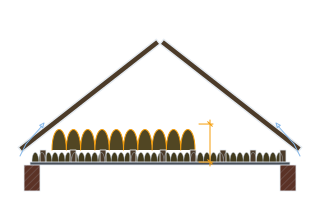
SettingsSettings for this calculationUS
Your attic's existing insulation R-value.
If unknown, measure existing insulation depth and multiply by its material's R-per-inch, or have an energy auditor assess it.
The recommended attic R-value for your climate zone.
Many North American climate zones recommend R-49 to R-60 for attics — check your local energy code or a climate zone insulation guide for your specific area.
Different materials need different depths to reach the same R-value.
Cellulose has the highest R-per-inch of these three, meaning it reaches a target R-value at a shallower depth.
Additional insulation depth needed
12 in of additional insulation
R-per-inch varies somewhat by brand and how densely the material settles over time — check your specific product's published R-value chart.
- Additional R-value needed
- 30 R
They open the calculator with your figures already in it
Attic Insulation Upgrade Calculator: 12 in of additional insulation — shown in imperial, US market. The link sets both, so the result they see is the one on your screen.
Show calculation logicHide calculation logic
How this was calculated
Formula source(s)
- Standard published R-value per inch for loose-fill blown insulation: fiberglass ~2.5, cellulose ~3.7, mineral wool ~3.0
- Additional depth needed (in) = (target R-value - current R-value) / R-value per inch of the chosen material
Inputs used
- Current Attic R-Value
- 19
- Target R-Value
- 49
- Insulation Type
- Blown fiberglass
Intermediate steps
- Additional R-value needed
- 30 R
Confidence note: R-per-inch varies somewhat by brand and how densely the material settles over time — check your specific product's published R-value chart.
What this calculation does not cover
- The model uses one nominal R-per-inch per material — blown fiberglass 2.5, cellulose 3.7, mineral wool 3.0. Real loose-fill R-per-inch shifts with installed density and with how far the material settles, so install to the depth your product's coverage chart gives for that R-value. This returns depth only: no bag count, no coverage per bag.
- The depth is sized for the insulation on its own. Joists and truss chords bridging the fill, thin coverage at the eaves and around penetrations, and air leakage through the ceiling plane all leave the finished ceiling below the target R. Air sealing the ceiling plane before you blow is usually worth more than the last increment of depth.
- Nothing here checks whether the attic can take the added depth. Soffit baffles and eave clearance, ventilation, joist height and any loss of walkway or storage, clearance around chimneys and flues, recessed lights not rated for insulation contact, and knob-and-tube wiring are install and fire-safety questions this calculation does not touch — settle them before ordering.
- Your current R-value is taken at face value. Settled, compressed, wind-washed or damp insulation is worth less than its depth times a published R-per-inch, and material that is wet or rodent-fouled has to come out rather than be covered. Neither condition is detected here.
- The target is whatever you type: no climate zone lookup, no energy code or rebate threshold check, and no payback, energy saving or condensation risk assessment. Both R-value fields are US customary R (ft²·°F·h/BTU) — RSI figures entered here return a depth several times too shallow.
Add the equipment this sizes
This result is a specification — 12 in of additional insulation — not a quantity. Put the thing it sizes into your project: how many, what you call it, and your supplier’s price.
Part of bigger jobs
This trade is one line of a job takeoff. Run the whole job and every other trade comes back with it, off the same measurements.
Or plan the space itself: measure it once, doors and windows included, and this figure comes back worked out on that space, with what goes with it.
also measuresBlown-In Insulation Bag Count
Computed in your browser — nothing you enter is uploaded. Presented in US customary units and US trade terminology. Where a formula follows a published standard, that standard and its edition are cited beside it on this page; where none governs, the page says so. Local amendments override model codes — verify against the code in force where you build.
Sources checked 2026-09-02 · in the site-wide review of 2026-09-06 · v1.0.1
Regulatory standards & verification citations2
- Standard published R-value per inch for loose-fill blown insulation: fiberglass ~2.5, cellulose ~3.7, mineral wool ~3.0
- Additional depth needed (in) = (target R-value - current R-value) / R-value per inch of the chosen material
Cite this page
Your workspace
Most jobs need more than one number. Add the calculators you need next and they open right here, underneath this one — your figures stay on screen and nothing is lost to a page change.
Protection this work requires
- Stop and check first. Textured ceiling coatings, board behind panels, floor tiles and bitumen adhesive in older buildings — built before asbestos was banned or phased out where you are — can contain asbestos, and drilling or sanding them releases fibres. Do not disturb it — have it sampled first. This is not a job for better PPE.
Tools and safety for this job
To fit batt insulation. Generic types, no brands, no prices.
- Mineral and glass wool irritate skin, eyes and airways: cover your arms, wear a P2/N95 respirator while cutting, and rinse in cold water — hot water drives fibres in.
- Most fatal falls on small jobs are from under three metres: use a tower or a ladder tied at the top, and never work off the top two rungs.
- Knives cause more site injuries than any power tool: cut away from your body, change blades often, and wear cut-resistant gloves to EN 388 level C for repeated cutting.
Show the 5 tools this job needsHide tools
Essential
Tape measure
Utility knife
Recommended
Staple gun
Step ladder
Optional
Dust extractor or vacuum with a fine filter
Also needed as materials: replacement blades, staples.
what each insulation tool is for, and the spec that decides which to buy where one does.