
SettingsSettings for this calculationUS
The combined area of the windows being replaced.
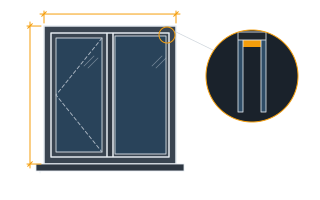
Measure each window's height x width and add them together.
Lower U-factor means better insulation — check the window's label or use a typical value for its type.
Single-pane windows are commonly around U-1.0; older double-pane without low-E coating around U-0.5.
The U-factor of the replacement windows, from their NFRC label.
Modern double-pane low-E windows are commonly U-0.25 to U-0.35; triple-pane can be lower still.
The typical indoor-to-outdoor temperature difference on a cold winter day.
70°F indoors minus a 20°F winter design outdoor temperature gives a 50°F difference — check your climate's typical winter design temperature.
Heat loss reduction
3,850 BTU/hr reduction
This estimates the heat-loss-rate reduction at design conditions, not a full seasonal energy cost — actual dollar savings also depend on your heating system's efficiency, fuel cost, and how many hours per year approach the design temperature difference.
- U-factor improvement
- 0.7 U
They open the calculator with your figures already in it
Window Heat Loss Savings Calculator: 3,850 BTU/hr reduction — shown in imperial, US market. The link sets both, so the result they see is the one on your screen.
Show calculation logicHide calculation logic
How this was calculated
Formula source(s)
- Standard heat loss formula: Q = U x Area x temperature difference; savings = (U-old - U-new) x window area x design temperature difference
Inputs used
- Total Window Area
- 110 sq ft
- Current Window U-Factor (BTU/hr·ft²·°F)
- 1
- New Window U-Factor
- 0.3
- Design Temperature Difference
- 50 °F
Intermediate steps
- U-factor improvement
- 0.7 U
Confidence note: This estimates the heat-loss-rate reduction at design conditions, not a full seasonal energy cost — actual dollar savings also depend on your heating system's efficiency, fuel cost, and how many hours per year approach the design temperature difference.
What this calculation does not cover
- Conduction only. Air moving through worn sash seals, failed hardware and the joint between frame and wall is often the larger share of what a draughty window costs in winter, and none of it is in this number — a replacement window renews all of it and gets no credit here.
- Solar heat gain is outside the model. A lower-U replacement commonly carries a lower SHGC as well, which cuts the free winter gain the old glass was admitting and pulls the net benefit below the figure shown; on a west or south elevation the same change is mostly a summer cooling story this calculation never counts.
- This is a heat loss RATE at one design condition, not an annual figure. There are no degree days, no boiler, furnace or heat pump efficiency, no fuel price and no allowance for how few hours a year actually approach the design temperature difference, so it cannot be multiplied out to a yearly saving or a payback. It is also not a room or dwelling heat loss calculation and not a compliance check against a fenestration U-factor limit.
- Both U-factors are taken as whole-window ratings covering the glass, the edge-of-glass band and the frame. Enter a centre-of-glass figure and the loss of both windows is understated. Nothing here accounts for how the unit is actually fitted either — thermal bridging at head, jamb and sill, and an unsealed or unfilled gap between frame and structural opening, all sit outside the rating.
- Nothing converts or checks the U-factor you type. The two fields are the North American IP convention, BTU per hour per square foot per degree Fahrenheit, so a product rated in W/m²K must be divided by 5.678 before it goes in — a raw EN figure entered anywhere below the field's maximum of 1.3 is accepted without complaint and produces an answer roughly 5.7 times too large.
Add the equipment this sizes
This result is a specification — 3,850 BTU/hr reduction — not a quantity. Put the thing it sizes into your project: how many, what you call it, and your supplier’s price.
Part of a bigger job
This trade is one line of a job takeoff. Run the whole job and every other trade comes back with it, off the same measurements.
Computed in your browser — nothing you enter is uploaded. Presented in US customary units and US trade terminology. Where a formula follows a published standard, that standard and its edition are cited beside it on this page; where none governs, the page says so. Local amendments override model codes — verify against the code in force where you build.
Sources checked 2026-09-06 · in the site-wide review of 2026-09-06 · v1.1.1
Regulatory standards & verification citations1
- Standard heat loss formula: Q = U x Area x temperature difference; savings = (U-old - U-new) x window area x design temperature difference
Cite this page
Your workspace
Most jobs need more than one number. Add the calculators you need next and they open right here, underneath this one — your figures stay on screen and nothing is lost to a page change.