
SettingsSettings for this calculationUS
The standard allowance most suppliers and estimating guides assume for ordinary work.
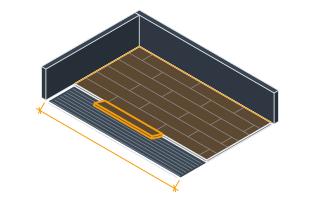
The floor area the screed covers.
Take the whole poured area, including any perimeter strip left untubed — the screed goes there too. Where several rooms are poured in one operation but tubed at different centres, run each zone separately and add the results, since the displacement differs between them.
Screed depth measured from the top of the tube to the finished surface.
This is the dimension a heated floor specification actually controls, because it governs both the screed's strength over the tube and how evenly heat spreads before it reaches the surface. It is not the total screed depth; the calculator adds the tube's own diameter to get that.
Outside diameter of the heating tube itself.
Outside, over the wall of the pipe — that is what sits in the screed and what displaces it. Pipe is often named by a nominal size that matches neither its bore nor its outside dimension, so take the figure from the manufacturer's data rather than from the product name.
Centre-to-centre spacing of the tube runs across the floor.
Used to work out how much tube is in the floor, and therefore how much screed it pushes out of the way. Tighter centres near external walls raise the displacement locally; where a zone is deliberately split into two spacings, calculate the two areas separately.
Density of the hardened screed mix being placed.
Sand-cement and flowing anhydrite screeds sit near the top of this range; lightweight and fibre-modified mixes sit well below it. This drives only the mass figure, so a rough value here does not disturb the volume the rest of the page is built on.
The finished volume one bag makes up, taken from the bag itself.
Yield is a mixed-and-placed figure, not the dry contents, and it moves with how much water the mix takes. Where the material is being delivered as a pumped screed rather than in bags, ignore this line and order against the volume and mass instead.
Extra for an uneven substrate, spillage and the mixer's leavings.
The dominant term on most floors is not spillage but substrate tolerance: a slab a few millimetres low over part of its area quietly absorbs a real percentage of the pour. Where the base has been surveyed and is known to be flat, this can come down.
Screed volume required
6.797 yd³
- Screed thickness over the substrate
- 2.38 in
- Volume before the tube displacement is taken out
- 6.32 yd³
- Volume displaced by the tube
- 0.14 yd³
- Length of tube in the floor
- 1,720 ft
- Screed mass at the density entered
- 12.03 tons
- Bags to order
- 368 bags
They open the calculator with your figures already in it
Heated Screed Volume Calculator: 6.8 yd³ — shown in imperial, US market. The link sets both, so the result they see is the one on your screen.
Show calculation logicHide calculation logic
How this was calculated
Formula source(s)
- Gross volume = floor area × (cover over the tube crown + tube outside diameter). Displaced volume = π/4 × diameter² × total tube length, with tube length taken as area ÷ tube centres. Net screed is the difference, before the waste allowance.
- BS 8204, Screeds, bases and in-situ floorings — the series covering screed thickness, strength and soundness over a heated build-up
- EN 1264, Water-based surface embedded heating and cooling systems — where the required cover over the tube comes from; take the figure from it or from the system supplier rather than assuming one here
Inputs used
- Heated Floor Area
- 860 sq ft
- Cover Over the Tube Crown
- 1.75 in
- Tube Outside Diameter
- 0.63 in
- Tube Centres
- 6 in
- Hardened Screed Density
- 131.1 pcf
- Yield per Bag
- 0.5 ft³
- Waste Allowance (%)
- 10
Intermediate steps
- Screed thickness over the substrate
- 2.38 in
- Volume before the tube displacement is taken out
- 6.32 yd³
- Volume displaced by the tube
- 0.14 yd³
- Length of tube in the floor
- 1,720 ft
- Screed mass at the density entered
- 12.03 tons
- Bags to order
- 368 bags
What this calculation does not cover
- Assumes the tube sits on the substrate or a thin clip rail. Tube carried on a raised rail or a profiled panel needs that build-up added to the cover depth.
- Perimeter edge strip, movement joint fill and any levelling compound over the finished screed are separate items.
Estimated cost — your price
This site holds no price list for this material — local prices vary too much to publish honestly. Enter your supplier's price and the result is costed with it.
Part of a bigger job
This trade is one line of a job takeoff. Run the whole job and every other trade comes back with it, off the same measurements.
Computed in your browser — nothing you enter is uploaded. Presented in US customary units and US trade terminology. Where a formula follows a published standard, that standard and its edition are cited beside it on this page; where none governs, the page says so. Local amendments override model codes — verify against the code in force where you build.
Sources checked 2026-09-02 · in the site-wide review of 2026-09-06 · v1.0.1
Regulatory standards & verification citations3
- Gross volume = floor area × (cover over the tube crown + tube outside diameter). Displaced volume = π/4 × diameter² × total tube length, with tube length taken as area ÷ tube centres. Net screed is the difference, before the waste allowance.
- BS 8204, Screeds, bases and in-situ floorings — the series covering screed thickness, strength and soundness over a heated build-up
- EN 1264, Water-based surface embedded heating and cooling systems — where the required cover over the tube comes from; take the figure from it or from the system supplier rather than assuming one here
Cite this page
Your workspace
Most jobs need more than one number. Add the calculators you need next and they open right here, underneath this one — your figures stay on screen and nothing is lost to a page change.
Tools and safety for this job
To lay a floor screed. Generic types, no brands, no prices.
Protection this work requires
- Cutting or grinding concrete, masonry, screed, tile or fibre-cement board releases respirable silica: cut wet or extract at the tool, and wear a P2/N95 respirator at minimum — a nuisance dust mask does not filter it.
- Wet cement and lime burn skin and eyes painlessly until the damage is done: waterproof gloves to EN 374, safety glasses whenever the mix can splash, and never kneel in wet mix in permeable trousers.
- Boards, blocks and bagged material cause most lasting back injuries on small sites: two people or a lifter for full sheets, and never a bag on one shoulder up a ladder.
Show the 6 tools this job needsHide tools
Essential
Mixing bucket or tub
Screed bar or rail
Shovel and spade
Spirit level
Recommended
Moisture meter
Paddle mixer
what each flooring tool is for, and the spec that decides which to buy where one does.