
SettingsSettings for this calculationUS
Waste is set to 5% by hand. Pick a tier above to replace it, or keep your own figure.
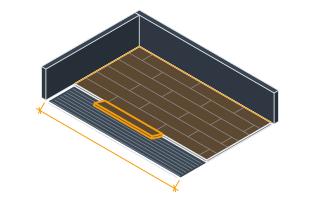
The area of floor the screed covers, room by room where the depth changes.
Length times width of each room, added together. Measure inside the walls; the edge strip round the perimeter takes almost nothing. Where one area is laid deeper than the next (a bathroom dropped for a level-access shower, a kitchen built up to meet a hall), run each at its own depth and add the answers, because one averaged depth gives the wrong order for both.
Tools needed: Tape measure
The depth the screed is laid at on average across the floor, not only its thinnest point.
Over a flat, level base this is the specified depth. Over a base that is out of level the screed runs deeper in the low places, so take levels on a grid, from a datum at the finished floor level, and use the average of the depths you find. The thickness calculator works out how deep the screed must be at its thinnest; this page needs the depth averaged over the whole floor, which is what the volume is made of.
Tools needed: Laser or optical level, Staff or tape
Bonded to the base, separated from it, or floating on insulation: it sets the least depth shown, not the volume.
This changes no quantity. It picks the least depth the page sets beside your depth: BS 8204-1's for a cement and sand screed, and Anhydritec's for its calcium sulfate screed. A screed over insulation is floating; one over a damp-proof membrane laid on the slab is unbonded; only a screed laid onto a prepared slab with a bonding coat is bonded.
Mixed on site from sand and cement, delivered ready to lay, from bags of premix, or pumped as a liquid screed.
Each arrives in its own unit, so the order changes with it. Site-mixed screed is bought as cement in bags and sharp sand by weight. A ready-to-use screed comes from a plant, retarded so it stays workable through the day, and is sold by weight. A bagged premix needs only water and is counted in bags. A liquid calcium sulfate screed is pumped from a truck mixer and booked by volume. The depth a floor needs also differs: a flowing calcium sulfate screed can be laid far thinner than a cement and sand one, which is where most of the difference in material comes from.
Parts of sand for each part of cement, by weight. 1 : 4 is the usual screed.
BS 8204-1, as the Mineral Products Association reports it, recommends nominal proportions by weight of 1 : 4 cement to sand, with 1 : 3 the richest and 1 : 4.5 the leanest it recommends for a levelling screed. A specification that names a ratio governs over the page's. Merchants often quote a screed by volume instead: Marshalls sells 1 : 3 for heavy duty, 1 : 4 for general purpose and 1 : 5 for light duty, all as volume proportions, and a ratio by volume is not the same mix as the same ratio by weight, so read theirs as theirs. The 1 : 5 here is by weight, as Sika's data sheet gives one for its screed binder; the page works it out and says it sits outside the standard's range.
How much sand and cement, as batched, a volume of compacted screed holds: 2,000 kg/m³ (125 lb/ft³) on Sika's figures.
The bridge from a volume of screed to the weights you buy, because the cement fills the spaces between the sand grains and the two volumes never simply add. Sika's data sheet for its screed binder puts 400 kg/m³ (25 lb/ft³) of binder into fresh mortar at 1 : 4 with sand by weight, which makes 2,000 kg/m³ (125 lb/ft³) of material as batched; the sheet does not say whether its sand is dry or damp. Its leaner mixes come out at 2,030 and 2,040 kg/m³ (127 lb/ft³ to the nearest pound), so the figure hardly moves with the ratio. A supplier who quotes a different figure for the sand you are buying, or for a different binder, is the one to use.
The weight of one bag of cement as sold: 25 kg (55 lb) in the UK, a 94 lb (42.6 kg) sack in the US.
Read it off the bag. UK cement comes in 25 kg (55 lb) bags; in the US, portland cement is sold in 94 lb (42.6 kg) sacks, and QUIKRETE also packs it in 47 lb (21.3 kg) bags. For a screed binder rather than plain cement, enter that binder's bag, and use its maker's figure for the sand and cement in a volume laid if the data sheet gives one.
Extra on top of the volume for spillage, the mixer's leavings and edges. Holcim UK recommends 5%.
Holcim UK's screed calculator recommends allowing a 5% margin to cover additional needs, and that is where this opens. It is not the place to absorb a base that is out of level: a floor that runs a little deep over all of its area is a bigger depth, and an average depth is the better way in. Raise the margin for small rooms, many doorways and hand mixing in batches.
Screed to order, margin included
2.139 yd³
The cement and the sand share the mix by weight at the ratio chosen, so at 1 : 4 one part in five is cement; the cement is rounded up to whole bags and the sand is shown by weight. BS 8204-1, as the Mineral Products Association's screed data sheet reports it, gives 65 mm (2.56 in) as the least depth for a floating cement and sand screed in housing.
- Screed volume at the depth entered
- 2.04 yd³
- Sand and cement together, as batched
- 3.61 tons
- Cement by weight
- 1,442.09 lb
- Cement bags at the size entered
- 16 bags
- Sharp sand by weight
- 2.88 tons
- Least depth for this screed laid this way
- 2.56 in
They open the calculator with your figures already in it
Floor Screed Calculator — Sand and Cement, Bagged or Liquid: 2.14 yd³ — shown in imperial, US market. The link sets both, so the result they see is the one on your screen.
Show calculation logicHide calculation logic
How this was calculated
Formula source(s)
- Mineral Products Association, MPA Mortar Data Sheet 22, Screeds (Issue 3, October 2023), reporting BS 8204-1: a bonded screed at least 25 mm thick, with 40 mm normally specified to accommodate deviations in the base; an unbonded screed at least 50 mm, with 70 mm specified; a floating screed at least 75 mm, although 65 mm is normally considered satisfactory for domestic housing; nominal proportions by weight of cement to fine aggregate of 1:4, with a lower limit of 1:3 and an upper limit of 1:4.5
- Anhydritec Ltd, Gyvlon XTR free flowing calcium sulfate screed (NBS Source product page): minimum thickness bonded 25 mm, in contact with the substrate 30 mm, unbonded 30 mm, floating domestic 35 mm, floating commercial 40 mm, and 25 mm (30 mm nominal) cover to underfloor heating pipes; wet density 2,200 kg/m³, dry density 2,000 kg/m³
- ARDEX UK, ARDEX A 70 GYPFLO product data sheet (July 2019), a bagged calcium sulphate flowing screed: minimum thickness floating 35 mm domestic and 45 mm commercial, unbonded 30 mm domestic and 40 mm commercial; a 25 kg bag covers approximately 0.4 m² at 35 mm — a second maker's figures, which is why the page names whose minimum it quotes
- Sika, SikaScreed-40 Binder product data sheet (Version 04.01, February 2026): binder to sand by weight, 400 kg of binder per m³ of fresh mortar at 1:4 (4 bags of 20 kg to about 320 kg of aggregate in a 200 litre mixer), 340 kg at 1:5 and 290 kg at 1:6 — 2,000 kg of material as batched in each cubic metre at 1:4; the sheet does not say whether the aggregate is dry
- Marshalls, Factory Batched Screed data sheet (13 April 2018), ready-to-lay retarded cement and sand screeds: coverage 45.0 m² a tonne at 10 mm, 18.0 at 25 mm, 9.0 at 50 mm and 6.0 at 75 mm, which is 0.45 m³ of laid screed a tonne; its traditional levelling screeds are sold in volume proportions, 1:3 for heavy duty, 1:4 for general purpose and 1:5 for light duty
- ARDEX UK, ARDEX A 38 MIX product data sheet (January 2024), a pre-blended cement and graded sand screed in 25 kg bags: material requirement approximately 1.85 kg per m² per millimetre of thickness, about 0.5 m² at 25 mm a bag; laid bonded at 15–40 mm, unbonded from 40 mm, floating from 75 mm or 65 mm in lightly loaded or domestic locations
- QUIKRETE Sand/Topping Mix (No. 1103) data sheet (revised December 2022): for overlays less than 2 in (50 mm) thick and thick setting beds for floor tile; an 80 lb bag yields approximately 0.66 ft³ (18.7 L), and the Canadian 25 kg bag approximately 0.46 ft³ (13 L)
- QUIKRETE Portland Cement (No. 1124) data sheet (revised August 2022): sold in 94 lb (42.6 kg) bags, among other sizes
- Holcim UK, Screed Calculator: "We recommend allowing for a 5% margin to cover additional needs" — the margin this page opens on
- Heidelberg Materials UK, Sharp Sand product guide: a washed sand to BS EN 13139 for screeds, with a typical moisture content of 5%
Inputs used
- Floor Area
- 220 sq ft
- Average Screed Depth
- 3 in
- How the Screed Is Laid
- Floating on insulation, in housing
- Screed Type and How It Arrives
- Sand and cement, mixed on site
- Mix Ratio, Cement to Sand by Weight
- 1 : 4 by weight (BS 8204-1's nominal mix)
- Sand and Cement per Volume Laid
- 124.86 pcf
- Cement Bag Size
- 94 lb
- Ready-to-Use Screed per Volume Laid
- 138.59 pcf
- Yield of One Bag of Screed Mix
- 0.66 ft³
- Waste / Over-Order (%)
- 5
Intermediate steps
- Screed volume at the depth entered
- 2.04 yd³
- Sand and cement together, as batched
- 3.61 tons
- Cement by weight
- 1,442.09 lb
- Cement bags at the size entered
- 16 bags
- Sharp sand by weight
- 2.88 tons
- Least depth for this screed laid this way
- 2.56 in
Confidence note: The cement and the sand share the mix by weight at the ratio chosen, so at 1 : 4 one part in five is cement; the cement is rounded up to whole bags and the sand is shown by weight. BS 8204-1, as the Mineral Products Association's screed data sheet reports it, gives 65 mm (2.56 in) as the least depth for a floating cement and sand screed in housing.
What this calculation does not cover
- The volume is the area times the depth entered. Over a base that is out of level the depth varies from place to place, and the figure is only as good as the average depth typed in; the thickness calculator works out the least depth a cement and sand screed needs over the high spots.
- A screed over underfloor heating pipes is not worked here. The pipe takes some of the volume and the cover over it carries its own minimum, and the heated screed calculator handles both.
- The sand is the sand in the mix by weight, at the figure entered for the sand and cement in a volume laid. Sharp sand is sold damp — Heidelberg Materials gives a typical moisture content of 5% for its sharp sand — so part of a delivered load's weight is water. If the figure entered is for dry sand, an order to it alone leaves the mix a little short of sand unless the margin covers it; Sika's data sheet, where the page's figure comes from, does not say whether its sand is dry.
- Every yield here is a maker's figure for its own product: Sika's for the site mix as batched, Marshalls' coverage for a ready-to-use screed, ARDEX's and QUIKRETE's for a bag. A different sand, binder or premix changes them, and the supplier's data sheet is the figure to enter.
- The least depth shown is BS 8204-1's for a cement and sand levelling screed, as the Mineral Products Association reports it, or Anhydritec's for its calcium sulfate screed. Another maker's product can ask for more or allow less. ARDEX A 70 GYPFLO asks 45 mm (1.77 in) floating and 40 mm (1.57 in) unbonded in commercial work, where Anhydritec asks 40 mm (1.57 in) and 30 mm (1.18 in); the page's unbonded choice has no commercial line, so an unbonded floor at 30 mm (1.18 in) in commercial work is not flagged against ARDEX's figure. Nothing here designs a screed for vehicles, racking or other heavy loads, or for use as a wearing surface.
- Edge insulation strip, the membrane or separating layer, insulation boards, reinforcement, primer and bonding coat are separate items, as are the drying time before a floor covering and the moisture test that settles it.
Estimated cost — your price
This site holds no price list for this material — local prices vary too much to publish honestly. Enter your supplier's price and the result is costed with it.
Computed in your browser — nothing you enter is uploaded. Presented in US customary units and US trade terminology. Where a formula follows a published standard, that standard and its edition are cited beside it on this page; where none governs, the page says so. Local amendments override model codes — verify against the code in force where you build.
Sources checked 2026-10-05 · v1.0.0
Regulatory standards & verification citations10
- Mineral Products Association, MPA Mortar Data Sheet 22, Screeds (Issue 3, October 2023), reporting BS 8204-1: a bonded screed at least 25 mm thick, with 40 mm normally specified to accommodate deviations in the base; an unbonded screed at least 50 mm, with 70 mm specified; a floating screed at least 75 mm, although 65 mm is normally considered satisfactory for domestic housing; nominal proportions by weight of cement to fine aggregate of 1:4, with a lower limit of 1:3 and an upper limit of 1:4.5
- Anhydritec Ltd, Gyvlon XTR free flowing calcium sulfate screed (NBS Source product page): minimum thickness bonded 25 mm, in contact with the substrate 30 mm, unbonded 30 mm, floating domestic 35 mm, floating commercial 40 mm, and 25 mm (30 mm nominal) cover to underfloor heating pipes; wet density 2,200 kg/m³, dry density 2,000 kg/m³
- ARDEX UK, ARDEX A 70 GYPFLO product data sheet (July 2019), a bagged calcium sulphate flowing screed: minimum thickness floating 35 mm domestic and 45 mm commercial, unbonded 30 mm domestic and 40 mm commercial; a 25 kg bag covers approximately 0.4 m² at 35 mm — a second maker's figures, which is why the page names whose minimum it quotes
- Sika, SikaScreed-40 Binder product data sheet (Version 04.01, February 2026): binder to sand by weight, 400 kg of binder per m³ of fresh mortar at 1:4 (4 bags of 20 kg to about 320 kg of aggregate in a 200 litre mixer), 340 kg at 1:5 and 290 kg at 1:6 — 2,000 kg of material as batched in each cubic metre at 1:4; the sheet does not say whether the aggregate is dry
- Marshalls, Factory Batched Screed data sheet (13 April 2018), ready-to-lay retarded cement and sand screeds: coverage 45.0 m² a tonne at 10 mm, 18.0 at 25 mm, 9.0 at 50 mm and 6.0 at 75 mm, which is 0.45 m³ of laid screed a tonne; its traditional levelling screeds are sold in volume proportions, 1:3 for heavy duty, 1:4 for general purpose and 1:5 for light duty
- ARDEX UK, ARDEX A 38 MIX product data sheet (January 2024), a pre-blended cement and graded sand screed in 25 kg bags: material requirement approximately 1.85 kg per m² per millimetre of thickness, about 0.5 m² at 25 mm a bag; laid bonded at 15–40 mm, unbonded from 40 mm, floating from 75 mm or 65 mm in lightly loaded or domestic locations
- QUIKRETE Sand/Topping Mix (No. 1103) data sheet (revised December 2022): for overlays less than 2 in (50 mm) thick and thick setting beds for floor tile; an 80 lb bag yields approximately 0.66 ft³ (18.7 L), and the Canadian 25 kg bag approximately 0.46 ft³ (13 L)
- QUIKRETE Portland Cement (No. 1124) data sheet (revised August 2022): sold in 94 lb (42.6 kg) bags, among other sizes
- Holcim UK, Screed Calculator: "We recommend allowing for a 5% margin to cover additional needs" — the margin this page opens on
- Heidelberg Materials UK, Sharp Sand product guide: a washed sand to BS EN 13139 for screeds, with a typical moisture content of 5%
Which documents these citations point at
Standards referenced: BS EN 13139 (European Committee for Standardization, as published in the UK by BSI, European (EN)).
Cite this page
Your workspace
Most jobs need more than one number. Add the calculators you need next and they open right here, underneath this one — your figures stay on screen and nothing is lost to a page change.
Tools and safety for this job
To lay a floor screed. Generic types, no brands, no prices.
Protection this work requires
- Cutting or grinding concrete, masonry, screed, tile or fibre-cement board releases respirable silica: cut wet or extract at the tool, and wear a P2/N95 respirator at minimum — a nuisance dust mask does not filter it.
- Wet cement and lime burn skin and eyes painlessly until the damage is done: waterproof gloves to EN 374, safety glasses whenever the mix can splash, and never kneel in wet mix in permeable trousers.
- Boards, blocks and bagged material cause most lasting back injuries on small sites: two people or a lifter for full sheets, and never a bag on one shoulder up a ladder.
Show the 6 tools this job needsHide tools
Essential
Mixing bucket or tub
Screed bar or rail
Shovel and spade
Spirit level
Recommended
Moisture meter
Paddle mixer
what each flooring tool is for, and the spec that decides which to buy where one does.