
SettingsSettings for this calculationUS
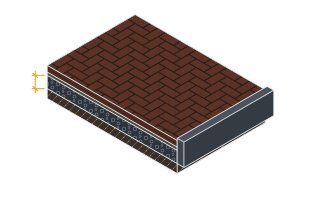
The total surface area of the permeable interlocking concrete pavement.
Use the plan-view area of the PICP surface that drains into the aggregate reservoir layer beneath it.
The depth of the open-graded aggregate reservoir layer beneath the pavement.
This is the thickness of the storage layer only — typically a clean, open-graded stone base — not the total pavement section thickness.
The fraction of the aggregate layer's volume that is open void space available for water storage.
Void ratio depends on the specific aggregate gradation used.
Stormwater storage volume
3,160 gal
Void ratio depends on the specific aggregate gradation used — confirm the actual void ratio for your chosen open-graded base material (commonly tested per ASTM C29) rather than assuming a generic value.
They open the calculator with your figures already in it
PICP Permeable Pavement Infiltration Storage Calculator: 3,164 gal — shown in imperial, US market. The link sets both, so the result they see is the one on your screen.
Show calculation logicHide calculation logic
How this was calculated
Formula source(s)
- Storage volume = surface area × reservoir depth × aggregate void ratio, the standard method for estimating the water storage capacity within a permeable pavement system's open-graded aggregate base
Inputs used
- Permeable Pavement Surface Area
- 1080 sq ft
- Aggregate Reservoir Depth
- 11.75 in
- Aggregate Void Ratio (Typically 0.3-0.4 for Open-Graded Stone)
- 0.4
Confidence note: Void ratio depends on the specific aggregate gradation used — confirm the actual void ratio for your chosen open-graded base material (commonly tested per ASTM C29) rather than assuming a generic value.
What this calculation does not cover
- It gives the void volume the stone can hold, not whether that water leaves. Drawdown depends on the subgrade's infiltration rate measured at formation level and on the safety factor your authority applies to it, and neither is an input here. A reservoir that holds the volume but will not empty within the permitted time still fails.
- There is no demand side to this. Design storm, rainfall depth and run-on from adjacent roof or asphalt sit outside the model, so the number tells you what the section holds, not what it has to hold. A bay taking run-on is asked to store several times its own rainfall, and most manuals cap that run-on ratio.
- Full depth is assumed available across the whole footprint, level. Sloping subgrade, check dams, and an underdrain invert set above the bottom of the stone all cut usable storage - on a sloped site without check dams only the deep end fills - and none of that is modelled.
- Only the reservoir layer counts. Bedding and choker courses, a sub-base of a different gradation, and the joint fill contribute nothing to this figure, and there is no allowance for void space lost as sediment works down into the stone over the life of the system.
- This is a volume estimate, not a stormwater design or a pavement section design. It does not check separation between the reservoir bottom and groundwater or bedrock, does not size the section for traffic, and does not demonstrate compliance with a water quality volume or a discharge rate. The void fraction a reviewer will credit is often lower than what the stone actually holds.
Estimated cost — your price
This site holds no price list for this material — local prices vary too much to publish honestly. Enter your supplier's price and the result is costed with it.
Computed in your browser — nothing you enter is uploaded. Presented in US customary units and US trade terminology. Where a formula follows a published standard, that standard and its edition are cited beside it on this page; where none governs, the page says so. Local amendments override model codes — verify against the code in force where you build.
Sources checked 2026-09-02 · in the site-wide review of 2026-09-06 · v1.0.1
Regulatory standards & verification citations1
- Storage volume = surface area × reservoir depth × aggregate void ratio, the standard method for estimating the water storage capacity within a permeable pavement system's open-graded aggregate base
Cite this page
Your workspace
Most jobs need more than one number. Add the calculators you need next and they open right here, underneath this one — your figures stay on screen and nothing is lost to a page change.