
SettingsSettings for this calculationUS
The AASHTO structural layer coefficient for the asphalt surface course.
Select this value from AASHTO 1993 guidance (or your DOT's pavement design manual) based on the surface mix's stiffness and quality.
The thickness of the asphalt surface course, as used directly in the AASHTO SN equation.
The equation is written in INCHES and the layer coefficients are calibrated to it, so a thickness entered in millimetres converts before it reaches the arithmetic — the structural number itself is dimensionless and carries no unit at all. AASHTO also sets minimum thicknesses by traffic level, and they exist for constructability rather than structure: a surface course much under 1.5 in cannot be compacted properly against a coarse base, and a thin lift loses heat before the roller reaches it. A design that satisfies SN with a surface below the minimum has not satisfied the guide.
The AASHTO structural layer coefficient for the granular or treated base course.
0.14 is the long-standing value for a dense-graded crushed granular base, and it is the number most designs start from. Treated bases are worth substantially more: cement-treated and bituminous-treated bases carry coefficients roughly one and a half to two and a half times that, which is how a thinner section reaches the same SN. The coefficient is a function of the layer's resilient modulus, so it belongs to the material as specified and tested — reading one off a neighbouring state's manual for a base built to a different gradation is where these designs quietly go wrong.
The thickness of the base course.
SN is not unique: many combinations of layer thickness give the same number, and the equation will not tell you which to build. The choice among them is cost, constructability and drainage. A base much under about 4 in cannot be spread and compacted to a uniform density over a soft subgrade, and AASHTO's layered analysis expects each layer to be thick enough to protect the one below it — satisfying the total SN while starving an individual layer produces a section that fails from the bottom.
The AASHTO drainage coefficient applied to the base layer's contribution to SN.
A value of 1.0 represents average drainage quality and exposure; adjust up or down per AASHTO Table 2.4 based on how quickly water drains from the base and how often it is exposed to near-saturated conditions.
The AASHTO structural layer coefficient for the subbase course.
0.11 is the usual figure for a granular subbase, a little below the base value because the material is typically less well graded and less densely compacted. The gap between them is small enough that subbase is often the cheapest structural number on the job — it is the layer to thicken when SN is short and the budget is not, provided the added depth does not push the formation below the water table.
The thickness of the subbase course.
The subbase does two jobs the structural number cannot see. It carries water away from under the base, which is what the drainage coefficient below is trying to price; and in a frost region it holds the freezing front above the subgrade, where a frost-susceptible soil would heave. Both of those can require more depth than SN alone asks for, and neither shows up as a shortfall in this equation — a section designed only to the number can be structurally adequate and still fail in its first spring.
The AASHTO drainage coefficient applied to the subbase layer's contribution to SN.
Read from the same AASHTO table as the base coefficient above, on the same two questions: how fast water leaves the layer once it is in, and what fraction of the year the layer sits near saturation. The subbase usually scores worse than the base on both, because it is lower, finer and further from any daylighted edge — so a design that applies the same figure to each is usually being optimistic about the one it can see least. Below 1.0 the coefficient is deducting structural value, which is the table saying that a wet granular layer is a weaker one.
Structural Number (SN)
3.54 SN
Layer coefficients and drainage coefficients must be selected per AASHTO 1993 guidance (or your DOT's pavement design manual) for your actual materials — this calculator only sums the SN equation from values you provide; it does not select or validate those coefficients, nor does it determine whether the resulting SN meets your required design SN from traffic (ESAL) analysis.
They open the calculator with your figures already in it
Flexible Pavement AASHTO Structural Number (SN) Calculator: 3.54 SN — shown in imperial, US market. The link sets both, so the result they see is the one on your screen.
Show calculation logicHide calculation logic
How this was calculated
Formula source(s)
- AASHTO 1993 Guide for Design of Pavement Structures: SN = a1×D1 + a2×D2×m2 + a3×D3×m3, where a1/a2/a3 are layer coefficients for the surface/base/subbase layers, D1/D2/D3 are layer thicknesses (in), and m2/m3 are drainage coefficients for the base/subbase layers
Inputs used
- Surface Layer Coefficient (a1)
- 0.44
- Surface Layer Thickness
- 4 in
- Base Layer Coefficient (a2)
- 0.14
- Base Layer Thickness
- 8 in
- Base drainage coefficient m₂
- 1
- Subbase Layer Coefficient (a3)
- 0.11
- Subbase Layer Thickness
- 6 in
- Subbase drainage coefficient m₃
- 1
Confidence note: Layer coefficients and drainage coefficients must be selected per AASHTO 1993 guidance (or your DOT's pavement design manual) for your actual materials — this calculator only sums the SN equation from values you provide; it does not select or validate those coefficients, nor does it determine whether the resulting SN meets your required design SN from traffic (ESAL) analysis.
What this calculation does not cover
- The one layer this equation never mentions is the one holding everything up. SN describes the pavement ABOVE the subgrade; the SN you need comes from the subgrade's resilient modulus together with the design reliability, the overall standard deviation and the serviceability loss you are prepared to accept. The same 3.5 that is generous over a stiff gravel subgrade is thin over a soft clay, and nothing entered here distinguishes the two.
- Layer coefficients are not material constants. They are a curve fit to the AASHO Road Test — two years of trucks over one subgrade in one Illinois climate, finished in 1960 — and axle loads, tyre pressures and mix designs have all moved on since. A section far outside that envelope, whether from very heavy gear, high tyre pressures or deep seasonal frost, is extrapolation, which is precisely why most state DOTs publish their own calibrated coefficients rather than the guide's.
- Three layers and no more. There is no term here for a lime- or cement-stabilised subgrade, for geogrid or geotextile reinforcement, or for an existing pavement being overlaid — an overlay is designed from the effective SN of what is already in the ground, a different calculation entirely. Entering a stabilised layer as though it were granular base is how that value gets quietly lost, or invented.
Add the equipment this sizes
This result is a specification — 3.54 SN — not a quantity. Put the thing it sizes into your project: how many, what you call it, and your supplier’s price.
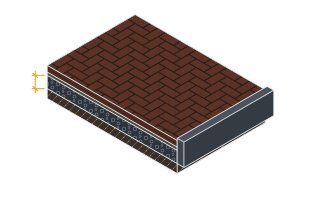
Every band is at the thickness you entered, and the vertical scale is the horizontal scale — so a thin course looks thin. The width shown is a fixed slice; this drawing is about depth.
Computed in your browser — nothing you enter is uploaded. Presented in US customary units and US trade terminology. Where a formula follows a published standard, that standard and its edition are cited beside it on this page; where none governs, the page says so. Local amendments override model codes — verify against the code in force where you build.
Sources checked 2026-09-06 · in the site-wide review of 2026-09-06 · v1.0.1
Regulatory standards & verification citations1
- AASHTO 1993 Guide for Design of Pavement Structures: SN = a1×D1 + a2×D2×m2 + a3×D3×m3, where a1/a2/a3 are layer coefficients for the surface/base/subbase layers, D1/D2/D3 are layer thicknesses (in), and m2/m3 are drainage coefficients for the base/subbase layers
Cite this page
Your workspace
Most jobs need more than one number. Add the calculators you need next and they open right here, underneath this one — your figures stay on screen and nothing is lost to a page change.