
SettingsSettings for this calculationUS
The drainage product's rated flow capacity per unit width, from the manufacturer's data sheet.
Dimpled sheet drain products are rated for flow capacity along a linear meter (or foot) of drain width, typically at a stated compressive load condition. This field wants the PER METER figure even when the width box below is set to imperial — it does not follow the unit toggle. US product data states the same rating in US gallons per minute per foot of width, and that unit differs from L/s per m in the volume and the time as well as the width, so the two stand 4.83 apart rather than the 3.28 the meter-to-foot factor alone suggests: 1 gallon per minute per foot is 0.207 L/s per m. Divide a gallons-per-minute-per-foot rating by 4.83 before entering it here. Typed straight in, a rating of 15 or under sits inside this field's 1-15 range and is accepted in silence at 4.83x the true capacity; anything larger — the 5 L/s per m default here is 24.2 in those units — is clamped to the 15 maximum instead, which still triples the answer. Both mistakes overstate the drain.
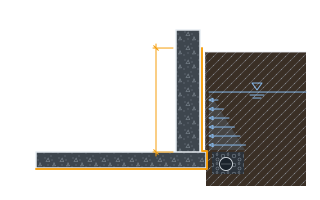
The total width of foundation wall covered by the sheet drain.
Measure the horizontal run of foundation wall being drained, along the base of the wall.
Total drainage capacity
213 CFM
Rated flow capacity varies by product and compressive load condition (capacity typically decreases under soil/backfill load) — use your specific sheet drain product's rated capacity under expected field loading, not an uncompressed lab value.
They open the calculator with your figures already in it
Foundation Sheet Drain Drainage Rate Calculator: 213 CFM — shown in imperial, US market. The link sets both, so the result they see is the one on your screen.
Show calculation logicHide calculation logic
How this was calculated
Formula source(s)
- Total drainage capacity = the drain product's rated flow capacity per unit width × total drainage width, the standard method for scaling a manufacturer's per-unit-width flow rating to a full installation
Inputs used
- Rated Flow Capacity per Meter (L/s per m)
- 5
- Total Drainage Width
- 66 ft
Confidence note: Rated flow capacity varies by product and compressive load condition (capacity typically decreases under soil/backfill load) — use your specific sheet drain product's rated capacity under expected field loading, not an uncompressed lab value.
What this calculation does not cover
- This is the supply side only. A capacity means nothing until it is set against the flow that actually arrives at the wall, and that comes from the catchment above and around the excavation, the permeability of the backfill and the natural soil behind it, and the design storm — none of which appear on this page. A drain rated at three times the flow it will ever see and one rated at a tenth of it return the same confident number here.
- Rated flow assumes the drain stays open, and what keeps it open is the filter fabric. Fines migrating out of the backfill blind the geotextile over years, and once it blinds, the core behind it is dry and useless whatever the lab rating says. The fabric's opening size has to be matched to the actual backfill gradation — a silty or fine sand backfill against the wrong fabric is the usual way a drainage plane stops draining.
- Capacity assumes an unbroken path in and out. The sheet has to start at the footing drain and run continuously up to near grade, with the top terminated so surface water and soil cannot get in behind the fabric, and every joint lapped in the direction of flow. A plane stopped short of the footing, or one torn during backfill, delivers a fraction of this figure regardless of what the product is rated at.
Add the equipment this sizes
This result is a specification — 213 CFM — not a quantity. Put the thing it sizes into your project: how many, what you call it, and your supplier’s price.
Computed in your browser — nothing you enter is uploaded. Presented in US customary units and US trade terminology. Where a formula follows a published standard, that standard and its edition are cited beside it on this page; where none governs, the page says so. Local amendments override model codes — verify against the code in force where you build.
Sources checked 2026-09-06 · in the site-wide review of 2026-09-06 · v1.0.1
Regulatory standards & verification citations1
- Total drainage capacity = the drain product's rated flow capacity per unit width × total drainage width, the standard method for scaling a manufacturer's per-unit-width flow rating to a full installation
Cite this page
Your workspace
Most jobs need more than one number. Add the calculators you need next and they open right here, underneath this one — your figures stay on screen and nothing is lost to a page change.