
SettingsSettings for this calculationUS
The center-of-glass (or whole-glass) U-factor for the glazing component.
Use the manufacturer's tested or NFRC-rated U-factor for the glass makeup. THIS BOX IS ALWAYS W/m²K, and it is the one field here the metric/imperial switch leaves alone — the two area boxes beside it do follow the switch, and so does the U-factor this page reports. A US or NFRC label quotes U-factor in Btu/h·ft²·°F, and converting it is NOT the square-foot factor of 10.76: the Btu, the hour and the Fahrenheit degree convert as well as the area, so 1 Btu/h·ft²·°F = 5.6783 W/m²K and 1 W/m²K = 0.17611 Btu/h·ft²·°F. Multiply your label figure by 5.6783 before typing it. The 1.8 default here is 0.317 on a Btu label. Typing the Btu number instead is not refused. Below 0.5 — which is every glazing label except single glazing — it is rewritten to 0.5 and you get a notice that names no unit, so it reads as a narrow range rather than a wrong one: on this page's US defaults of 86 sq ft of glass and 22 sq ft of frame, that turns a composite of 2.15 into 1.11 W/m²K, roughly half, in the flattering direction. Between 0.5 and 4 there is no notice at all — a single-glazing 1.04 is taken exactly as typed, so 5.91 W/m²K is read as 1.04 and the composite comes out 1.54 where the truth is 5.42. The frame box below is the same unit and wants the same multiplication.
The total visible glass area in the window wall assembly.
Sum the visible glass area across all lites in the assembly.
The U-factor for the frame/mullion component, typically higher (less insulating) than glass.
Use the manufacturer's tested or NFRC-rated U-factor for the frame profile.
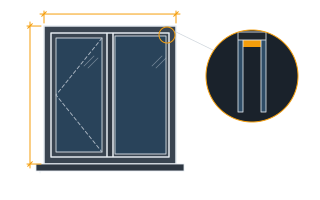
The total opaque frame/mullion area in the window wall assembly.
Use the actual opaque frame area from the shop drawings, not the glass area.
Composite area-weighted U-factor
0.3769 BTU/(hr·ft²·°F)
They open the calculator with your figures already in it
Window Wall Area-Weighted U-Factor Calculator: 0.3769 BTU/(hr·ft²·°F) — shown in imperial, US market. The link sets both, so the result they see is the one on your screen.
Show calculation logicHide calculation logic
How this was calculated
Formula source(s)
- Area-weighted composite U-factor = (Uglass×Aglass + Uframe×Aframe) ÷ (Aglass+Aframe), the standard NFRC method for combining component U-factors into a single assembly rating
Inputs used
- Glass U-Factor (W/m²K)
- 1.8
- Glass Area
- 86 sq ft
- Frame U-Factor (W/m²K)
- 3.5
- Frame Area
- 21.53 sq ft
What this calculation does not cover
- The assembly is split into two areas here, glass and frame, while the NFRC method the source names uses three: centre-of-glass, a 63.5 mm (2.5 in) edge-of-glass band where the spacer and sealant conduct around the perimeter of each lite, and frame. Entering a centre-of-glass U-factor across the whole glass area therefore averages that colder band in as though it were centre glass, and the composite lands lower — better — than the rated whole-window U-factor for the same product.
- Nothing checks that the glass area and the frame area actually tile the opening. Taking the frame area from the outside frame footprint while the glass area comes from the daylight opening double-counts the overlap and pushes the composite up; missing a mullion, a transom or a stack joint leaves that area out and pulls it down. Neither mistake raises an error, because the two figures are only ever used as weights against their own sum.
- Area weighting does not capture thermal bridging. The anchors, brackets and the slab-edge and head-and-sill details that tie a window wall back to the structure conduct around both of the areas entered here, and they are quantified by a linear psi-value or a two-dimensional thermal model rather than by an average of two U-factors.
- The output is a conduction rating, not a heat loss and not an energy performance figure. It is computed in W/m²K and restated as BTU/(hr·ft²·°F) when the page is set to US units, while the two U-factor boxes above stay in W/m²K whichever way that switch is set. Multiply it by the assembly area and the design temperature difference to get watts, and handle solar separately, since gain is governed by SHGC and shading — a low composite U-factor says nothing about overheating on a west elevation. Air leakage through the perimeter seal and the joint to the slab is outside the rating as well.
- An area-weighted average is a mean, and condensation is a local event. The sight line, the spacer and the frame itself all run colder than the composite figure implies, so an assembly that meets a U-factor target can still run wet at the glass edge; that question needs the manufacturer's condensation resistance figure or a thermal model of the actual profile.
Add the equipment this sizes
This result is a specification — 0.3769 BTU/(hr·ft²·°F) — not a quantity. Put the thing it sizes into your project: how many, what you call it, and your supplier’s price.
Computed in your browser — nothing you enter is uploaded. Presented in US customary units and US trade terminology. Where a formula follows a published standard, that standard and its edition are cited beside it on this page; where none governs, the page says so. Local amendments override model codes — verify against the code in force where you build.
Sources checked 2026-09-06 · in the site-wide review of 2026-09-06 · v1.0.1
Regulatory standards & verification citations1
- Area-weighted composite U-factor = (Uglass×Aglass + Uframe×Aframe) ÷ (Aglass+Aframe), the standard NFRC method for combining component U-factors into a single assembly rating
Cite this page
Your workspace
Most jobs need more than one number. Add the calculators you need next and they open right here, underneath this one — your figures stay on screen and nothing is lost to a page change.