
SettingsSettings for this calculationUS
The glass's own solar heat gain coefficient with no shading applied.
Found on the manufacturer's NFRC label or spec sheet — typically 0.2–0.5 for most architectural glazing.
The sun's angle above the horizon at the time of day/year being checked.
A higher altitude angle (sun higher in the sky, e.g. summer midday) casts a shorter shadow; a lower angle (winter, early/late day) casts a longer one.
How far the horizontal overhang or shading device projects out from the wall face.
From the WALL FACE, and include any gap where the device is stood off the wall, because the shadow starts from its outer edge either way. An overhang works with the sun's altitude, not its direction alone — which is why the same projection shades a sun-facing window well around midday and does almost nothing on an east or west elevation, where the sun is low and comes in under it.
The vertical distance from the underside of the overhang down to the top of the window.
The shadow must drop past this gap before it starts shading the glass itself.
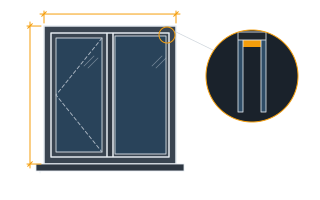
The full height of the window glass being shaded.
The glass, not the opening. What the calculation needs is the FRACTION of the glass in shadow, which is the shadow's depth divided by this height — so a tall window under a given overhang is shaded across a smaller share of its area than a short one under the same overhang. Tall glazing therefore needs more projection rather than the same, which is the opposite of the intuition that a big overhang suits a big window.
Effective SHGC
0.15 SHGC
This simplified geometric approximation is for a window facing directly toward the sun (zero azimuth difference) and treats shaded glass as receiving negligible direct gain, which overstates shading benefit since diffuse/reflected radiation still reaches shaded glass. For precise energy modeling, use ASHRAE 90.1/LBNL Projection Factor tables or full solar gain software.
- Shaded fraction of window
- 0.63
They open the calculator with your figures already in it
SHGC Effective Shading Fraction Calculator: 0.1495 SHGC — shown in imperial, US market. The link sets both, so the result they see is the one on your screen.
Show calculation logicHide calculation logic
How this was calculated
Formula source(s)
- ASHRAE profile-angle method (Fundamentals Ch. 15): shadow drop on the glass = overhang projection × tan(solar altitude angle) [for a window facing directly into the sun]; shaded fraction = clamp((shadow drop − head gap) ÷ window height, 0, 1); a common simplified approximation is effective SHGC ≈ glass SHGC × (1 − shaded fraction), treating shaded glass as receiving negligible direct gain
Inputs used
- Glass SHGC (Unshaded)
- 0.4
- Solar Altitude Angle (° above horizontal)
- 60
- Overhang Projection Depth
- 2 ft
- Gap Between Overhang and Window Head
- 4 in
- Window Height
- 5 ft
Intermediate steps
- Shaded fraction of window
- 0.63
Confidence note: This simplified geometric approximation is for a window facing directly toward the sun (zero azimuth difference) and treats shaded glass as receiving negligible direct gain, which overstates shading benefit since diffuse/reflected radiation still reaches shaded glass. For precise energy modeling, use ASHRAE 90.1/LBNL Projection Factor tables or full solar gain software.
What this calculation does not cover
- One instant, not a season. This is the shading at a single solar altitude — one time of day on one day of the year — and a fixed overhang cannot be tuned to more than a few of them. Whether the overhang is any good comes from the balance across the year: summer shading set against the winter sun it also blocks, and how it behaves through the mid-afternoon hours when a cooling peak usually lands rather than at noon, when it always looks best.
- The overhang is treated as infinitely wide. The shadow here drops straight down the glass with no ends to it, but a real overhang stops somewhere, often at or just past the jambs, and sun reaches in around both sides for much of the day. The narrower the overhang relative to the window, and the further the sun swings off the facade's normal, the more that end effect eats into the shaded fraction this returns.
- A horizontal overhang is close to useless on east and west glass, and nothing here will say so. The sun is low whenever it faces those elevations, so the shadow drop the formula returns is small at exactly the hours the gain is worst. Those windows need vertical fins, exterior blinds or glass with a lower SHGC — size an east or west shade off a noon altitude figure and you build a device that shades nothing when it matters.
Add the equipment this sizes
This result is a specification — 0.15 SHGC — not a quantity. Put the thing it sizes into your project: how many, what you call it, and your supplier’s price.
Computed in your browser — nothing you enter is uploaded. Presented in US customary units and US trade terminology. Where a formula follows a published standard, that standard and its edition are cited beside it on this page; where none governs, the page says so. Local amendments override model codes — verify against the code in force where you build.
Sources checked 2026-09-06 · in the site-wide review of 2026-09-06 · v1.0.1
Regulatory standards & verification citations1
- ASHRAE profile-angle method (Fundamentals Ch. 15): shadow drop on the glass = overhang projection × tan(solar altitude angle) [for a window facing directly into the sun]; shaded fraction = clamp((shadow drop − head gap) ÷ window height, 0, 1); a common simplified approximation is effective SHGC ≈ glass SHGC × (1 − shaded fraction), treating shaded glass as receiving negligible direct gain
Cite this page
Your workspace
Most jobs need more than one number. Add the calculators you need next and they open right here, underneath this one — your figures stay on screen and nothing is lost to a page change.