
SettingsSettings for this calculationUS
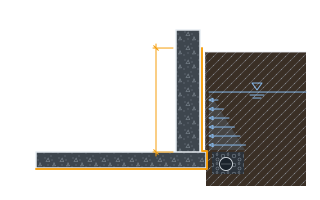
The total below-grade foundation wall area to be protected.
Measure the height times length of each below-grade wall face that carries the waterproofing membrane and needs protection board before backfilling.
The area of a single protection board sheet.
Multiply the sheet's width by its length, per the manufacturer's standard sheet dimensions. A 1.2 m × 2.4 m board covers 2.88 m², which is 31 sq ft; the North American 4 ft × 8 ft board is a different sheet and covers 32 sq ft (2.97 m²).
Protection board sheets needed
17 sheets
They open the calculator with your figures already in it
Foundation Waterproofing Protection Board Calculator: 17 sheets — shown in imperial, US market. The link sets both, so the result they see is the one on your screen.
Show calculation logicHide calculation logic
How this was calculated
Formula source(s)
- Sheet count = ceil(wall area ÷ sheet area), the standard coverage method for protection board installed over waterproofing membrane before backfilling
Inputs used
- Foundation Wall Area
- 540 sq ft
- Sheet Area
- 32 sq ft
What this calculation does not cover
- The count is wall area divided by sheet area, with no allowance for cutting waste, offcuts around window wells and pipe penetrations, or the extra coverage some specifications require at corners and footing turn-downs. Rounding up is not that allowance: 50 m² of wall on 2.88 m² boards gives 18 sheets, which is 1.84 m² of spare board across the whole job.
- Sheet area is the only property of the board this page uses, so a thin asphaltic hardboard, a dimpled polymer sheet and a rigid insulation panel all return the same count for the same wall. Whether the board's thickness and compressive strength survive the backfill material, the lift depth and the compaction plant is a separate judgement the sheet count does not make.
- Only the boards are counted. The mastic dabs, tape, termination bar and mechanical fixings that hold the board against the wall until backfill is placed are not in the result, and neither is the membrane, the primer or the perimeter drain the board exists to protect.
- The sheet area field runs from 1 to 6 m² (10.8 to 64.6 sq ft), so a protection course supplied as a roll cannot be entered as a single unit, and the wall area field replaces anything above its 1,000 m² maximum (about 10,760 sq ft) with that maximum. A wall larger than that has to be run in sections and the counts added, which rounds up once per section.
Estimated cost — your price
This site holds no price list for this material — local prices vary too much to publish honestly. Enter your supplier's price and the result is costed with it.
Computed in your browser — nothing you enter is uploaded. Presented in US customary units and US trade terminology. Where a formula follows a published standard, that standard and its edition are cited beside it on this page; where none governs, the page says so. Local amendments override model codes — verify against the code in force where you build.
Sources checked 2026-09-02 · in the site-wide review of 2026-09-06 · v1.1.1
Regulatory standards & verification citations1
- Sheet count = ceil(wall area ÷ sheet area), the standard coverage method for protection board installed over waterproofing membrane before backfilling
Cite this page
Your workspace
Most jobs need more than one number. Add the calculators you need next and they open right here, underneath this one — your figures stay on screen and nothing is lost to a page change.
Tools and safety for this job
To tank the walls and a basement's floor (waterproofing). Generic types, no brands, no prices.
Protection this work requires
- Cutting or grinding concrete, masonry, screed, tile or fibre-cement board releases respirable silica: cut wet or extract at the tool, and wear a P2/N95 respirator at minimum — a nuisance dust mask does not filter it.
- A dust mask does nothing about solvent vapour: ventilate through, and use an organic-vapour (A1) cartridge respirator in an enclosed room.
- Wet cement and lime burn skin and eyes painlessly until the damage is done: waterproof gloves to EN 374, safety glasses whenever the mix can splash, and never kneel in wet mix in permeable trousers.
- Saws, grinders and breakers run above 85 dB, where hearing damage accumulates and does not recover: defenders or plugs for every cut, not just the long ones.
- Breakers and grinders cause permanent nerve damage: limit continuous trigger time, keep hands warm, and stop if fingers tingle or blanch.
- Boards, blocks and bagged material cause most lasting back injuries on small sites: two people or a lifter for full sheets, and never a bag on one shoulder up a ladder.
- Knives cause more site injuries than any power tool: cut away from your body, change blades often, and wear cut-resistant gloves to EN 388 level C for repeated cutting.
Tank the walls and a basement's floor (waterproofing): Applying a slurry or a coating to its maker's instructions is within reach of a competent builder. Which grade of dry space the basement needs (in the UK, BS 8102's grades 1 to 3), whether a barrier on its own will do or a drained cavity is needed with it, and how every joint, penetration and junction is detailed are the waterproofing designer's, and the standard asks for a waterproofing specialist in that design; this site flags the grade and never chooses it. A barrier on the inside face holds back water under pressure only where the wall behind it can carry that pressure, a structural question this site never sizes. On a wall that holds back no ground, where a damp specification names this protection, that specification sets which walls and how high, and the basement grade above does not apply.
Show the 6 tools this job needsHide tools
Essential
Brushes
Mixing bucket or tub
Paddle mixer
SDS rotary hammer
Recommended
Plastering trowel and hawk
Optional
Utility knife
Also needed as materials: replacement blades, SDS bits and chisels.
what each waterproofing tool is for, and the spec that decides which to buy where one does.