
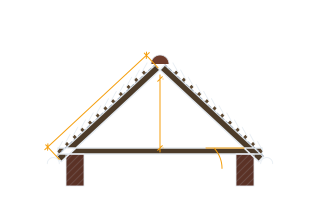
SettingsSettings for this calculationUS
The combined length of all flashing runs needed on the job.
Add up every window head, wall-to-roof intersection, and other transition that needs flashing to get the total run length.
The length of a single flashing sheet or cut coil piece as supplied.
Check the stock length of the flashing product you're buying — common brake-formed sheets and pre-cut coil pieces are often supplied in 10 ft (3.05 m) lengths.
Flashing sheets needed
5 sheets
They open the calculator with your figures already in it
Exterior Flashing Layout Trim Sheet Calculator: 5 sheets — shown in imperial, US market. The link sets both, so the result they see is the one on your screen.
Show calculation logicHide calculation logic
How this was calculated
Formula source(s)
- Sheet count = ceil(total flashing run length ÷ standard sheet/coil piece length), the standard method for estimating sheet metal flashing material at window heads, wall-to-roof intersections, and other transitions
Inputs used
- Total Flashing Run Length
- 49 ft
- Standard sheet or coil piece length
- 10 ft
What this calculation does not cover
- Rounds up on the total when each run has to come out of one sheet. Five separate 3.5 m (11.5 ft) runs from 3.05 m (10 ft) stock take ten pieces, not the six that dividing the combined 17.5 m (57 ft) suggests, because offcuts do not join end to end. Run this per length of flashing rather than per job total.
- Says nothing about coil width. Flashing is brake-formed from flat stock, so the stock has to cover the developed girth — every leg, plus hems and the metal taken up in each bend — and coil comes in fixed widths. The right number of pieces in stock too narrow to fold the profile is not usable material.
- Blind to the metal. Aluminum against pressure-treated lumber or in contact with a copper gutter corrodes at that contact, gauge decides whether a long run stays flat or oil-cans, and pre-finished coil carries a coating that will not survive being folded the wrong way. A sheet count chooses none of that.
Estimated cost — your price
This site holds no price list for this material — local prices vary too much to publish honestly. Enter your supplier's price and the result is costed with it.
Part of bigger jobs
This trade is one line of several job takeoffs. Run the whole job and every other trade comes back with it, off the same measurements.
also measures9 other trades
also measures24 other trades
also measures10 other trades
also measures9 other trades
also measures19 other trades
also measures24 other trades
also measures24 other trades
Computed in your browser — nothing you enter is uploaded. Presented in US customary units and US trade terminology. Where a formula follows a published standard, that standard and its edition are cited beside it on this page; where none governs, the page says so. Local amendments override model codes — verify against the code in force where you build.
Sources checked 2026-09-06 · in the site-wide review of 2026-09-06 · v1.0.1
Regulatory standards & verification citations1
- Sheet count = ceil(total flashing run length ÷ standard sheet/coil piece length), the standard method for estimating sheet metal flashing material at window heads, wall-to-roof intersections, and other transitions
Cite this page
Your workspace
Most jobs need more than one number. Add the calculators you need next and they open right here, underneath this one — your figures stay on screen and nothing is lost to a page change.
Tools and safety for this job
To fit flashings where the roof meets a wall and fit the cladding trims and vented closers. Generic types, no brands, no prices.
Protection this work requires
- Cutting or grinding concrete, masonry, screed, tile or fibre-cement board releases respirable silica: cut wet or extract at the tool, and wear a P2/N95 respirator at minimum — a nuisance dust mask does not filter it.
- Hardwood dust is a recognised carcinogen: extract at the tool and wear a P2/N95 respirator when cutting or sanding indoors.
- Saws, grinders and breakers run above 85 dB, where hearing damage accumulates and does not recover: defenders or plugs for every cut, not just the long ones.
- Breakers and grinders cause permanent nerve damage: limit continuous trigger time, keep hands warm, and stop if fingers tingle or blanch.
- Most fatal falls on small jobs are from under three metres: use a tower or a ladder tied at the top, and never work off the top two rungs.
- Knives cause more site injuries than any power tool: cut away from your body, change blades often, and wear cut-resistant gloves to EN 388 level C for repeated cutting.
Show the 8 tools this job needsHide tools
Essential
Angle grinder
Cordless drill/driver
Metal snips
Tape measure
Recommended
Caulking gun
Mitre saw
Rubber mallet
Spirit level
Also needed as materials: caulk and sealant cartridges, cutting and diamond discs, drill and driver bits, mitre saw blades.
what each roofing tool is for and what each cladding tool is for, and the spec that decides which to buy where one does.