
SettingsSettings for this calculationUS
Depth of the open-graded storage layer, measured from the subgrade up to the top of the reservoir stone.
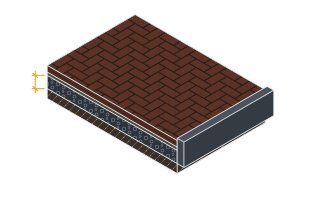
This is the storage layer only. The choker course and the bedding course above it hold a little water too, but they are shallow, differently graded, and normally left out of the drawdown check as a conservatism.
Fraction of the reservoir layer that is open void space rather than stone.
Only the voids hold water, so the depth of actual water in a saturated reservoir is the layer depth times this fraction. Open-graded stone commonly falls between 0.3 and 0.4, but the figure depends on gradation and source and is properly confirmed by test rather than assumed.
Field-measured rate at the excavation bottom, before any safety factor is applied (1 in/hr is 25.4 mm/hr).
Measure at the elevation the excavation will actually finish at, because the rate at the surface says nothing about the horizon two metres down. If the bottom has been trafficked by loaded plant the measured rate no longer describes the soil you will build on — smearing is not recoverable by scarifying.
Divisor applied to the measured rate to obtain the design rate, as required by the governing manual.
Manuals differ widely here, and some require a larger factor where only one test was done, where the soil is variable, or where the pavement drains a large contributing area relative to its own footprint. Take the number from the document your submission will be reviewed against.
Whether a perforated underdrain relieves the upper part of the reservoir.
A full-infiltration section empties entirely through the subgrade. A partial-infiltration section carries an underdrain set above the subgrade, so only the water below that invert has to infiltrate; everything above it leaves through the pipe. Raising the invert is the usual way to keep a marginal soil compliant.
The longest drawdown the governing manual allows for this system.
The limit exists to keep the storage available for the next storm, to avoid standing water long enough to breed mosquitoes, and to stop the subgrade sitting saturated. Commonly it falls somewhere between one and three days, but which end applies is a jurisdictional question rather than an engineering preference.
Reservoir drawdown time
30.5 hours
The reservoir empties with about 17.5 hours in hand against the permitted maximum. That margin is only as good as the infiltration test behind it — a single test on a variable soil is thin evidence for a whole footprint.
- Design infiltration rate after the safety factor
- 0.24 in/hr
- Depth of stored water that must infiltrate
- 7.2 in
- Permitted maximum drawdown
- 48 hours
- Margin against the permitted maximum
- 17.52 hours
They open the calculator with your figures already in it
Permeable Reservoir Drawdown Time Calculator: 30.48 hours — shown in imperial, US market. The link sets both, so the result they see is the one on your screen.
Show calculation logicHide calculation logic
How this was calculated
Formula source(s)
- ASTM D3385, Standard Test Method for Infiltration Rate of Soils in Field Using Double-Ring Infiltrometer, is one accepted way of measuring the subgrade rate; the measurement is taken at the elevation of the finished excavation, not at the ground surface
- The safety factor applied to the measured rate and the permitted maximum drawdown time are both set by the governing stormwater manual, which is why both are entered here rather than supplied by this page
- Drawdown time = depth of stored water divided by the design infiltration rate; the stored water depth is the aggregate depth multiplied by its void ratio, since only the voids hold water
Inputs used
- Aggregate Reservoir Depth
- 18 in
- Aggregate Void Ratio
- 0.4
- Measured Subgrade Infiltration Rate (mm/hr)
- 12
- Design Safety Factor on the Measured Rate
- 2
- Underdrain
- None — full infiltration section
- Underdrain Invert Height Above Subgrade
- 6 in
- Permitted Maximum Drawdown (hours)
- 48
Intermediate steps
- Design infiltration rate after the safety factor
- 0.24 in/hr
- Depth of stored water that must infiltrate
- 7.2 in
- Permitted maximum drawdown
- 48 hours
- Margin against the permitted maximum
- 17.52 hours
Confidence note: The reservoir empties with about 17.5 hours in hand against the permitted maximum. That margin is only as good as the infiltration test behind it — a single test on a variable soil is thin evidence for a whole footprint.
What this calculation does not cover
- One-dimensional vertical infiltration only: no credit is taken for lateral seepage out of the sides of the excavation, and none for evaporation.
- Assumes the reservoir starts full. A design storm that only part-fills it drains proportionally faster.
Computed in your browser — nothing you enter is uploaded. Presented in US customary units and US trade terminology. Where a formula follows a published standard, that standard and its edition are cited beside it on this page; where none governs, the page says so. Local amendments override model codes — verify against the code in force where you build.
Sources checked 2026-08-30 · in the site-wide review of 2026-09-06 · v1.0.0
Regulatory standards & verification citations3
- ASTM D3385, Standard Test Method for Infiltration Rate of Soils in Field Using Double-Ring Infiltrometer, is one accepted way of measuring the subgrade rate; the measurement is taken at the elevation of the finished excavation, not at the ground surface
- The safety factor applied to the measured rate and the permitted maximum drawdown time are both set by the governing stormwater manual, which is why both are entered here rather than supplied by this page
- Drawdown time = depth of stored water divided by the design infiltration rate; the stored water depth is the aggregate depth multiplied by its void ratio, since only the voids hold water
Which documents these citations point at
Standards referenced: ASTM D3385 (ASTM International, United States).
Cite this page
Your workspace
Most jobs need more than one number. Add the calculators you need next and they open right here, underneath this one — your figures stay on screen and nothing is lost to a page change.