
SettingsSettings for this calculationUS
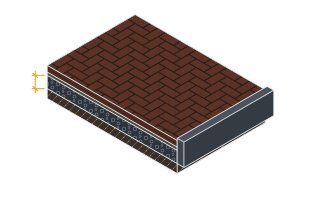
Plan area of the permeable surface that this screeded course sits under.
Take the area between the edge restraints, not the excavation area. The bedding course stops at the restraint; the base and subbase below it usually run wider, so their quantities come off a different figure.
Screeded depth of the bedding course before the units go down — the reference detail is a nominal 50 mm (2 in).
Thickness tolerance here is tighter than it looks, because bedding depth turns directly into surface elevation once the pavers are compacted. A thick spot densifies further than a thin one and shows as a low unit that cannot be corrected from above.
Extra loose stone ordered to cover the course closing up when the units are compacted.
Screeded open-graded stone is placed loose and never precompacted, so the delivered volume exceeds the finished volume. There is no universal figure for the difference — it depends on gradation, screed technique and how much plate work the surface gets. Treat the value here as a starting allowance and reconcile it against what the first bay actually consumed.
Uncompacted bulk density of the delivered gradation, from the supplier's ticket or data sheet.
Open-graded stone is lighter in place than a dense-graded aggregate because the voids that make it work are voids you are not buying. Ask the quarry for the loose density of the specific gradation; a figure carried over from a crusher-run base will over-order.
Delivered bedding stone
9.73 tons
Both the loose density and the densification allowance are site figures rather than constants. Order the first delivery against this estimate, screed one bay, and reconcile before the balance is called off.
- Screeded stone volume to deliver
- 7.96 yd³
- Course volume once the units are bedded and compacted
- 6.92 yd³
- Volume the course loses to densification
- 1.04 yd³
They open the calculator with your figures already in it
Open-Graded Bedding Course Stone Calculator: 9.73 tons — shown in imperial, US market. The link sets both, so the result they see is the one on your screen.
Show calculation logicHide calculation logic
How this was calculated
Formula source(s)
- ASCE/T&DI 68-18, Permeable Interlocking Concrete Pavement, gives the bedding course as a screeded layer of open-graded No. 8 stone at a nominal 50 mm (2 in), laid to a uniform thickness and not compacted before the units are set
- Loose (uncompacted) bulk density of the delivered stone is the supplier's figure for the gradation and quarry actually being used; it is entered here rather than assumed, because it varies with source and moisture
- The densification allowance — the extra loose stone needed because a screeded course closes up when the pavers are plate-compacted — is a rule of thumb rather than a published coefficient; check it against the first bay laid and revise the order
Inputs used
- Area of Pavement Being Bedded
- 1290 sq ft
- Nominal Screeded Thickness
- 2 in
- Densification Allowance (%)
- 15
- Loose Bulk Density of the Stone
- 90.52 pcf
Intermediate steps
- Screeded stone volume to deliver
- 7.96 yd³
- Course volume once the units are bedded and compacted
- 6.92 yd³
- Volume the course loses to densification
- 1.04 yd³
Confidence note: Both the loose density and the densification allowance are site figures rather than constants. Order the first delivery against this estimate, screed one bay, and reconcile before the balance is called off.
What this calculation does not cover
- Covers the bedding course only — the No. 57 choker, the subbase and the joint fill are separate gradations bought separately.
- Assumes a uniform screeded thickness across the whole area; a section that varies in depth has to be split and run per zone.
Estimated cost — your price
This site holds no price list for this material — local prices vary too much to publish honestly. Enter your supplier's price and the result is costed with it.
Computed in your browser — nothing you enter is uploaded. Presented in US customary units and US trade terminology. Where a formula follows a published standard, that standard and its edition are cited beside it on this page; where none governs, the page says so. Local amendments override model codes — verify against the code in force where you build.
Sources checked 2026-09-06 · in the site-wide review of 2026-09-06 · v1.0.1
Regulatory standards & verification citations3
- ASCE/T&DI 68-18, Permeable Interlocking Concrete Pavement, gives the bedding course as a screeded layer of open-graded No. 8 stone at a nominal 50 mm (2 in), laid to a uniform thickness and not compacted before the units are set
- Loose (uncompacted) bulk density of the delivered stone is the supplier's figure for the gradation and quarry actually being used; it is entered here rather than assumed, because it varies with source and moisture
- The densification allowance — the extra loose stone needed because a screeded course closes up when the pavers are plate-compacted — is a rule of thumb rather than a published coefficient; check it against the first bay laid and revise the order
Cite this page
Your workspace
Most jobs need more than one number. Add the calculators you need next and they open right here, underneath this one — your figures stay on screen and nothing is lost to a page change.