
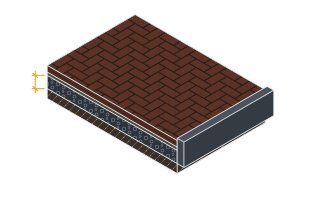
SettingsSettings for this calculationUS
The length of the paved area.
Measure the overall patio or walkway length.
Tools needed: Tape measure
The width of the paved area.
Measure perpendicular to the length.
Tools needed: Tape measure
4-6 in (10-15 cm) is standard for a patio; use the higher end for driveways or heavier loads.
A deeper base improves drainage and reduces settling over time.
1 in (2.5 cm) is standard for the leveling sand layer directly under the pavers.
Too thick a sand layer can cause pavers to shift or settle unevenly.
Estimated paver base & sand needed
1.605 yd³ (gravel base)
- Patio area
- 130 sq ft
- Bedding sand needed
- 0.4 yd³
They open the calculator with your figures already in it
Paver Base & Sand Calculator: 1.6 yd³ (gravel base) — shown in imperial, US market. The link sets both, so the result they see is the one on your screen.
Show calculation logicHide calculation logic
How this was calculated
Formula source(s)
- A typical paver installation uses a 4-6 in compacted gravel base plus a 1 in bedding sand layer beneath the pavers
Inputs used
- Patio Length
- 13 ft
- Patio Width
- 10 ft
- Gravel Base Depth
- 4 in
- Bedding Sand Depth
- 1 in
Intermediate steps
- Patio area
- 130 sq ft
- Bedding sand needed
- 0.4 yd³
What this calculation does not cover
- The volume covers the paver footprint only — length × width at the depth you enter. A compacted base is normally carried past the paver edge on every side so the edge restraint has something to sit on, and that perimeter band is not counted here.
- Both figures are finished, in-place depths. Crushed base and bedding sand are delivered loose and lose volume as they are compacted and screeded, so the quantity to order is higher than the number shown. No waste, over-dig or shrinkage allowance is applied.
- Only the two layers you enter are counted. Geotextile separation fabric, an open-graded drainage course, edge restraint and the jointing sand that goes between the pavers all sit outside the figure — as does the paver thickness, so this is not your excavation depth.
- The calculation applies whatever depth you type; it does not test whether that depth suits the subgrade, the frost depth or the load. Soft clay, organic or filled ground, poor drainage and anything carrying vehicles are pavement design decisions made from the soil and the traffic, not from these dimensions.
- The area is treated as one rectangle at a single uniform depth. Curved, L-shaped or multi-level layouts have to be split into rectangles and run separately, and any local thickening — a deeper base under a step, a soft spot dug out and backfilled — is not in the total.
Estimated cost — your price
This site holds no price list for this material — local prices vary too much to publish honestly. Enter your supplier's price and the result is costed with it.
Part of bigger jobs
This trade is one line of a job takeoff. Run the whole job and every other trade comes back with it, off the same measurements.
Or plan the space itself: measure it once, doors and windows included, and this figure comes back worked out on that space, with what goes with it.
also measuresPaverPaver EdgingPaver Polymeric SandPaver Sealer
Computed in your browser — nothing you enter is uploaded. Presented in US customary units and US trade terminology. Where a formula follows a published standard, that standard and its edition are cited beside it on this page; where none governs, the page says so. Local amendments override model codes — verify against the code in force where you build.
Sources checked 2026-09-02 · in the site-wide review of 2026-09-06 · v1.0.1
Regulatory standards & verification citations1
- A typical paver installation uses a 4-6 in compacted gravel base plus a 1 in bedding sand layer beneath the pavers
Cite this page
Your workspace
Most jobs need more than one number. Add the calculators you need next and they open right here, underneath this one — your figures stay on screen and nothing is lost to a page change.
Tools and safety for this job
To lay paving and lay and compact the hardcore. Generic types, no brands, no prices.
Protection this work requires
- Cutting or grinding concrete, masonry, screed, tile or fibre-cement board releases respirable silica: cut wet or extract at the tool, and wear a P2/N95 respirator at minimum — a nuisance dust mask does not filter it.
- Saws, grinders and breakers run above 85 dB, where hearing damage accumulates and does not recover: defenders or plugs for every cut, not just the long ones.
- Breakers and grinders cause permanent nerve damage: limit continuous trigger time, keep hands warm, and stop if fingers tingle or blanch.
- Boards, blocks and bagged material cause most lasting back injuries on small sites: two people or a lifter for full sheets, and never a bag on one shoulder up a ladder.
Show the 9 tools this job needsHide tools
Essential
Plate compactor
Rubber mallet
Shovel and spade
Spirit level
String line and pins
Wheelbarrow
Recommended
Block splitter
Laser level
Optional
Angle grinder
Also needed as materials: cutting and diamond discs.
what each landscaping tool is for and what each groundwork tool is for, and the spec that decides which to buy where one does.